Lexenfeld Camp
Displacement in Europe
Lexenfeldstraße, Salzburg-Liefering, Austria · Postwar camp 1945–1964; Ukrainian community especially 1945–1949
A barracks camp built in the war for refugees from Ukraine, on the grounds of a closed missionary school at Liefering. Under the Americans it became one of the largest Ukrainian camps in Austria, with 976 Ukrainians counted in 1948; after they emigrated it served Salzburg as refugee and municipal housing until 1964.
Introduction
Lexenfeld stood on Lexenfeldstraße in Liefering, on the north-western edge of Salzburg, on the grounds of the Herz-Jesu missionaries’ school. American authorities used the huts after the liberation in May 1945. The camp belonged to Austria’s American occupation zone and was administered under UNRRA Team 323, and by 1948 it held more Ukrainians than any other camp in Austria.
Its name was an accident. The camp had been built during the war on part of the school grounds, and the Americans attached the name Lexenfeld to it in error when they took it over.
It was one camp within a larger regional community. A November 1945 eyewitness report describes approximately 5,000 Ukrainians across the Salzburg area, concentrated particularly at Lexenfeld and Camp Greene. Others lived in damaged buildings, rented rooms or on farms. That regional estimate should not be treated as Lexenfeld’s population.
A history in dates
- 1938The regime closes the Herz-Jesu missionaries’ private gymnasium.
- 1943Seventeen huts stand on the former school grounds, built as a camp for refugees from Ukraine.
- May 1945American authorities take the barracks over and, by a naming error, call the place Lexenfeld.
- 21 September 1945Displaced people in Allied uniform are ordered to wear a D. P. armband.
- 26 December 1945Maxglan scouts celebrate Christmas with Ukrainian scouts at Lexenfeld.
- 13 February 1946The American military government orders the registration of all displaced people in Salzburg living outside camps.
- 1946The missionaries’ gymnasium reopens.
- 5 August 1946Displaced people in the American zone are made subject to the same labour-service rules as Austrians.
- 1947–1949Ukrainian gymnasium attendance is documented.
- 21 February 1948Salzburg’s camps hold a one-day hunger strike and fly black flags after thirty displaced people bound for Argentina are handed to Soviet authorities.
- 30 September 1948The IRO return counts 976 Ukrainians at Lexenfeld, the largest camp figure in Austria.
- 1949–1950The memorial describes Ukrainian emigration to Canada and the United States.
- 1950The missionaries reoccupy the school building.
- 30 June 1950Lexenfeld no longer appears in the IRO return for Austria.
- 31 December 1951The American Displaced Persons Act expires; people queue at the visa office in the Lehen barracks until the doors close.
- 25 April 1953The province takes the camp over for conversion to housing; the city plans a hostel and a kindergarten there.
- 30 June 1953An outpatient clinic for refugees and expellees opens at Lexenfeld.
- 10 September 1953The new municipal kindergarten at Lexenfeld opens.
- 1964The site returns to the Herz-Jesu missionaries.
- 2005 and 2019A commemorative panel is installed and subsequently renewed.
A camp built for Ukrainians
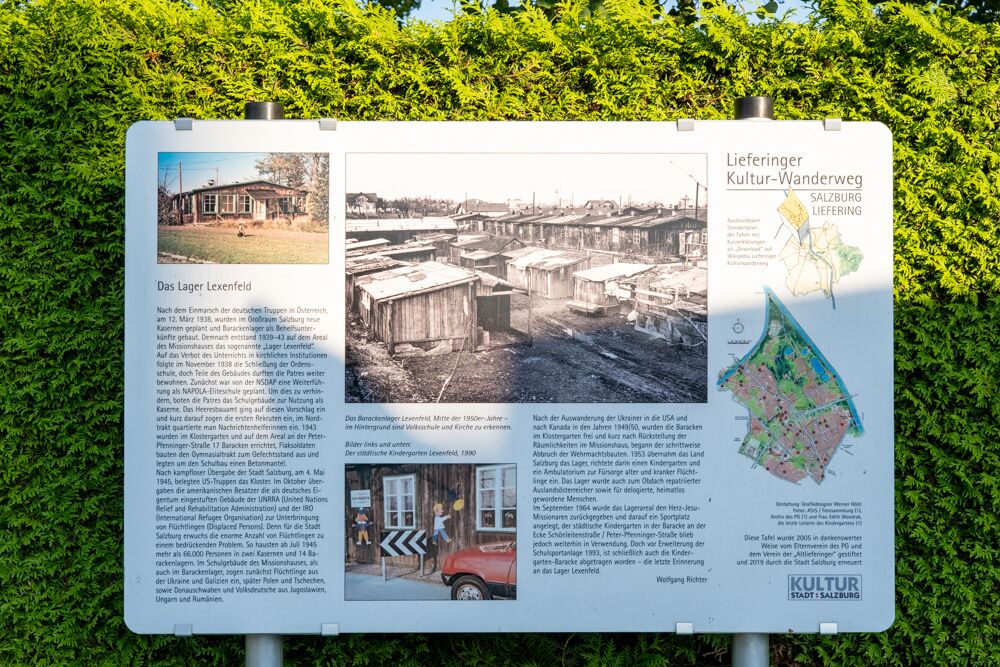
The National Socialist regime closed the missionaries’ private gymnasium in 1938, intending to turn the buildings into a school of its own. A barracks camp was then laid out on part of the grounds and on neighbouring land for refugees from Ukraine, and Ukrainians were also housed in the school building itself. Seventeen huts had been built by 1943.
The camp that the Americans inherited in May 1945 was therefore not improvised for the postwar emergency. It had been put up for people fleeing westwards ahead of the Red Army, and part of its population simply stayed on when the war ended.
Sources for this section
Making a home in the barracks
The eyewitness account describes families sharing barrack rooms, with blankets or sheets hung up to create a little privacy. Communal kitchens issued rations at fixed hours, while residents took turns cleaning and attended evening announcements. Elementary teaching continued despite a shortage of books.
A Ukrainian committee registered new arrivals, arranged ration claims and applied for travel permits. It also brought together singers, dancers and musicians. These functions linked basic household survival with collective cultural life; they were part of the Salzburg community described across both principal camps.
Camp life was also shaped from outside. From 21 September 1945 anyone not in military service who wore Allied uniform had to wear an armband lettered D. P. In February 1946 the American military government ordered the registration of every displaced person and refugee in Salzburg who was not living in a camp, and from August 1946 displaced people in the American zone of Austria came under the same labour-service rules as Austrian citizens, with exemptions only for those persecuted on racial, political or religious grounds. In March 1947 the provincial governor appealed to the Salzburg press to report on displaced people fairly and to stop repeating that they were all work-shy.
Sources for this section
School and scouting
Lexenfeld had a Ukrainian high school. Its teachers helped establish Plast, the Ukrainian scouting movement, as an activity for young people outside the classroom. Because American authorities initially prohibited new youth organisations, Salzburg’s recognised Austrian scouts sponsored the Ukrainian units as part of their own organisation while allowing them to conduct their own activities.
A record from the Austrian side supplies a precise early encounter: the Maxglan scout group’s chronology records a Christmas celebration with Ukrainian exile scouts at Lexenfeld on 26 December 1945. This was a practical local relationship as well as an administrative arrangement.
The Ukrainian gymnasium continued into the later 1940s. The Encyclopedia of Ukraine documents attendance there in 1947–1949 in its account of a former pupil. Schooling formed part of the community’s preparation for a future that increasingly lay outside Austria.
Sources for this section
How many Ukrainians
The clearest figure for the camp itself comes from the IRO’s own returns. On 30 September 1948 Lexenfeld held 976 Ukrainians — more than any other camp in Austria, and more than half of the 1,863 counted in Salzburg’s camps that day, the rest of them at Hellbrunn. Austria as a whole held 6,402.
By 30 June 1950 Lexenfeld had gone from the table altogether. Hellbrunn was down from 887 to 58, Wegscheid had appeared with 191, and the Austrian total had fallen to 2,572. The Ukrainian community at Lexenfeld had left within those twenty-one months.
The United Ukrainian American Relief Committee’s 1948 statistical report places Salzburg under the US zone and records 4,636 Ukrainians: 3,093 in camps and 1,543 outside camps. Its categories make visible a community divided between communal accommodation and private housing. These are Salzburg totals, not a count for Lexenfeld alone.
Ukrainians in the IRO camps around Salzburg
| Camp | 30 September 1948 | 30 June 1950 |
|---|---|---|
| Lexenfeld | 976 | — |
| Hellbrun | 887 | 58 |
| Wegscheid | — | 191 |
| Salzburg group | 1,863 | — |
| American zone of Austria | 2,869 | 1,171 |
| Austria total | 6,402 | 2,572 |
Ukrainians in the Salzburg area, 1948
| Accommodation | People |
|---|---|
| In camps | 3,093 |
| Outside camps | 1,543 |
| Total | 4,636 |
Getting out
Departure depended on quotas set far away, and the camps followed the news closely. When thirty displaced people were arrested by Italian police before boarding an IRO ship for Argentina and handed to the Soviet authorities, the residents of Salzburg’s camps went on a one-day hunger strike on 21 February 1948 and hung the camps with black flags.
The memorial panel at the site records that many Ukrainians left for Canada and the United States in 1949 and 1950, which is where the Ukrainian entry in the IRO returns disappears. For those who had still not gone, the American Displaced Persons Act of 1948 expired at midnight on 31 December 1951; people gathered outside the visa office in the Lehen barracks that evening, and about seventy were still waiting when the doors shut.
From Ukrainian camp to municipal housing
After 1945 the accommodation served several refugee populations in turn, including Ukrainians, Poles and ethnic Germans displaced from eastern and southeastern Europe. The gymnasium reopened in 1946, and in 1950 the missionaries took their school building back into use.
On 25 April 1953 the province of Salzburg took the camp over in order to convert it for housing, and the city undertook to put a hostel for the homeless and a kindergarten into it, as it had at the Guggenmoosstraße camp. An outpatient clinic for refugees and expellees opened at Lexenfeld on 30 June 1953, paid for by the National Catholic Welfare Conference with support from the provincial government, and the new municipal kindergarten opened on 10 September 1953.
The grounds returned to the missionaries in 1964 and the barracks were pulled down. The later municipal camp should not be mistaken for an unchanged Ukrainian community lasting twenty years: the Ukrainians had gone by 1950, and what followed was Austrian welfare housing on the same ground.
Remembering Lexenfeld
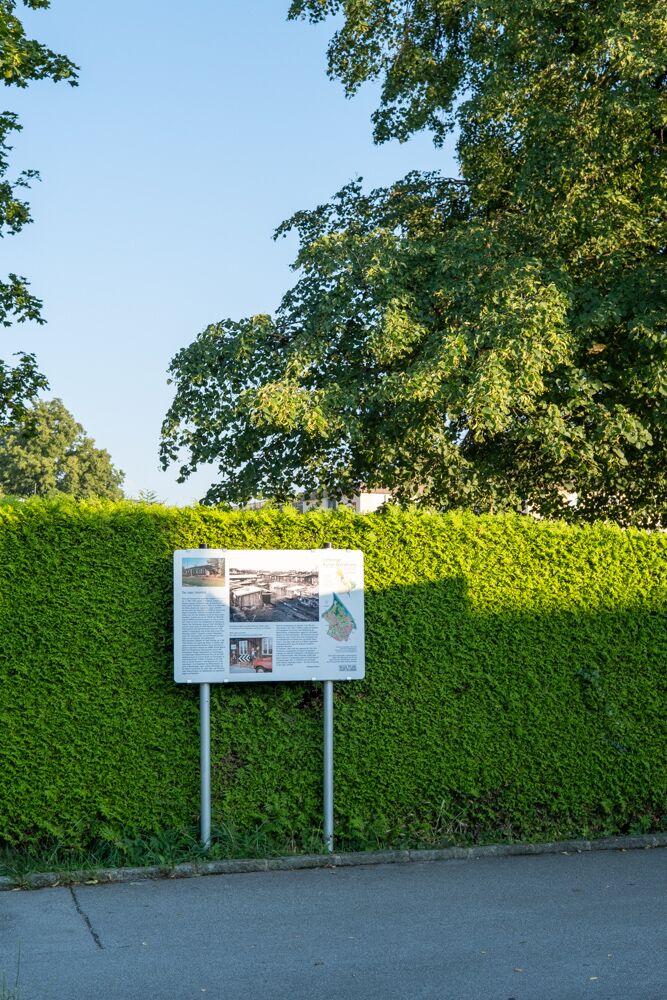
A memorial panel installed in 2005 and renewed in 2019 identifies the former camp beside today’s Herz-Jesu-Gymnasium. Its historical photograph shows dense rows of wooden huts; the accompanying account connects the school grounds, refugee accommodation and later redevelopment. The surviving marker preserves the camp’s position in the landscape after the barracks disappeared.
Sources for this section
Sources
- Gedenktafel für das Lager Lexenfeld
University of Graz, DERLA; Lieferinger Kulturwanderweg · Photographed 2024
Full historical description and memorial photograph read. Photograph by Sebastian Sillinger. The panel includes emigration in 1949–1950. Later camp dates differ from unsourced claims of closure in 1950.
- Ukrainian Displaced Persons in Salzburg, Austria
The Ukrainian Weekly · 10 November 1945
Original PDF page 2 read; eyewitness regional description covers Lexenfeld and Camp Greene. Statistics from the adjacent anonymous UNRRA letter are not assigned to Lexenfeld.
- Plast: Ukrainian Scouting, a Unique Story
Orest Subtelny and collaborators · 2016
Original PDF page 151, printed page 123: Lexenfeld school and Austrian scout patronage.
- Chronik
Pfadfindergruppe Salzburg 6 Maxglan · Chronology 1945
Original organisational history; 26 December 1945 Lexenfeld celebration.
- Huzar, Liubomyr
Internet Encyclopedia of Ukraine · Biographical entry
Supports the Lexenfeld gymnasium in 1947–1949; personal name omitted from the article.
- Report: history, accomplishments, statistics and plans
United Ukrainian American Relief Committee · 30 June 1948
Original PDF page 32 visually read: Salzburg total 4,636, including 3,093 in camps and 1,543 outside. Regional figures, not an individual camp count.
- Lager Lexenfeld
SALZBURGWIKI, Salzburger Nachrichten · Revision of 10 April 2023
Full article read in German: closure of the Herz-Jesu missionaries’ private gymnasium under the regime; a barracks camp built on part of the grounds for refugees from Ukraine, with Ukrainians also housed in the school building; American reuse and the naming error; the gymnasium reopened in 1946, the school building reoccupied in 1950 and the barracks demolished. Licensed CC BY-NC-SA.
- Chronik der Stadt Salzburg 1945–1955
Stadt Salzburg, Stadtarchiv · City chronicle, entries 1945–1955
Original 257-page PDF searched. Entries read: 21 September 1945, D. P. armbands; 13 February 1946, registration of displaced people outside camps; 5 August 1946, labour-service rules; 11 March 1947, the provincial governor’s appeal to the press; 21 February 1948, the one-day hunger strike and black flags in the Salzburg camps; 31 December 1951, the expiry of the Displaced Persons Act and the queue at the Lehen barracks; 25 April 1953, the province takes over Lager Lexenfeld and the city’s plans for a hostel and kindergarten; 30 June 1953, the refugee outpatient clinic; 10 September 1953, the municipal kindergarten.
- Ukrainian Population Migration after World War II, Table 5
Ihor Stebelsky, in The Refugee Experience: Ukrainian Displaced Persons after World War II (Canadian Institute of Ukrainian Studies Press, 1992) · 1992
Table 5, Ukrainians in the PCIRO or IRO Camps of Austria, printed page 43 (PDF page 70), read from the page image. Columns 30 September 1948 and 30 June 1950. Lexenfeld 976 and no entry; Hellbrun 887 and 58; Wegscheid no entry and 191; the Salzburg sub-total 1,863; American Zone 2,869 and 1,171; Austria Total 6,402 and 2,572. The author notes that the zone and group totals are simple summations of the camps listed and may understate the true numbers.
- Displaced Persons Camps in Austria, L–O
DP Camps, sponsored by the Michigan Family History Network · Accessed September 2026
Lexenfeld entry read in full: Lexenfeldstraße, Land Salzburg, US zone, UNRRA Team 323, district Liefering, Barackenlager, and an Ambulatorium from 1953. Correspondents’ family enquiries on the same page are not used.
Last researched 12 September 2026