The United States Displaced Persons Act
Germany, Austria and Italy to the United States·1948–1952
The Displaced Persons Act of 1948 opened 202,000 American visas to people the International Refugee Organisation was responsible for, on condition that a sponsor guaranteed each of them a job and a home; the 1950 amendment raised the ceiling to 341,000 and removed the cut-off date that had excluded most later arrivals. About 85,000 Ukrainians entered the United States under the Act, and because every one of them was admitted against an assurance, the United States built no reception camps at all.
Introduction
The United States took more displaced persons than any other country, and it took them through a statute rather than a labour agreement. The Displaced Persons Act of 1948 admitted people outside the ordinary immigration quotas, but only against an assurance from someone in America that the newcomer would have suitable employment and safe and sanitary housing. That single requirement shaped the vetting, the delays, the role of the voluntary agencies, and the absence of any American equivalent to Bonegilla.135
Ukrainians were among the largest beneficiaries: approximately 85,000 Ukrainian immigrants entered under the 1948 Act, and the United Ukrainian American Relief Committee had sponsored some 33,000 of them by 1952.6
A history in dates
- January 1947Truman tells Congress in his State of the Union message that the United States has not done its part in admitting displaced persons.3
- September to October 1947Congressmen visit 150 displaced persons camps in Germany, Austria and Italy and recommend an international conference on resettlement with the United States in a leadership role.11
- 25 June 1948
- 23 July 1948The White House announces the amendments Truman will seek: an end to discrimination by race or religion, an end to quota mortgaging, and an increase to 402,000 displaced persons over four years.3
- 21 October 1948The US Army transport General Black leaves Bremerhaven with the first shipload of refugees admitted under the Act.5
- 30 October 1948General Black reaches New York; the preserved passenger list carries 819 names.5
- February 1949 to November 1950IRO press releases record arriving ships, passenger nationalities and professions, the states of settlement and the voluntary agencies assisting.5
- 31 May 1950172,230 visas have been issued under the Act.4
- 16 June 1950
- End of September 1951A Ukrainian family at Bad Aibling Children's Village is authorised to move to the resettlement centre at Munich Funk-Kaserne for medical screening and final departure to the United States.8
- 31 August 1952The Displaced Persons Commission's term ends; the IRO is abolished the same year and its functions pass to the United Nations High Commissioner for Refugees.5
Origins and purpose
President Truman had pressed Congress for displaced persons legislation since his State of the Union message of January 1947, without result. The bill that finally reached him, S. 2242, passed on the last day of the session. He signed it on 25 June 1948 with what he called very great reluctance, calling it flagrantly discriminatory.3
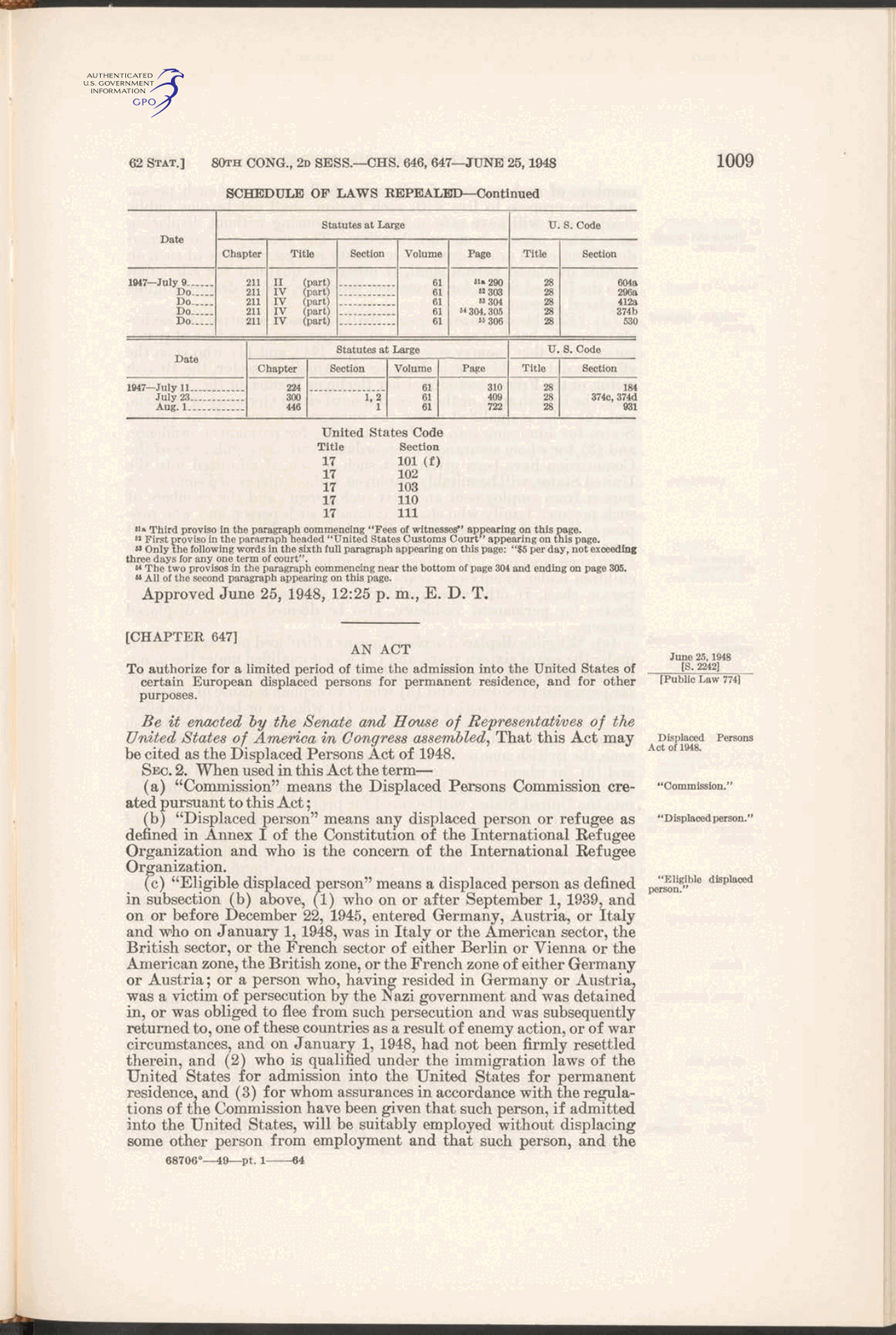
His objection was mainly to the eligibility date. The Act defined an eligible displaced person as one who had entered Germany, Austria or Italy between 1 September 1939 and 22 December 1945 and was still in a western zone or sector on 1 January 1948. Truman argued that this excluded more than ninety per cent of the remaining Jewish displaced persons, and also Catholic refugees who had fled communist rule into the western zones later. He objected too to the reservation of at least 40 per cent of visas for people whose place of origin or country of nationality had been de facto annexed by a foreign power, and to the mortgaging of up to half of each country's future immigration quota.13
The Act's preferences were occupational as well as national. First preference went to displaced persons previously engaged in agriculture who would work in agriculture in the United States, and not less than 30 per cent of all visas were reserved for them. Second preference covered household, construction, clothing and garment workers, others needed in the locality where the person proposed to live, and people with special professional or scientific qualifications. Third preference went to blood relatives within the third degree. A study of the Act's passage records that it also permitted 15,000 individuals, primarily Jewish students, who had entered the United States before 1948 to remain.111
The legislative groundwork included direct inspection of the camps. In September and October 1947 congressmen visited 150 displaced persons camps in Germany, Austria and Italy, noted that repatriation was nearing completion, and recommended an international conference to establish an interstate agreement, with the United States taking a leadership role.11
How it worked in practice
The Act created a Displaced Persons Commission of three members appointed by the President. The Commission wrote the regulations that governed assurances, investigated the character, history and eligibility of applicants, and reported to the President and Congress. It operated from the enactment of the statute until the programme closed in 1952.1
An assurance was a written guarantee, given under the Commission's regulations, that the person if admitted would be suitably employed without displacing some other person from employment, and would have safe and sanitary housing without displacing another person. Under the 1950 amendment the applicant also had to swear to accept the terms of that employment before a visa could be issued. Truman called these prior assurances niggardly conditions.123
Processing happened in occupied Germany and Austria. The IRO ran an emigrant staging area at Bremen, where index cards were filed for every displaced person emigrating, over 500,000 of them between 1946 and 1952, alongside language lessons and orientation for the destination country. In the British zone the barracks at Wentorf Resettlement Centre were an emigration camp from 1948 to 1951 under IRO administration, holding as many as 12,000 people at times. In the American zone the Funk-Kaserne in Munich was the resettlement centre where those preparing to leave completed their medical examinations: a Ukrainian family at Bad Aibling was authorised at the end of September 1951 to move there for medical screening and final departure to the United States.18910
Ships sailed from Bremerhaven. The first, the United States Army transport General Black, left on 21 October 1948 and reached New York on 30 October; the preserved passenger list carries 819 names with age, marital status, nationality, occupation and religion. IRO press releases through 1949 and 1950 named the arriving ships, the passengers' nationalities and professions, the states where they would settle, and the voluntary agencies assisting them.5
That last item explains why the United States never opened reception camps. The IRO paid for the Atlantic passage, but organisations such as the National Catholic Welfare Board and the Hebrew Immigrant Aid Society took the new arrivals from the port of entry to their destinations and provided the housing and employment the Act required. Because admission depended on an assurance already in place, an arriving family had a named job and a named address before it landed. There was nothing for a reception centre to allocate and no contract to be served out in one: the work Bonegilla or a Canadian bulk labour placement did after arrival was done in advance by a sponsor and a voluntary agency.15
Conditions written into the Act
| Condition | Requirement | Provision |
|---|---|---|
| Eligibility window, 1948 | Entered Germany, Austria or Italy between 1 September 1939 and 22 December 1945, and present in a western zone or sector on 1 January 1948 | Section 2(c), 1948 Act |
| Eligibility window as amended | Entered before 1 January 1949 and present on 1 January 1949 | 1950 amendment |
| Assurance | Written guarantee of suitable employment without displacing another worker, and of safe and sanitary housing without displacing another person | Section 2(c), 1948 Act |
| Sworn acceptance | The applicant must first swear to abide by the terms of employment in the assurance | 1950 amendment |
| Annexed territories | Not less than 40 per cent of visas reserved for people whose place of origin or country of nationality had been de facto annexed by a foreign power | Section 3(a), 1948 Act |
| Agricultural preference | Not less than 30 per cent of visas reserved for people previously in agriculture who would work in agriculture in the United States | Section 6(a), 1948 Act |
| Quota mortgage | Visas charged against the country-of-birth quota, not more than 50 per cent of any quota in a fiscal year | Section 3(b), 1948 Act |
| Reporting after arrival | Annual reports of residence and employment to the Commission until four reports have been made | Section 8, 1948 Act |
The first sailing under the Act
| Stage | Detail | Source scope |
|---|---|---|
| Departure | US Army transport General Black, Bremerhaven, 21 October 1948 | One voyage |
| Arrival | New York, 30 October 1948 | One voyage |
| Passenger list | 819 names, with age, gender, marital status, nationality, occupation and religion | The list preserved in the Truman Library |
Sources for this section
- Displaced Persons Act of 1948, Public Law 774, 62 Stat. 1009
- An Act to amend the Displaced Persons Act of 1948, Public Law 555, 64 Stat. 219
- Statement by the President Upon Signing the Displaced Persons Act
- Bohdan Kantor, personal account
- The emigration of displaced persons
- Displaced Persons Camp Wentorf, Mai 1945 bis Januar 1952
- International Refugee Organization Records, 1948–1950, finding aid
The Ukrainian experience within the Act
The Ukrainian population in the camps was large: over 200,000 Ukrainians remained in Germany and Austria by 1946, in a camp system of which about eighty camps were predominantly Ukrainian. Most emigrated across the Atlantic between 1947 and 1952, and the United States admitted the largest number.7
The United Ukrainian American Relief Committee made that possible for Ukrainians. Founded in 1944, it had sponsored some 33,000 incoming Ukrainians by 1952, out of the approximately 85,000 who entered under the Act. Sponsorship was not a formality: the committee had to find an American willing to guarantee a job and housing, file the assurance with the Commission and see it approved before a consular officer would issue the visa.6
The third wave differed from earlier Ukrainian immigration to the United States. It came entirely out of the camps in Austria and Germany, the majority from Western Ukraine, and it was literate, with many holding higher education. Its members arrived between 1947 and 1955 into established Ukrainian communities in the industrial cities of the north-east.6
Ukrainian figures and their scope
| Measure | Figure | Source scope |
|---|---|---|
| Ukrainians remaining in Germany and Austria by 1946 | over 200,000 | Ukrainians only, both countries, one year |
| Predominantly Ukrainian camps | about 80 | Camps, not people |
| Ukrainian immigrants entering the United States under the 1948 Act | approximately 85,000 | Ukrainians only, whole programme |
| Ukrainians sponsored by the United Ukrainian American Relief Committee by 1952 | some 33,000 | Ukrainians only, one sponsoring organisation |
| Refugees resettled worldwide by the IRO by 1952 | over 600,000 | All nationalities, all destinations |
Sources for this section
What happened afterwards
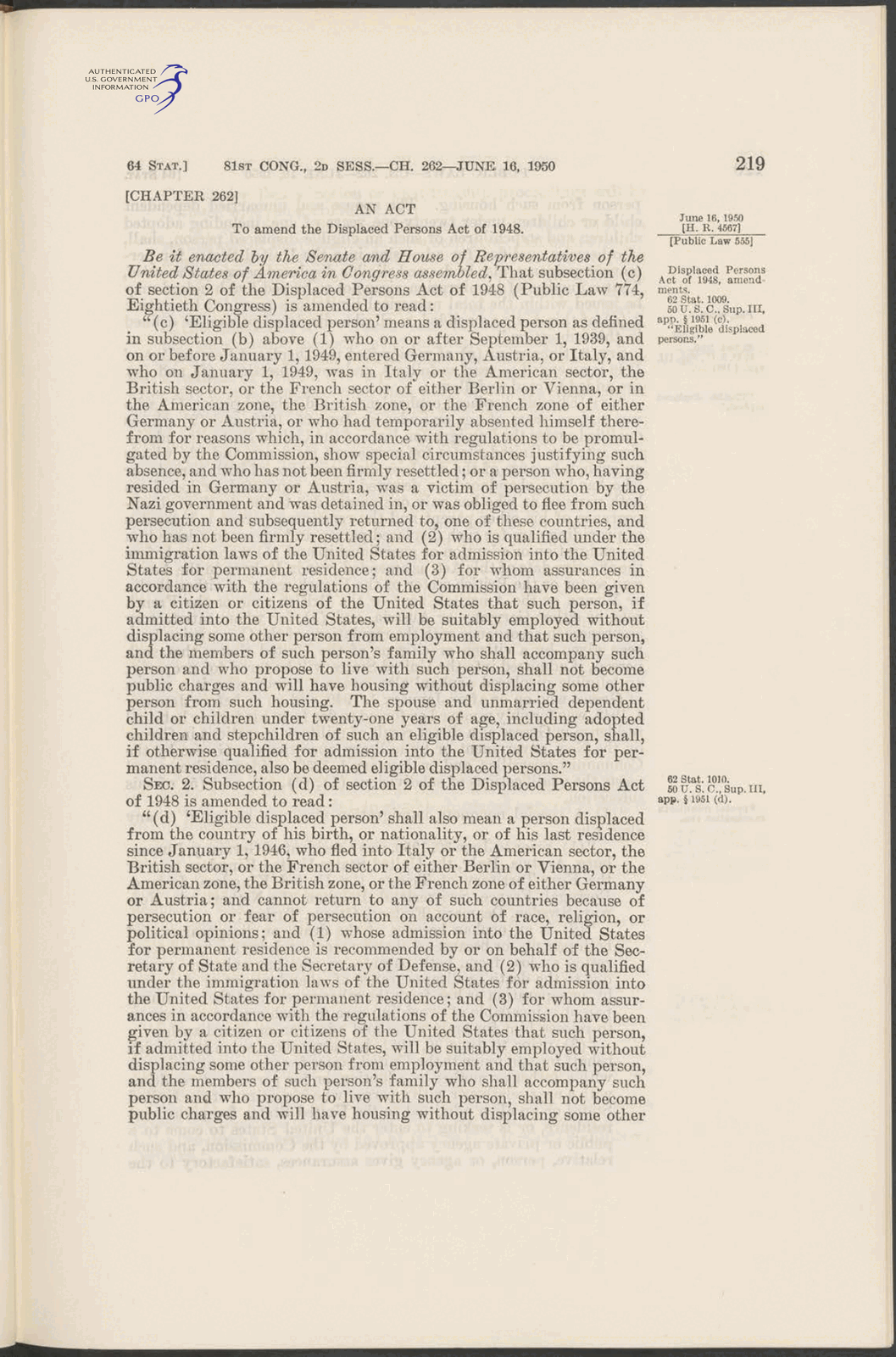
Congress amended the Act on 16 June 1950. The amendment moved the eligibility date from 22 December 1945 to 1 January 1949, raised the displaced persons ceiling to 341,000, and added categories: 10,000 war orphans, 4,000 refugees who had fled to the Far East, 18,000 veterans of the exiled Polish Army then in England, 10,000 Greek refugees, 2,000 displaced persons in Trieste and Italy, and 54,744 refugees and expellees of German origin. Truman noted that the amended law authorised 400,744 visas in all, including the 172,230 issued up to 31 May 1950, and that the postwar victims of totalitarianism were now on an equal footing with earlier victims of Nazi aggression.24
The same day he signed an executive order designating the Commission to carry out the required investigations and reports on displaced persons and persons of German ethnic origin seeking admission. The Commission's term ran to 31 August 1952; the IRO was abolished the same year and its functions passed to the United Nations High Commissioner for Refugees.45
The obligations of the Act outlasted the voyage. An admitted person had to report their residence and employment to the Commission each year until four reports had been made, and under the 1950 amendment had already sworn to abide by the employment terms in the assurance. The entry had also been charged against the future immigration quota of the country of birth, up to half of that quota in any year.123
A doctoral study of the resettlement programme puts the total at nearly 395,000 displaced persons resettled to the United States between 1948 and 1952.12
Visa numbers under the Act and its 1950 amendment
| Provision | Number of visas | Source scope |
|---|---|---|
| Displaced persons, 1948 Act | 202,000 | Statute ceiling, 62 Stat. 1009, all nationalities |
| Displaced orphans, 1948 Act | 3,000 | Statute ceiling, special nonquota visas |
| Recent Czech refugees, 1948 Act | 2,000 | Statute ceiling |
| Displaced persons, as amended 1950 | 341,000 | Statute ceiling, 64 Stat. 219 |
| War orphans, 1950 | 10,000 | Truman's signing statement |
| European refugees who fled to the Far East, 1950 | 4,000 | Truman's signing statement |
| Veterans of the exiled Polish Army in England, 1950 | 18,000 | Truman's signing statement |
| Greek refugees, 1950 | 10,000 | Truman's signing statement |
| Displaced persons in Trieste and Italy, 1950 | 2,000 | Truman's signing statement |
| Refugees and expellees of German origin, 1950 | 54,744 | Truman's signing statement |
| Total authorised by the amended law | 400,744 | Includes the 172,230 visas issued up to 31 May 1950 |
Sources for this section
- An Act to amend the Displaced Persons Act of 1948, Public Law 555, 64 Stat. 219
- Statement by the President Upon Signing Bill Amending the Displaced Persons Act
- International Refugee Organization Records, 1948–1950, finding aid
- Displaced Persons Act of 1948, Public Law 774, 62 Stat. 1009
- Statement by the President Upon Signing the Displaced Persons Act
- Humanitarian Capitalism: Displaced Persons Resettlement in America, 1948-1952
Sources
- Displaced Persons Act of 1948, Public Law 774, 62 Stat. 1009
United States Government Publishing Office · 25 June 1948
Statute text read. Sections 2, 3, 6 and 8 supply the definition of an eligible displaced person and the 22 December 1945 and 1 January 1948 dates, the assurance requirement of suitable employment without displacing another worker and safe and sanitary housing, the 202,000 visa ceiling, the 40 per cent annexed-territories proviso, the 50 per cent quota mortgage, the 3,000 orphan visas, the 30 per cent agricultural preference and the second and third preferences, and the creation, duties and reporting requirements of the Displaced Persons Commission.
- An Act to amend the Displaced Persons Act of 1948, Public Law 555, 64 Stat. 219
United States Government Publishing Office · 16 June 1950
Statute text read for the amended eligibility date of 1 January 1949, the raised ceiling of 341,000 visas, the added categories, and the requirement that a person admitted on an assurance of employment first swear to abide by its terms.
- Statement by the President Upon Signing the Displaced Persons Act
Public Papers of the Presidents, Harry S. Truman Library and Museum · 25 June 1948
Read in full. Truman's reluctance, the legislative delays, his objection to the 22 December 1945 date and its effect on Jewish and Catholic displaced persons, the 40 per cent annexed-territories requirement, the quota mortgaging, and his description of the prior assurances of suitable employment and safe and sanitary housing as niggardly conditions.
- Statement by the President Upon Signing Bill Amending the Displaced Persons Act
Public Papers of the Presidents, Harry S. Truman Library and Museum · 16 June 1950
Read in full. Supplies the added categories with their numbers, the total of 400,744 visas including the 172,230 issued to 31 May 1950, and Executive Order 10131 designating the Commission to investigate and report on displaced persons and persons of German ethnic origin.
- International Refugee Organization Records, 1948–1950, finding aid
Harry S. Truman Library and Museum · Processed 2024
Archival finding aid read in full. Gives the General Black sailing from Bremerhaven on 21 October 1948 and arrival in New York on 30 October, the preserved list of 819 passengers with age, gender, marital status, nationality, occupation and religion, the content of the IRO press releases, the IRO's payment of the transatlantic passage, and the responsibility of voluntary agencies for transport from the port of entry and for housing and employment as required by the Act.
- United States of America
Internet Encyclopedia of Ukraine, Canadian Institute of Ukrainian Studies · Accessed 2026
Read for the third wave: arrivals between 1947 and 1955, approximately 85,000 Ukrainian immigrants entering under the Displaced Persons Act of 1948, the United Ukrainian American Relief Committee founded in 1944 and sponsoring some 33,000 by 1952, and the origins and education of the wave.
- Displaced persons
Internet Encyclopedia of Ukraine, Canadian Institute of Ukrainian Studies · Accessed 2026
Read for over 200,000 Ukrainians remaining in Germany and Austria by 1946, about eighty predominantly Ukrainian camps, emigration across the Atlantic in 1947 to 1952, and the naming of the United Ukrainian American Relief Committee among the Ukrainian relief bodies.
- Bohdan Kantor, personal account
American Friends Service Committee · Accessed 2026
Firsthand Ukrainian account read for the move authorised at the end of September 1951 from Bad Aibling Children's Village to the resettlement centre at Munich Funk-Kaserne for medical screening and final departure to the United States.
- The emigration of displaced persons
Arolsen Archives · Accessed 2026
Read for the IRO emigrant staging area at Bremen, the over 500,000 emigration index cards filed there between 1946 and 1952, the preparatory courses and language lessons for the destination country, and the principal destinations.
- Displaced Persons Camp Wentorf, Mai 1945 bis Januar 1952
Wentorf im Blick, no. 84 · May 2020
Local history account read for the camp's phases: repatriation under British administration and then UNRRA from 1945 to 1948, and from 1948 to 1951 an emigration camp for displaced persons administered by the IRO, with up to 12,000 people accommodated at times, a hospital, schools, three churches and a radio station.
- President Harry Truman and the Socio-Political Discourse in the United States: The Path to the Displaced Persons Act of 1948
Volodymyr Yushkevych, Eminak 4 (52) · 2025
Pages 164 and 171 read: the congressional visit to 150 displaced persons camps in Germany, Austria and Italy in September and October 1947 with its recommendation of an international conference, and the permission for 15,000 individuals, primarily Jewish students, who had entered the United States before 1948 to remain. The article's figure of 205,000 authorised persons was not used, the statute at source 1 setting the ceiling at 202,000.
- Humanitarian Capitalism: Displaced Persons Resettlement in America, 1948-1952
Andrew Joseph Marion, University of Mississippi doctoral dissertation; eGrove repository · 2023
Repository landing page and abstract read: nearly 395,000 displaced persons resettled to the United States between 1948 and 1952, each individual or family having an American sponsor committed to housing and employment. The dissertation itself was not read.
Last researched 13 September 2026