Sha’ar HaAliyah
Arrival and settlement
Haifa · Israel · 1949–1962
A former British army camp at St Luke’s in Haifa became Israel’s central immigrant reception and screening camp in March 1949, and nearly 400,000 people passed through before it closed in 1962. Fenced and policed as a quarantine its own officials knew to be porous, it also received a family from Radyvyliv, now in Ukraine, whose memoir is the page’s one direct Ukrainian link.
Introduction
Sha’ar HaAliyah, meaning Gate of Immigration, opened near Haifa in 1949 as the Jewish Agency’s central immigrant processing camp. Registration and health controls brought new arrivals into an enclosed reception system. Its role was settlement in Israel, rather than repatriation to Europe.
The site was not new. It had been the British military camp of St Luke’s on the southern edge of Haifa; the old name stuck for years. It was converted in March 1949 on a site of 200 dunams to bring the whole chain of arrival formalities, until then carried out on the Haifa quayside, into one place. The first 353 immigrants, from the ship Kadma, reached it on 14 March 1949.
A history in dates
- 1948Immigrants landing at Haifa port are processed on the quayside before being sent on to immigrant camps.
- 14 March 1949The former British camp of St Luke’s, 200 dunams, opens as the central reception and screening camp; the first 353 immigrants arrive on the ship Kadma from Marseille.
- 1949The central reception camp opens.
- 1950Yaakov Meridor criticises the barbed wire in the Knesset; the Jewish Agency refuses a police request to build a wall.
- April 1951A wall is under construction after continued police pressure.
- 9 August 1951Thousands of immigrants from Iraq refuse transfer to the ma’abarot; about two thousand leave after police threats.
- 1952A centre for children with ringworm and trachoma opens in a fenced off section of the camp; it runs until 1960.
- 1952 onwardsAdmissions decline as immigration and settlement policies change.
- December 1953About a thousand immigrants are in the camp.
- March 1955Staff are down to twenty six, excluding the ringworm and trachoma centre.
- April 1957The Radyvyliv memoir records arrival in Israel before a stay at Shaar HaAliya.
- 1958The camp’s area is added to the city of Haifa.
- 1962The camp officially closes and its last residents pass to the care of Haifa municipality.
- 2008Hecht Park opens on the strip west of the Sha’ar HaAliyah neighbourhood built on the camp’s ground.
A route from Radyvyliv
A memoir in the Radyvyliv memorial book describes a family leaving the Soviet Union through Poland and arriving in Israel in April 1957. After ten months at Shaar HaAliya, the Jewish Agency moved them to Holon. This connects the site with Jewish survivors from a town now in Ukraine; it does not establish an ethnic-Ukrainian camp population. The journey illustrates how displacement and resettlement could continue well into the 1950s.
That route fits a documented wave: between 1956 and 1960 communist Poland permitted free Jewish emigration, and an estimated 50,000 people reached Israel by it, among them some 13,000 to 15,000 Jews from the Soviet Union allowed to repatriate to Poland. Radyvyliv lay in interwar Poland and is now in Ukraine. No breakdown of the camp’s arrivals by region of origin has been found, and the memoir remains the only Ukraine connected account of the camp.
Sources for this section
Processing and everyday uncertainty
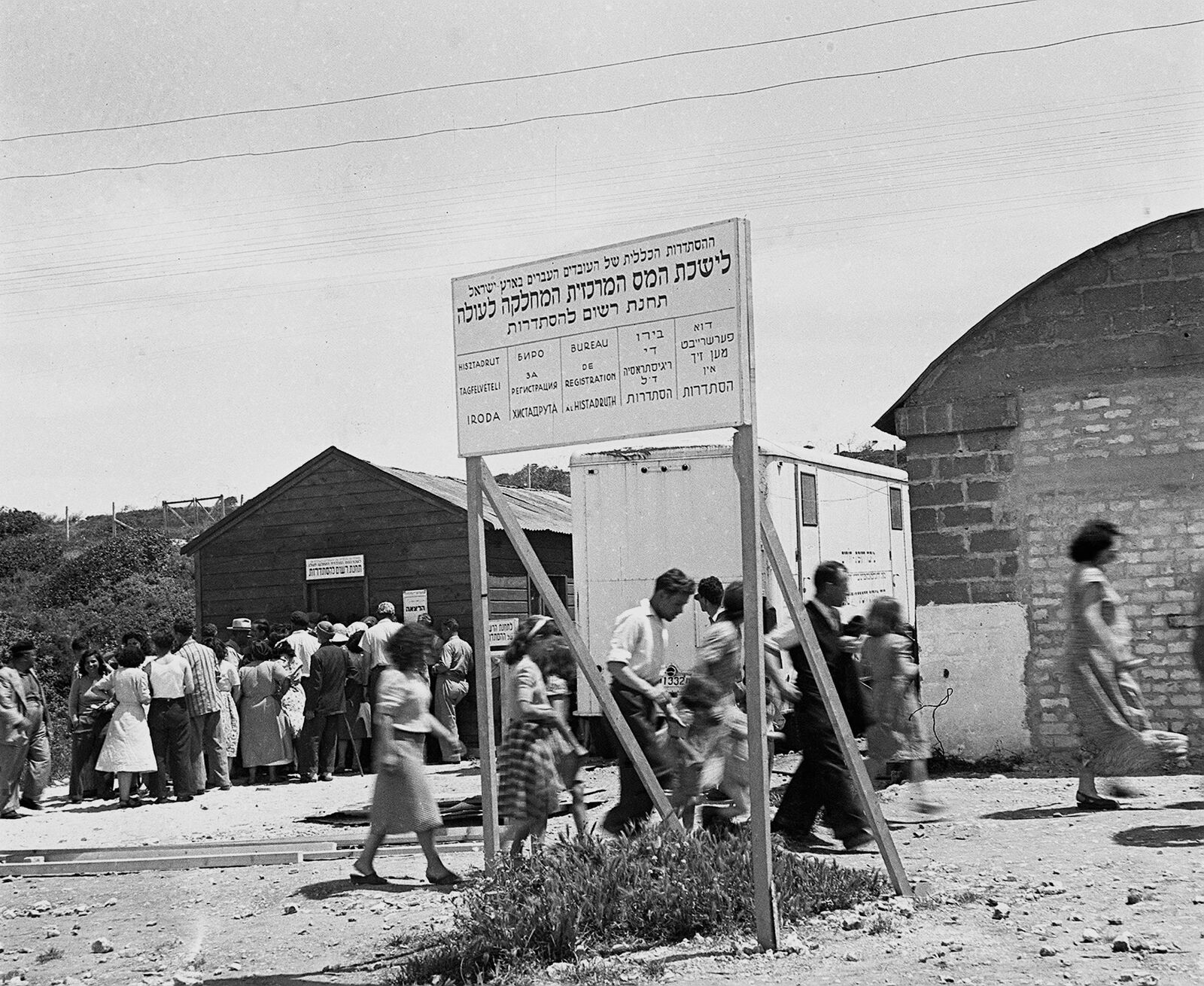
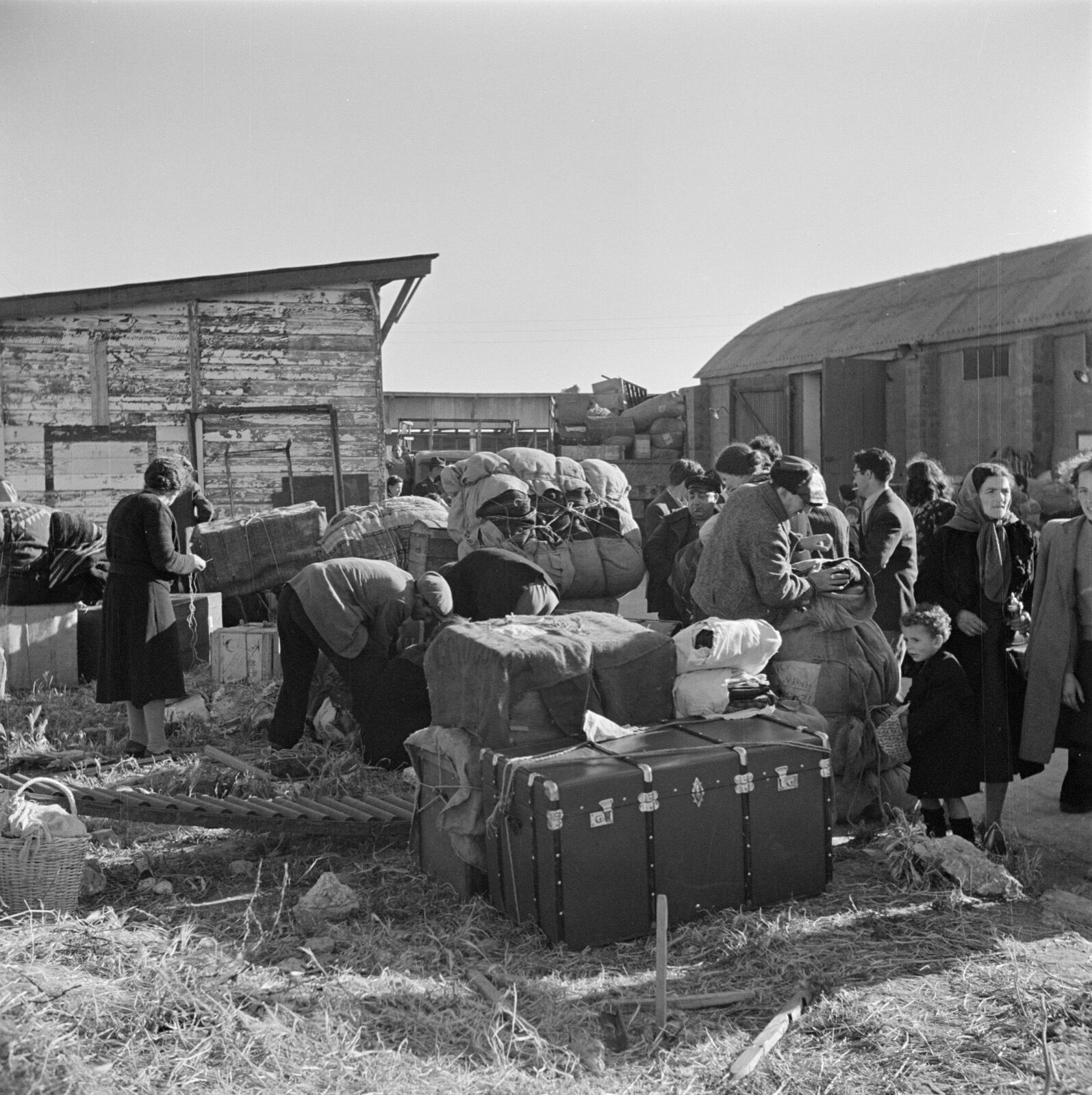
Arrivals were driven by lorry from Haifa port or Lod airport. Inside they passed border control, documents and customs, then blood tests, vaccination, chest screening by minograph and disinfection, with BCG for those showing no sign of tuberculosis. The sorting was meant to take five days, after which a person left as a citizen and a member of Kupat Holim and the Histadrut. Most stayed ten days or more.
Planned for 5,000 people, the camp held between 10,000 and 12,000 at its peak. Fencing and health restrictions provoked arguments about quarantine, citizenship and the treatment of newcomers. Experiences varied: some remembered distress and anger, while others regarded their stay as an uneventful part of immigration.
When the cabins filled, people went into tents. Cabins were dirty, tents came down in winter storms and dirt floors turned to mud. More than forty institutions worked inside the camp, whose staff were required to speak Hebrew. It was run by Yehuda Weisberger, director from 1949 to 1957, and the largest staff count, about 400, came in 1950.
Annual camp admissions
| Year | Admissions |
|---|---|
| 1949 | 97,840 |
| 1950 | 127,854 |
| 1951 | 99,602 |
| 1952 | 14,342 |
| 1953 | 6,692 |
| 1954 | 5,338 |
| 1955 | 576 |
Scale of the camp
| Measure | Figure |
|---|---|
| Site area on conversion, March 1949 | 200 dunams |
| First arrivals, 14 March 1949 (ship Kadma) | 353 |
| Planned capacity | 5,000 |
| Population at peak | 10,000 to 12,000 |
| Staff at peak, 1950 | about 400 |
| Staff, March 1955 (excluding the ringworm and trachoma centre) | 26 |
| Immigrants in the camp, December 1953 | about 1,000 |
| Total passing through, 1949 to 1962 | nearly 400,000 |
| Of which 1949 to 1951 (the study’s prose says 1949 to 1952) | 325,296 |
A changing reception system
The enclosure was the most contested feature. Isolation was enforced by a barbed wire fence and a police patrol, and Kalman Levin of the Absorption Department’s Haifa office wrote that the camp had to be fenced and closed because it was a quarantine. In 1950 the Knesset member Yaakov Meridor asked publicly whether it accorded with the honour of the Jewish state to hold new immigrants behind barbed wire. The Jewish Agency refused a police request for a wall that year, fearing the impression of a prison courtyard, but one was under construction by April 1951.
Contemporary reporting in June 1955 described controversy over sending immigrants to Shaar Haaliya. The proposed move would renew a period of waiting in a transit camp after the Jewish Agency had increasingly arranged direct journeys from ships to prepared settlements. This debate shows that the camp was one stage within a changing housing and settlement system.
The fence never worked as intended. Weisberger acknowledged in November 1950 that people left through holes in it despite the guards, and the common summary was that in theory the camp was closed but in reality it was open to all. On 9 August 1951 thousands of immigrants from Iraq refused transfer to the ma’abarot after two months in the camp; about two thousand left after police threats.
The later years
Pressure was eased by a second site: early in 1951 the former Atlit detention camp became a screening camp known as Sha’ar Aliyah Bet. From 1952 a fenced off section housed a large centre for children with ringworm and trachoma, which ran until 1960.
Throughput declined sharply after 1952. Later residents included people requiring additional assistance, such as older immigrants without family support. The camp officially closed in 1962. Its total admissions and its residents on any particular date are different measures.
Staffing fell with the numbers: about a thousand immigrants were in the camp in December 1953, and by March 1955 only twenty six staff remained. Over thirteen years nearly 400,000 immigrants passed through, the overwhelming majority of them at the beginning of the mass immigration. The study puts that majority at 325,296 and describes it as concentrated in 1949 to 1952, but its own Table 1 gives precisely that total for 1949, 1950 and 1951 together, with 1952 adding a further 14,342; the figure and the span the text attaches to it do not agree.
Closure and the site today
The camp’s land was taken into the municipal area of Haifa in 1958, and the camp closed at the beginning of 1962, its last residents passed to the care of Haifa municipality. A residential quarter planned on the ground afterwards carries the camp’s name. In 2021 a renewal scheme was approved for it, replacing 184 older flats with more than 800 homes.
Sources for this section
Sources
- Conflicts of Quarantine: The Case of Jewish Immigrants to the Jewish State
Rhona Seidelman, American Journal of Public Health, 2012
Indexed full article passages and Table 1 checked. Original archival research establishes 1949 opening, 1962 closure, capacity, processing numbers, quarantine debates and changing use. Direct local download returned a browser challenge; no claim that downloaded challenge is article text.
- A survivor’s account from Radyvyliv
Radyvyliv memorial book, translated by JewishGen
Original memoir translation, page 250: route from Radyvyliv and other Soviet locations through Poland, arrival April 1957, ten months at Shaar HaAliya and Jewish Agency transfer to Holon. No resident names published.
- Dispute between Israel parties creates confusion among immigrants
Jewish Telegraphic Agency, 7 June 1955
Contemporary reporting describes a proposed transfer to Shaar Haaliya as a return to transition-camp waiting, contrasted with direct placement from ships into prepared settlements.
- Immigrants outside the Histadrut registration office, 1 July 1949
Zoltan Kluger / Israeli Government Press Office, D597-046
Original GPO photograph metadata checked through Commons. Caption identifies the precise camp and date.
- שער העלייה (Sha’ar HaAliyah)
Hebrew Wikipedia
Read in Hebrew and saved verbatim on 13 September 2026. Framework article whose footnotes cite Rhona Seidelman, Under Quarantine (2020), Tom Segev, 1949, and Davar reports of 15 March 1950, 1 October 1950, 10 April 1951, 25 December 1953 and 4 February 1962. Source of the St Luke’s identification, the 200 dunam area, the Kadma and the 14 March 1949 opening, the processing chain, Yehuda Weisberger, Sha’ar Aliyah Bet at Atlit, the August 1951 protest, the 1958 municipal boundary change, the 1962 closure and the later neighbourhood, Hecht Park and the 2021 renewal scheme.
- Gomułka aliyah
English Wikipedia, citing Ewa Węgrzyn (2018)
Read 13 September 2026. Used only for the 1956 to 1960 emigration wave from Poland, the estimate of 50,000 arrivals in Israel and the 13,000 to 15,000 Jews from the Soviet Union repatriated to Poland. It says nothing about Sha’ar HaAliyah itself and is not used to claim a Ukrainian camp population.
- “Healing” the bodies and souls of immigrant children: The Ringworm and Trachoma Institute, Sha’ar ha-Aliyah, 1952–1960
Rhona D. Seidelman, S. Ilan Troen and Shifra Shvarts, Journal of Israeli History 29:2 (2010), 191–211
Publisher page returned HTTP 403 on 13 September 2026; bibliographic record verified through the Semantic Scholar API for the DOI. Cited only for the existence, title and 1952 to 1960 dates of the institute, which are independently supported by sources 1 and 5. Full text not read.
- Newly arrived immigrants sorting their baggage at the St Luke’s transit camp near Haifa, 1948
Willem van de Poll; Nationaal Archief, Fotocollectie Van de Poll, series Israel 1948–1949, via Wikimedia Commons · 1948
Photograph released under the Creative Commons CC0 public domain dedication. The Dutch archive caption names the camp as the St Luke’s transit camp at Haifa, the site that became Sha’ar HaAliyah.
Last researched 13 September 2026