Springwood Park
Arrival and settlement
Kelso, Scotland · Estate from 1750; wartime billeting; hostel recorded 1953
Springwood Park Hostel at Kelso was one of the Scottish Borders hostels where Ukrainians lived after the Second World War. Its name survives in Ukrainian community research and in a 1953 naturalisation notice for a caretaker, on an estate whose house, parkland and riverside grounds lay opposite Kelso near the meeting of the Teviot and Tweed.
Introduction
Springwood Park Hostel at Kelso was one of the Scottish Borders hostels where Ukrainians lived after the Second World War. Its name survives in Ukrainian community research and in a 1953 naturalisation notice for a caretaker. The hostel belonged to a landscape with a much longer history: Springwood’s house, parkland and riverside grounds lay opposite Kelso, near the meeting of the Teviot and Tweed.
A history in dates
- 1750Admiral Sir James Douglas bought the land and changed its name from Bridgend to Springwood Park.
- 1942 to 1945Sunlaws House served as headquarters of locally based Polish Army units, with billeting suggested at Springwood Park.
- After the Second World WarSpringwood accommodated Ukrainians in the Borders hostel network.
- 19 August 1953Naturalisation date recorded for Milan Vukmirovic, caretaker, at the hostel address.
- 16 October 1953The Edinburgh Gazette published Vukmirovic’s entry.
- 1954The Scottish National Buildings Record photographed the interior of Springwood House.
- After 1969The house, in disrepair, was demolished following the death of the sixth baronet.
A Ukrainian community in Kelso
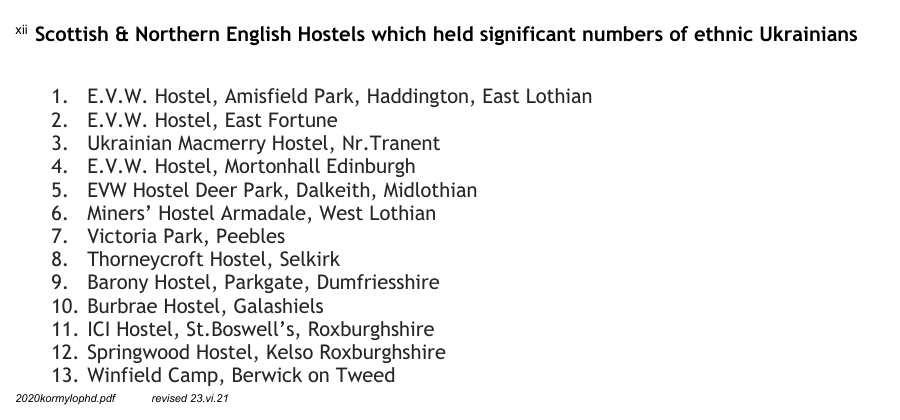
Peter Kormylo includes Springwood Park Hostel on his map of Ukrainian camps and hostels in Scotland during 1946 to 1951. His accompanying directory calls it Springwood Hostel, Kelso, Roxburghshire, among facilities with significant numbers of ethnic Ukrainians. The map draws on lists held by the Association of Ukrainians in Great Britain and the Ukrainian Catholic Church in Scotland. Nearby entries include hostels at Galashiels, Selkirk, St Boswells and Peebles, placing Kelso within a dispersed Borders network.
That network took its shape from a national change of administration. From 1947 responsibility for the camps began to pass from the War Office to the National Assistance Board, the National Service Hostels Corporation and other civilian bodies, and they were officially redesignated as hostels; most of their residents could only leave from the beginning of 1951, when employment restrictions started to be lifted, and by the mid-1950s most of the hostels had closed.
A name and an address in 1953
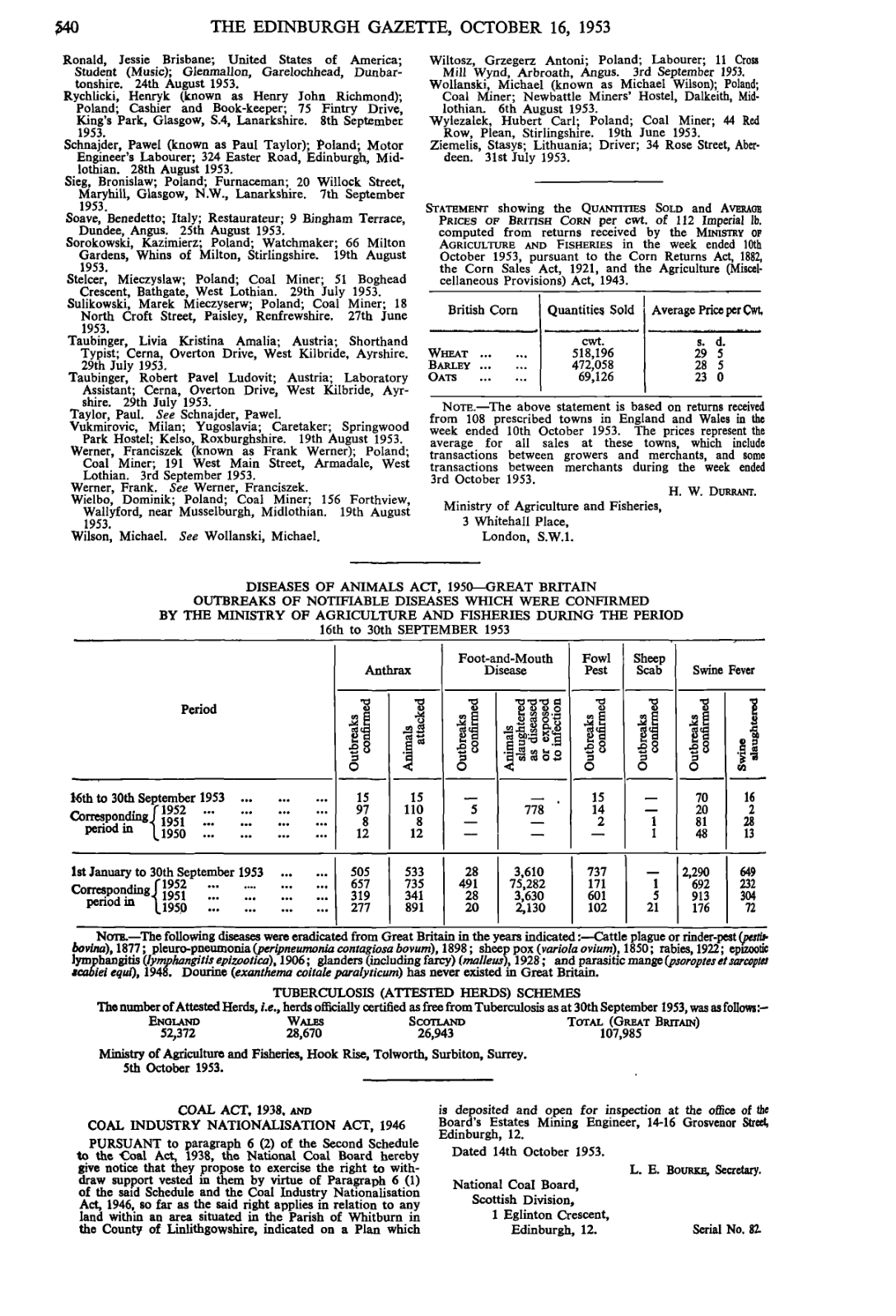
Milan Vukmirovic’s naturalisation entry gives Springwood Park Hostel, Kelso, Roxburghshire, as his address and caretaker as his occupation. It identifies his country as Yugoslavia and dates his naturalisation to 19 August 1953. Published on 16 October, the notice supplies a contemporary personal connection with the hostel beyond the period covered by Kormylo’s map. It does not identify Vukmirovic as Ukrainian. The same notice was printed in the London Gazette three days earlier and is not an independent second witness.
Springwood in the records
| Record | Name | What it records |
|---|---|---|
| Kormylo, map, p. 100 | Springwood Park Hostel | Ukrainian accommodation in the Borders |
| Kormylo, directory, p. 322 | Springwood Hostel | Kelso, Roxburghshire; significant Ukrainian presence |
| Edinburgh Gazette, 16 October 1953 | Springwood Park Hostel | Milan Vukmirovic, caretaker; naturalised 19 August 1953 |
| London Gazette, 13 October 1953 | Springwood Park Hostel | The same notice reprinted; not an independent witness |
Sources for this section
Springwood during the war
Local historian Roger Owen suggests that Polish soldiers and some prisoners of war were billeted at Springwood Park, within the wider wartime accommodation network administered from Sunlaws House. His account places the headquarters at Sunlaws and treats Springwood as a separate billeting location. This earlier military use precedes the postwar Ukrainian hostel recorded by Kormylo.
The Sunlaws organisation was substantial. Owen records that Sunlaws House was first the headquarters of locally based Polish Army units from 1942 to 1945, then used to organise the placement of Italian prisoners from 1943 and German prisoners from 1945 until 1947, and he quotes a former German prisoner describing Sunlaws as a big camp of twenty-two hostels spread over Roxburghshire and Selkirkshire. The house and grounds were requisitioned early in the war and derequisitioned in 1948. Those figures and dates belong to Sunlaws itself rather than to Springwood.
The park around the hostel
The council’s designed-landscape survey traces the estate back to Roy’s mid-eighteenth-century map, where an avenue and tree-lined parks appear under the names St Olaus and Chapelfarm. Later landscaping softened this formal arrangement. The grounds extend around two river meanders south of Kelso; the eastern Bridge-end Haugh became the showground, while other estate land developed as a caravan and holiday park. The monumental entrance at Kelso Lodge and surviving tree belts preserve parts of the older landscape. These are features of the estate rather than identified hostel buildings.
The national record of the historic environment describes Springwood House as an eighteenth-century country house, also known as Springwood Park Estate and Springwood Caravan Park, at NT 71661 33474 in Kelso parish. It numbers the estate structures separately: a mausoleum, home farm, walled garden, Teviot Lodge, Kelso Lodge, Springwood Cottage and the gateway and gates, with work by James Gillespie Graham about 1820 and by Brown and Wardrop between 1850 and 1865. The Scottish National Buildings Record photographed the interior of the house in 1954, so it was standing a year after the caretaker’s notice; the record now marks it demolished. None of the numbered structures can be identified as the hostel, and the record makes no mention of requisition, camp or hostel use.
Sources for this section
Sources
- Peter Kormylo, In which ways is the Ukrainian community in Scotland a diaspora?
University of Glasgow · 2021
PhD thesis, printed pages 100 and 322. Original map and appendix inspected. Map covers 1946 to 1951; this is not a hostel lifespan.
- Edinburgh Gazette, 16 October 1953, page 540
The Gazette · 16 October 1953
Original public PDF text inspected; Milan Vukmirovic naturalisation entry, heading on page 539. Duplicated in the London Gazette, issue 39986, page 5450, 13 October 1953; the same notice, not an independent witness. A phrase search of the Gazette on 13 September 2026 for Springwood Park Hostel returned only these two notices, and for Springwood Hostel Kelso none.
- Roger Owen, Prisoner of War Camp
Ancrum and District Heritage Society · June 2017
Read in full on 13 September 2026. Tentative identification of Springwood billeting within the Sunlaws network; Sunlaws as Polish Army headquarters 1942 to 1945, Italian placements from 1943 and German from 1945 to 1947; a former prisoner’s description of twenty-two hostels across Roxburghshire and Selkirkshire; requisition early in the war and derequisition in 1948. None of these figures is evidence about Springwood’s own buildings.
- Borders Designed Landscapes Survey: Springwood
Peter McGowan Associates for Scottish Borders Council · 31 August 2009
Site 103, printed page 111, PDF 112. Estate-wide landscape description; not a hostel footprint.
- Kelso, Springwood House (NRHE 112547)
Historic Environment Scotland, National Record of the Historic Environment · Undated architecture notes
Full record read 13 September 2026. Country House, eighteenth century, NT 71661 33474, Kelso parish; separately numbered mausoleum, home farm, walled garden, Teviot Lodge, Kelso Lodge, Springwood Cottage and gateway; architects including James Gillespie Graham about 1820; marked Demolished; Scottish National Buildings Record interior photographs dated 1954. No reference to requisition, camp, hostel or displaced persons.
- Roman Krawec, Post-war camps and hostels
Ukrainians in the United Kingdom online encyclopaedia · Published 10 February 2013
Read in full. Transfer of camp administration to civilian bodies from 1947 and redesignation as hostels; departures from the beginning of 1951; closure of most hostels by the mid-1950s. General framework; Springwood is not named in the article.
- Negative searches: Discovery and the Scottish Catholic Directory 1953
The National Archives; Scottish Catholic Archives · Searched 13 September 2026
Discovery searches for Springwood Park Hostel and for Springwood hostel Kelso returned no results; a search for Springwood Kelso returned only a 1909 letter at Surrey History Centre. The Scottish Catholic Directory for 1953 contains no occurrence of Springwood; its Kelso entry, printed page 95, names the cottage hospital and Inch Home at Kelso and the cottage hospital at Coldstream as its outlying duties. Discovery indexes catalogue descriptions, not file contents, and the directory covers Roman Catholic arrangements only.
- Springwood Park
The Douglas Archives · Page updated 19 April 2026
Read in full. The land became known as Springwood Park in 1750 when Admiral Sir James Douglas bought it and changed its name from Bridgend; the house fell into disrepair under the sixth baronet and was torn down after his death in 1969. A compiled local-history page, not an archival record.
- The Edinburgh Gazette, 16 October 1953, page 540
The Gazette (TSO, on behalf of His Majesty’s Stationery Office) · 16 October 1953
Page facsimile carrying the Home Office naturalisation list for Scotland, including Milan Vukmirovic, caretaker, of Springwood Park Hostel, Kelso, Roxburghshire. Crown copyright, reproduced under the Open Government Licence version 3.0; The Gazette notes that the licence does not extend to the re-use of personal data.
Last researched 13 September 2026