Burnbrae Hostel
Arrival and settlement
Galashiels, Scottish Borders, Scotland · Postwar
Burnbrae was part of the hostel network through which Ukrainians began life in the Scottish Borders. Photographs and family testimony place the wider Galashiels community in the town’s textile industry.
Introduction
Burnbrae Hostel was Ukrainian accommodation in Galashiels. It appears as Burnbrae on the Scottish settlement map and as Burbrae in the accompanying directory. Both records locate the hostel in the same town.
Sources for this section
A history in dates
- 30 June 1947564 EVWs have been placed in textiles nationally; the minister names camp accommodation near work as a major problem.
- PostwarBurnbrae is recorded among hostels with Ukrainian residents.
- 8 January 1949Ignacy Hoffman, a labourer in a Galashiels skinner’s yard, is naturalised from 260 Halliburton Place.
- 1949A photograph records female EVW textile workers in Galashiels; their hostel is not specified.
- From 1951Employment restrictions lifted for EVWs with three years in Britain; most hostels closed by the mid-1950s. National pattern, not a Burnbrae date.
- Early 1950sCamps close and Ukrainians are drawn to employment in Galashiels among other towns.
- January 1954Ukrainian Christmas Eve is celebrated in Galashiels, recorded in a photograph.
- 20 April 1990An Edinburgh Gazette notice gives Burnbrae, Mossilee Road, Galashiels as a public body’s office. Name match only.
- 14 January 1950Jozef Surmacewicz, a carding machine attendant, is naturalised from 3 Woodside Place, Galashiels.
- 13 November 1950Zbigniew Chelminski, a textile designer, and Jadwiga Chelminska are naturalised from 5 Meigle Street, Galashiels.
- 1951Aerofilms photographs Mossilee and Galashiels from the air.
- 7 December 1955Aleksander Kreiza, a tentering machine attendant, is naturalised from 55 Galapark Road, Galashiels.
Sources for this section
- European Voluntary Workers: employment placements
- In which ways is the Ukrainian community in Scotland a diaspora?
- Naturalisation list, page 76
- Post-war camps and hostels
- Tweed River Purification Board: notice of application for consent to discharge
- Naturalisation list, page 1295
- Naturalisation list, page 6209
- Redundancy and industry notices naming Galashiels woollen firms
- Naturalisation list, page 23
A town of textile workers
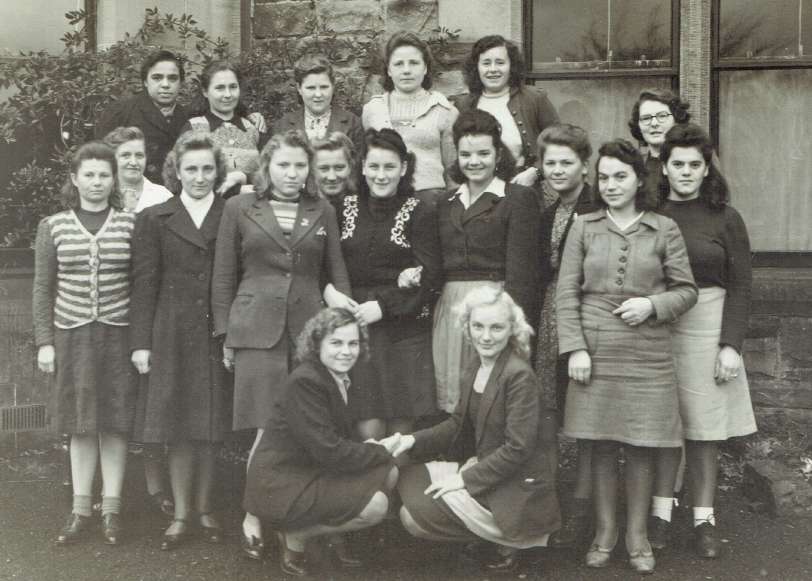
A 1949 photograph shows women employed as European Voluntary Workers in Galashiels textiles. Interviewed about the picture, a worker’s child identified her mother and explained that the group included Ukrainian, Polish and German women. The photograph records the town’s working community; it does not identify the women’s hostel.
Another family account describes a mother working as a weaver and friendships carried over from a displaced-persons camp in Germany. It connects the Borders textile towns with the continental camps from which people had come.
Kormylo also records that most Ukrainian women who came as EVWs chose textile work in England, and that only a few opted for Dundee or Galashiels. The Galashiels group was therefore small from the start, which makes the 1949 photograph and the family accounts unusually valuable as records of the town’s Ukrainian workers.
Galashiels was a town of mills, and the Gazette’s own notices of the period name them: Comelybank Mill, Gala Mills, Buckholm Mill, and the tweed firms of King Street. These were the works into which the hostels fed labour, and the reason the Ministry of Labour placed continental workers in the Borders at all.
Why hostels mattered
Accommodation was central to the national recruitment programme. On 8 July 1947, the Minister of Labour reported 564 EVWs placed in textiles by the end of June. He explained that workers needed training and camps close enough for travel to work. These are national figures, showing the employment setting behind local hostel accommodation.
The hostels that resulted were of several kinds, from former military camps to wartime industrial hostels and newly converted buildings, and they were run by bodies including the National Service Hostels Corporation, the Ministry of Agriculture, the YMCA, local authorities and private firms. Most residents could leave only after the beginning of 1951, when employment restrictions were lifted from those with three years in Britain, and most hostels had closed by the mid-1950s.
Sources for this section
From hostel to community
When the camps and hostels closed in the early 1950s, Kormylo writes, Ukrainians were drawn to employment in the cities and in towns including Galashiels. A second-generation interviewee remembered that in the early days there was no club: a Ukrainian Catholic priest, Fr Matyczak, came once a month to say Mass at the Catholic church in Galashiels between the two Roman Catholic Masses, and gave out the community’s announcements outside, round the back of the church, whatever the weather. That was how news travelled.
The naturalisation lists printed in the London and Edinburgh Gazettes show how quickly people moved from communal accommodation into the streets of the town, and what work they found there. Ignacy Hoffman, a labourer in a skinner’s yard, was naturalised in January 1949 from 260 Halliburton Place. Jozef Surmacewicz, a carding machine attendant, gave 3 Woodside Place in January 1950. Zbigniew Chelminski, a textile designer, and Jadwiga Chelminska were naturalised together from 5 Meigle Street in November 1950. Aleksander Kreiza, a tentering machine attendant, gave 55 Galapark Road in December 1955. Each entry records the former nationality as Poland, the category under which most people from the pre-war Polish territories, Ukrainians among them, were registered.
A photograph reproduced by Kormylo shows a Ukrainian Christmas Eve gathering in Galashiels in January 1954, and he lists a Galashiels community among the Scottish hromady whose choirs and dance groups competed at regional Ukrainian festivals. The online encyclopaedia of Ukrainians in the United Kingdom likewise names Galashiels among the few Scottish places, with Dundee, Edinburgh, Annan, Falkirk, Glasgow and Lockerbie, where organised communities were established, while noting that most Ukrainians who had lived in Scotland in the 1940s later moved to England and that probably fewer than a thousand remained.
The community did not keep a building of its own. Kormylo notes that by the time of his research there was no longer a community-owned premises in Galashiels, as in Dundee, Glasgow, Lockerbie and Annan, in contrast to Edinburgh. His interviews with members of the Galashiels community were recorded in 2016.
The Galashiels Ukrainian community in the record
| Date | Record | Source |
|---|---|---|
| 1949 | Photograph of female EVW textile workers, Galashiels | Kormylo, figure 4-7 |
| Early 1950s | Monthly Ukrainian Catholic Mass at the Galashiels Catholic church; announcements outside | Kormylo, interview G2/N19 |
| January 1954 | Ukrainian Christmas Eve gathering, Galashiels | Kormylo, figure 7-10 |
| Postwar | Galashiels listed among Scottish locations with an organised community | Ukrainians in the UK encyclopaedia |
| 2016 | Galashiels community interviews recorded | Kormylo, appendix |
Galashiels addresses and trades in the naturalisation lists
| Date of oath | Name | Trade | Address |
|---|---|---|---|
| 8 January 1949 | Ignacy Hoffman | Labourer (skinner’s) | 260 Halliburton Place |
| 14 January 1950 | Jozef Surmacewicz | Carding machine attendant | 3 Woodside Place |
| 13 November 1950 | Zbigniew Chelminski | Textile designer | 5 Meigle Street |
| 13 November 1950 | Jadwiga Chelminska | Housewife | 5 Meigle Street |
| 7 December 1955 | Aleksander Kreiza | Tentering machine attendant | 55 Galapark Road |
The name preserved
The directory preserves Burnbrae as an individual hostel within Galashiels, distinct from the entries for Selkirk, Kelso and Peebles. Its recorded town and name give the starting point for connecting family addresses with the wider Borders settlement story.
One later record carries the same name. A notice in the Edinburgh Gazette of 20 April 1990 gives the office of the Tweed River Purification Board as Burnbrae, Mossilee Road, Galashiels, on the western edge of the town at the foot of Meigle Hill, where post-war prefabs once stood along one side of the road.
Mossilee sits on the western edge of Galashiels below Meigle Hill. Historic Environment Scotland records a farmstead of that name at NT 47993 35891 in Galashiels parish, photographed from the air by Aerofilms in 1951 and again by the Royal Commission in 2009, and records the road itself separately as a post-medieval route. The 1951 aerial view is the earliest picture of the ground held in the national collection.
The hostel in the records
| Record | What it establishes |
|---|---|
| Map spelling | Burnbrae Hostel, Galashiels |
| Directory spelling | Burbrae Hostel, Galashiels |
| Regional setting | Scottish Borders textile towns |
| Later address with the same name | Burnbrae, Mossilee Road, Galashiels (1990 notice); candidate only, unproven |

Sources
- In which ways is the Ukrainian community in Scotland a diaspora?
Peter David Kormylo, University of Glasgow · 2021
Printed pages 23 (footnote 7), 100, 105 (footnote 61), 118, 204, 230, 255, 265 and 322; appendix xii entry 10. Figure 4-7 image and interview passages read. Town-level evidence not attributed to individual hostel residents.
- European Voluntary Workers: employment placements
House of Commons, Hansard · 8 July 1947
Original ministerial answer read. Figures cover all EVWs nationally, not one hostel or nationality.
- Tweed River Purification Board: notice of application for consent to discharge
The Edinburgh Gazette, issue 22745, page 685 · 20 April 1990
Original notice read in the Gazette PDF. Gives the Board’s office address as Burnbrae, Mossilee Road, Galashiels. Location candidate only; no hostel link.
- Mossilee Road, Galashiels
Mary and Angus Hogg, Geograph Britain and Ireland (CC BY-SA) · 2009
Photograph caption read. Describes the road on the edge of the town and the former post-war prefabs; not evidence of the hostel.
- Geographical distribution
Ukrainians in the United Kingdom: online encyclopaedia · Accessed 12 September 2026
Full entry read. Lists Galashiels among Scottish locations with organised Ukrainian communities and gives the national picture of Ukrainians leaving Scotland for England.
- Post-war camps and hostels
Ukrainians in the United Kingdom: online encyclopaedia · Accessed 12 September 2026
Full entry read. Describes the national hostel system, its administering bodies and the 1951 lifting of employment restrictions; it does not name this hostel.
- Naturalisation list, page 76
The Edinburgh Gazette, issue 16623 · 22 January 1949
Entry read in the Gazette’s full-text search: Ignacy Hoffman, Poland, labourer (skinner’s), 260 Halliburton Place, Galashiels, Selkirkshire, oath registered 8 January 1949.
- Naturalisation list, page 1295
The London Gazette, supplement 38862 · 14 March 1950
Entry read in the Gazette’s full-text search: Jozef Surmacewicz, Poland, carding machine attendant, 3 Woodside Place, Galashiels, Selkirkshire, 14 January 1950.
- Naturalisation list, page 6209
The London Gazette, issue 39090 · 12 December 1950
Entries read in the Gazette’s full-text search: Jadwiga Chelminska, Poland, housewife, and Zbigniew Chelminski, Poland, textile designer, both of 5 Meigle Street, Galashiels, Selkirkshire, 13 November 1950.
- Naturalisation list, page 23
The Edinburgh Gazette, issue 17360 · 13 January 1956
Entry read in the Gazette’s full-text search: Aleksander Kreiza, Poland, tentering machine attendant, 55 Galapark Road, Galashiels, Selkirkshire, 7 December 1955.
- Mossilee (NRHE 100147) and Mossilee road (NRHE 341847)
Historic Environment Scotland, National Record of the Historic Environment · Accessed 14 September 2026
Both site records read. Mossilee farmstead at NT 47993 35891 in Galashiels parish, photographed from the air by Aerofilms in 1951 and by RCAHMS in 2009; the road recorded separately as a post-medieval route at NT 47780 35610 below Meigle Hill.
- Redundancy and industry notices naming Galashiels woollen firms
The Edinburgh Gazette, issue 17802 · 8 March 1960
Notice read in the Gazette’s full-text search. Lists Scottish woollen firms including Arthur Dickson & Co. Ltd, Comelybank Mill, Galashiels; other Gazette notices of the period name Andrew Stewart (Woollens) Ltd of King Street, Keddie Gordon and Co. Ltd of Gala Mills, and Linkwood Tweeds Ltd of Buckholm Mill in the same town.
Last researched 14 September 2026