Treffling Camp
Displacement in Europe
Treffling, Seeboden, Carinthia, Austria · 1945–1952
Built along Trefflinger Straße, this British-zone camp became a temporary community with schools, medical care and a theatre. Ukrainians were among the residents who remained during its final resettlement years.
Introduction
Treffling Camp stood on both sides of Trefflinger Straße, from the site of today’s primary school to a point about 100 metres short of the roadside shrine. The British authorities commissioned its construction in summer 1945, and roughly 200 German prisoners of war, held as surrendered enemy personnel, put up about 200 barracks and ancillary buildings. Refugees began arriving that autumn, in numbers by All Saints’ Day.
The camp was one of a cluster in the Spittal an der Drau district, alongside the tuberculosis camp at Seebach, the largely German-speaking camp at Feffernitz and the Hungarian camp at Kellerberg. It held about 4,800 people at its peak in 1946 and existed until 1952. Its presence still shows in the local statistics: the 1951 census counted 533 inhabitants in a village that otherwise numbered a few hundred.
Sources for this section
A history in dates
- Summer 1945Construction begins under British direction; German prisoners of war build about 200 barracks.
- Autumn 1945The first refugees arrive.
- 1946The camp reaches about 4,800 residents.
- June 1947George Bolton of the British Red Cross leaves Treffling.
- 1947The International Refugee Organisation takes over supply and transport from UNRRA.
- 1948A cultural festival brings out the costumes, handicrafts and cooking of the camp’s national groups.
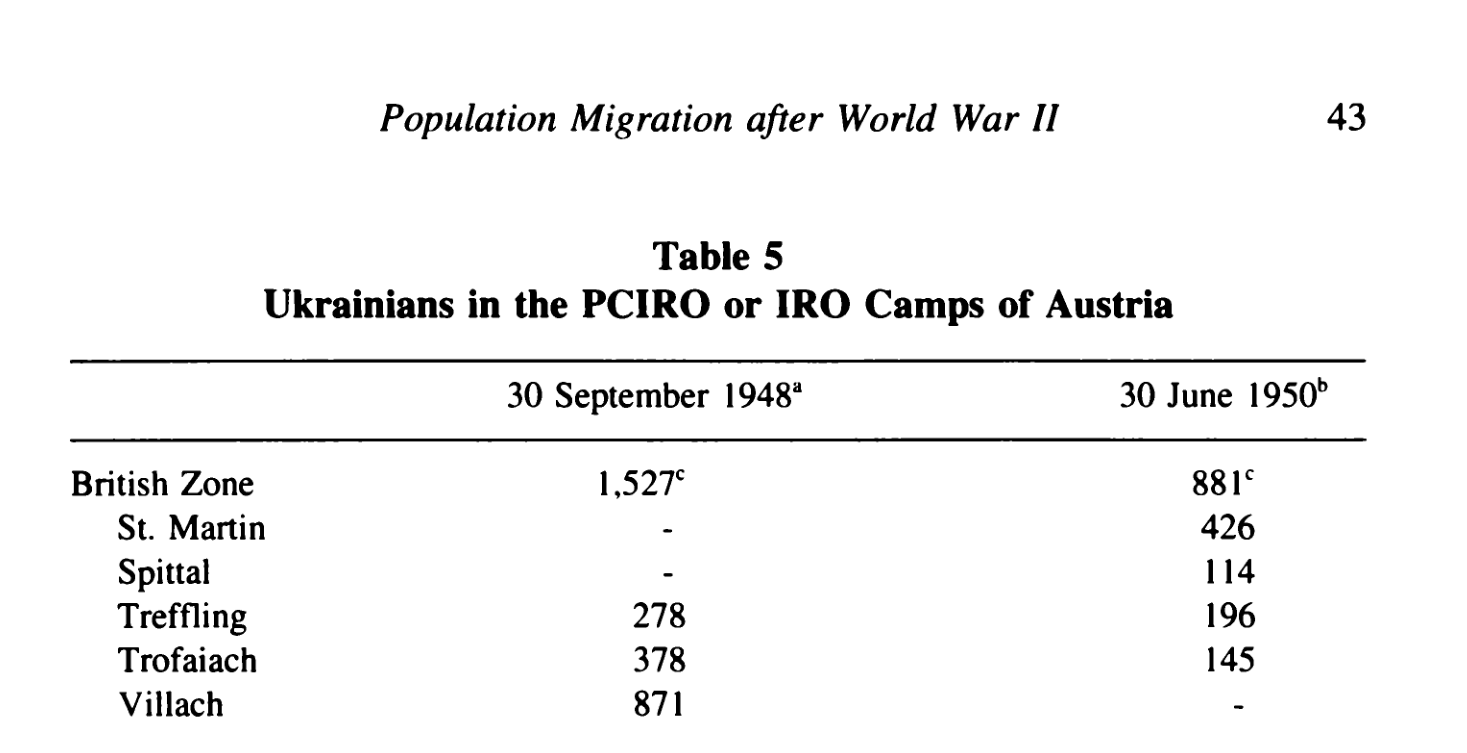
- 30 September 1948A return records 278 Ukrainians.
- 23 June 1950Austrian administration takes over.
- 30 June 1950A return records 196 Ukrainians.
- October 1952The camp is formally liquidated.
- 1983Twenty-six of the camp cemetery’s burials are reinterred at the Feffernitz refugee cemetery.
Who ran the camp
The British military administration ran Treffling and recruited its camp police from the residents themselves. George Bolton represented the British Red Cross at the camp and is remembered in the municipal history as the driving force behind its schooling and its theatre; he left Treffling in June 1947. UNRRA supplied the camp until 1947, after which the International Refugee Organisation took over supply and transport.
Rations were set above the level available to the surrounding Austrian population: about 2,000 kilocalories a day for displaced persons against about 1,500 for local civilians, with additional milk and chocolate rations for children. The British organised what the municipal account describes as a small municipality containing practically everything needed for daily life — piped water and electricity, a shop, washing barracks on concrete foundations, a large communal dining hall and a joinery workshop for repairs.
Sources for this section
The Ukrainian community in the returns
Residents were housed by nationality, with separate barracks for each group. Among them were Reich Germans from Silesia and East Prussia, ethnic Germans from the Batschka and the Banat, and Russians, Croats, Serbs and Hungarians. The population fell from about 4,800 in 1946 to roughly 4,000 in 1947 and about 1,000 by 1950.
Ukrainian residents are documented in the IRO camp statistics reproduced by Ihor Stebelsky: 278 on 30 September 1948 and 196 on 30 June 1950. These figures refer specifically to Ukrainians. The total camp population was much larger and included several eastern European and German-speaking groups.
The later figure is especially useful because it falls just after the transfer to Austrian administration. It establishes continuing Ukrainian residence during the camp’s contraction, rather than merely a brief passage through Treffling immediately after the war.
Total camp population
Ukrainians recorded at Treffling
| Date | Ukrainian residents |
|---|---|
| 30 September 1948 | 278 |
| 30 June 1950 | 196 |
Sources for this section
A school among the huts
Education became a major undertaking. The municipal history counts about 900 children in the camp, of whom 800 attended school in twenty classes spread across twelve barracks. Twenty-five teachers were needed, and they were recruited both from the surrounding district and from among the displaced people themselves. Furniture and supplies had to be assembled from what could be found.
The camp’s best-remembered production was A Midsummer Night’s Dream. Martha Molka directed and Herr Liere designed the staging; costumes were made from old clothing and the sets from scrap material. It was played nine times, in other camps as well as at Treffling, and at the Klagenfurt city theatre with the radio orchestra accompanying.
A separate recollection in the municipal archive of Gmünd in Kärnten records the daily journey of one of those teachers. Herbert Wagner, born in 1916, lost his teaching post after the war and worked as a carpenter’s assistant; for two years he taught in Treffling’s camp school, covering the distance from Gmünd on foot. He was taken back into the public school service in January 1948 and went on to direct the main school at Gmünd. Counting back two years from that date places his time at Treffling in 1946 and 1947, the camp’s fullest years. His experience places the camp school within the surrounding district’s disrupted professional life: its staff included people rebuilding their own livelihoods as well as children recovering an education.
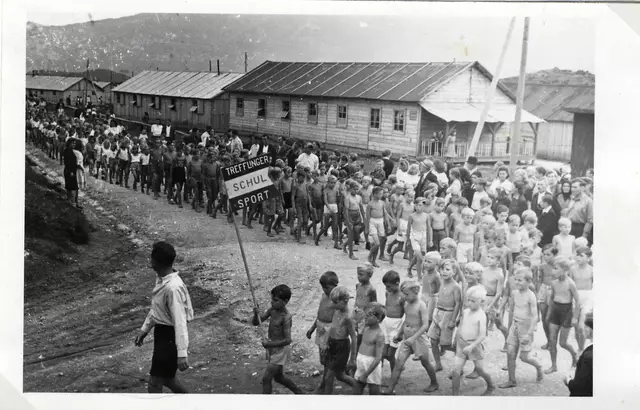
A photograph preserved by the Carinthian provincial archive shows children assembling for school sports beside the long wooden huts. The banner names Treffling. Published again in 2025, it gives a direct view of the camp’s educational life; it does not identify the children’s nationalities.
Education and camp life
| Evidence | Recorded detail |
|---|---|
| Municipal school account | About 900 children; 800 at school; 20 classes in 12 barracks; 25 teachers |
| Provincial archive photograph | School sports beside the huts |
| Municipal cultural account | A Midsummer Night’s Dream performed nine times, including at the Klagenfurt city theatre |
Life in a temporary village
Families divided shared rooms with blankets and later with fibreboard. Three churches served the camp — Catholic, Protestant and Orthodox — and a hospital with four or five doctors and nursing staff treated everything except infectious disease. Tuberculosis patients went instead to the separate sanatorium at Seebach, which operated from 1945 to 1951 and held up to 156 patients.
There was little paid work beyond maintaining the camp itself. Saturday evenings were spent in the dance barrack to accordion music; the Klagenfurt touring theatre came out to perform, films were shown, and on Wednesdays buses took residents to bathe in the lake, wearing paths that survived as local routes. A cultural festival in 1948 brought out the handicrafts, costumes and cooking of the different groups living in the camp.
Relations with the surrounding villages were on the whole workable. Some refugees found work with local farmers or offered trades and services; field guards from the camp and from the village patrolled the crops together. Marriages between refugees and local people took place, and a butcher and a dentist from the camp settled permanently in Spittal.
What the camp contained
| Provision | Recorded detail |
|---|---|
| Housing | About 200 barracks along both sides of Trefflinger Straße |
| Services | Piped water, electricity, washing barracks on concrete foundations |
| Food | Shop, large communal dining hall; about 2,000 kilocalories a day |
| Medical | Camp hospital with four or five doctors; tuberculosis cases sent to Seebach |
| Worship | Catholic, Protestant and Orthodox churches |
| Recreation | Dance barrack, film shows, visiting Klagenfurt theatre, Wednesday bathing buses |
Sources for this section
A route through the British camps in Carinthia
A first-person account published in 2017 follows a German-speaking family expelled from the Abstaller Feld, now in Slovenia, in January 1946. After a journey through Murakeresztúr on the Hungarian-Croatian border, Maribor and Jesenice, they were put over the frontier by rail to Rosenbach in Carinthia, where British soldiers took them by lorry to the British camp at Fürnitz near Villach. “Später kamen wir nach Treffing”, the account continues — later they came to Treffing, and were released from there to find private lodgings in Austria. The mother and daughter found accommodation with a farmer near Graz, while the son reached relatives farming near Mureck and went back to school there in May or June 1946 after an interruption of more than a year. The account spells the camp Treffing and says nothing further about it. The spelling is one letter from Treffling, the route runs between British-run Carinthian camps, and the dating falls inside Treffling’s fullest year; but the account itself supplies nothing that fixes it to this camp, and it records a German-speaking family’s passage rather than a Ukrainian one.
Sources for this section
Departure and dismantling
By 1948 repatriation had ceased to be a realistic prospect for most residents, and the British organised emigration instead — to Britain, Australia and North and South America. About 500 people left Treffling that way. Those with tuberculosis were refused visas and remained in Austria as welfare cases.
Austrian authorities completed the takeover on 23 June 1950. Residents who did not emigrate were moved to the camp at Spittal, where permanent housing was built on Fritjof-Nansen-Straße. Empty huts were handed to local families or moved elsewhere; three built on concrete foundations stood longer and made the ground harder to return to farming. The camp was formally liquidated in October 1952.
This history connects departure overseas with a second outcome: remaining in Austria and finding more permanent housing. The camp’s closure therefore marks the end of a particular settlement, not the end of displacement for everyone who had lived there.
Sources for this section
The camp cemetery
Thirty-one people of several denominations were buried at the camp between 1945 and 1947. In 1983 the graves were opened and twenty-six sets of remains were recovered and reburied at the refugee cemetery at Feffernitz.
That cemetery was laid out in 1945 for the Feffernitz and Kellerberg camps and closed in 1952. Its recorded burials are of 126 Danube Swabians, 26 Gottscheers, 25 Russians, 66 Ukrainians and 19 Hungarians; Orthodox graves are marked with stone crosses and the others with metal ones, and graves that could not be named carry the words “Unbekannter Flüchtling” — unknown refugee. It is the only refugee cemetery of its kind still standing in Austria, is cared for by the Austrian Black Cross, and was restored between 2013 and 2016 and blessed again on 4 November 2016.
Burials recorded at the Feffernitz refugee cemetery
| Group | Graves |
|---|---|
| Danube Swabians | 126 |
| Ukrainians | 66 |
| Gottscheers | 26 |
| Russians | 25 |
| Hungarians | 19 |
Sources for this section
Sources
- Das Trefflinger DP Lager
Christine Niedermayer, Marktgemeinde Seeboden · Municipal history, digitised 2012
Five-page municipal study drawing on provincial and diocesan archives, Stieber and oral histories. All five pages read in the digitised text.
- Ukrainians in the Displaced Persons Camps of Austria and West Germany
Ihor Stebelsky, The Refugee Experience · 1992
Table 5, printed page 43: 278 Ukrainians on 30 September 1948 and 196 on 30 June 1950.
- Gegen Ende des Krieges wurde es in Kärnten heftig
MeinBezirk; photograph from Landesarchiv Kärnten · 2025
Original photograph caption: school sports at Treffling near Seeboden, circa 1945–1950. Photograph visually inspected.
- Erinnerungen an Herbert Wagner
Anton Fritz, Stadtarchiv Gmünd in Kärnten · December 2009; online edition 2025
Full record read. Gmünd in Kärnten. Herbert Wagner, 1916–2009, teacher and later director of the town’s main school: after the war he worked as a carpenter’s assistant and taught for two years at the camp school in Treffling, walking there from Gmünd; “Im Jänner 1948 wurde er wieder in den Schuldienst aufgenommen.”
- Vertreibung aus dem Abstaller Feld
Neue Zeitung, issue 47/2017 · 2017
Page 4, first-person account of a German-speaking family’s expulsion from the Abstaller Feld and passage through Murakeresztúr, Maribor, Jesenice, Rosenbach and the British camp at Fürnitz. Read in the original PDF. Of the camp that follows it says only “Später kamen wir nach Treffing, von wo wir dann entlassen wurden und uns eine private Bleibe in Österreich suchen konnten.” The spelling “Treffing” is reproduced as printed and no identification with Treffling is asserted. No personal names reproduced.
- Treffling (Gemeinde Seeboden)
German Wikipedia · Accessed 13 September 2026
Village article read in full; camp dates, the 1946 peak of 4,800 and the inflated 1951 census figure taken from it. Its own cited authority for the camp is Niedermayer.
- Flüchtlingsfriedhof Feffernitz
Kleindenkmäler in Österreich · Accessed 13 September 2026
Full entry read: foundation 1945, closure 1952, burials by nationality, grave markings, care by the Österreichisches Schwarzes Kreuz and the 2013–2016 restoration.
Last researched 12 September 2026