Windlestone Hall
Arrival and settlement
Near Rushyford and Ferryhill, County Durham, England · Country house from the 1830s; prisoner-of-war camp 1945; postwar hostel documented 1948; residential school from the 1950s
Windlestone Hall, an Eden family mansion near Rushyford, held German prisoners of war and then became a hostel where Ukrainian, Latvian and Lithuanian European Voluntary Workers lived while working on the land. Family photographs, a Lithuanian newspaper and a Ukrainian hostel directory record the people who passed through it before County Durham turned the hall into a residential school.
Introduction
Windlestone Hall became a postwar hostel for European Voluntary Workers after serving as a prisoner-of-war site. Its Ukrainian connection is recorded in a directory of YMCA hostels, while Latvian family photographs and a Lithuanian newspaper reveal a wider community living in the grounds of a grand country house.
The directory entry names Windlestone as a YMCA hostel. The YMCA was one of the bodies that ran hostels for European Voluntary Workers in Britain, alongside the National Service Hostels Corporation, the Ministry of Agriculture, the National Coal Board, local authorities and private firms. No administrative file for the Windlestone hostel has been traced in the national catalogue, so the hostel is known mainly through the people who lived in it.
A history in dates
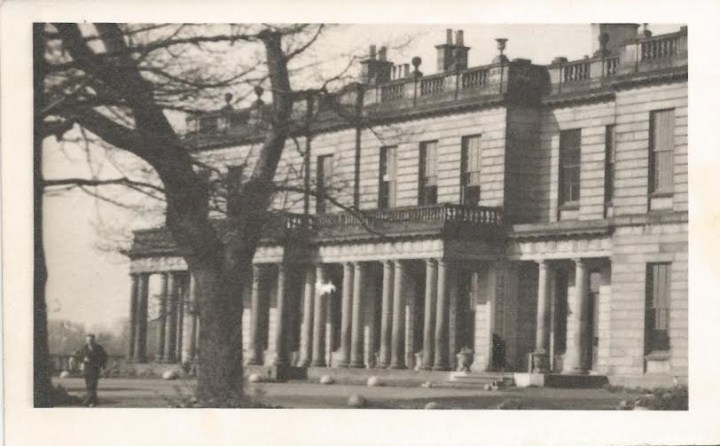
- About 1835The Eden family rebuild the hall, giving it the colonnaded east front seen in the residents’ photographs.
- 1920Windlestone Hall becomes the headquarters of the Wayfarers Benevolent Association, according to the parish council.
- 1945A local priest reports 210 German prisoners at Windlestone and difficulty arranging Sunday Mass.
- Postwar yearsEuropean Voluntary Workers live at the former camp; family photographs record Latvian residents and farm workers.
- 9 December 1948A Lithuanian newspaper records a Windlestone Hall branch donation to the National Fund.
- 1950–1955Date span of the Ministry of Education file on a proposed special school for delicate children at the hall.
- 1954Durham County Council purchases the hall, as recorded by the DiCamillo Companion.
- 1958–1984The hall runs as a residential school for 130 children with chronic health conditions, mainly asthma.
- 1984–1998The school takes children with behavioural problems.
- 2006The county council residential school closes, as recorded in the listed building entry.
- 2011The county council sells the hall for £240,000, as recorded by the DiCamillo Companion.
Sources for this section
- Windlestone Hall, Windlestone: listed building entry 1160327
- Windlestone Parish Council
- The spiritual welfare of German Catholic prisoners of war in the North East, 1940–1948
- Early accommodation: family photographs of Windlestone Hall
- Windlestone Hall branch donation
- Discovery catalogue entries for Windlestone Hall
- Windlestone Hall
- Windlestone’s war years (Echo Memories)
A country house adapted for new lives
The hall stands in a rural estate near Rushyford, with gardens, terraces, woodland and parkland. The Eden family developed the property over several centuries; the nineteenth-century house incorporated earlier buildings. Its setting explains the striking backdrop in the residents’ photographs: a colonnaded mansion rather than rows of purpose-built migrant housing.
The listed building record describes the house the residents photographed: a rebuilding of about 1835 attributed to Ignatius Bonomi for Sir Robert Johnson Eden, in ashlar sandstone, its long east front carrying a balustraded Doric colonnade across the first seven bays. That colonnade is the backdrop in the family photographs. Windlestone and neighbouring Rushyford lie on the old Great North Road, at the former crossing of the London to Edinburgh route, and the Eden family had held the estate since the Elizabethan period.
The parish council records a use between the Eden family’s ownership and the wartime camp: in 1920 Windlestone Hall became the headquarters of the Wayfarers Benevolent Association. Its account lists the later uses of the hall as a prisoner-of-war camp, a refugee centre and a residential school used by Durham County Council, and gives no dates for any of them.
The prisoner-of-war years
Before the civilian hostel, Windlestone held German prisoners of war. A 1945 letter from Father William Malone, a priest in Ferryhill, reported 210 German prisoners there. Camp officials would allow Sunday Mass in the recreation hall but would not let the men leave to attend church.
Malone already had two Sunday services to conduct and could not provide another at the camp. His letter, preserved in the diocesan correspondence and later transcribed by historian Aidan Harrison, records a practical obstacle to worship during captivity. This prisoner population belongs to an earlier phase, before the European Voluntary Workers photographed after the war.
How long the camp ran, and under what number, is not settled. Emily Gilbert, writing about Baltic workers, states that a published list of British prisoner-of-war camps enters Windlestone Hall as Camp No 4 and that the site later housed Latvian workers. That number could not be confirmed from an institutional record. The North East War Memorials Project lists a Windlestone Hall Camp at Rushyford among County Durham camps without giving a number, dates or occupants, and a catalogue search of the Foreign Office prisoner-of-war camp files produced no Windlestone entry.
Work and time together
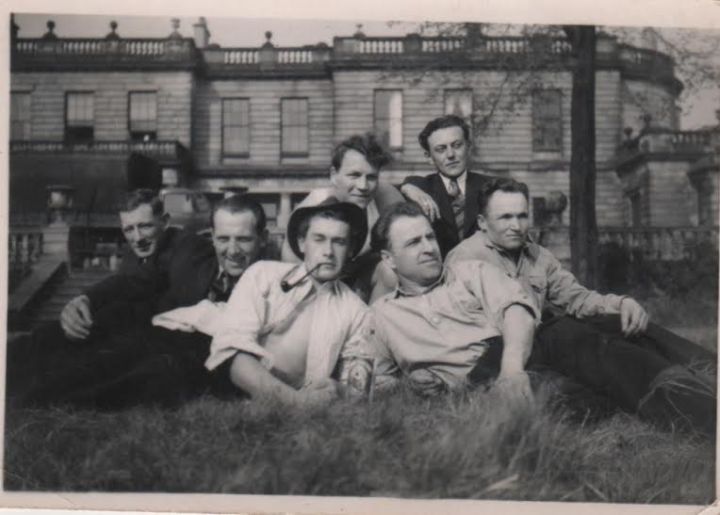
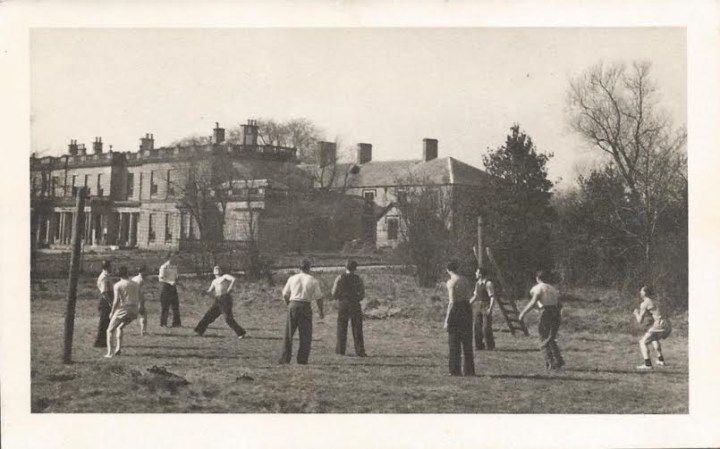
Photographs supplied to historian Emily Gilbert by Pauline Szelewski and Sarah Dauksta show the civilian hostel at a more personal scale. Their fathers lived at Windlestone. One photograph shows farm workers resting outside the hall; another records Latvian residents playing a ball game in its grounds.
Gilbert places Windlestone among the countryside hostels that housed agricultural and forestry workers, and notes that the authorities tried to move women into private billets first, so it was often men who stayed longest in the larger camps. Some hostels held a single nationality; many held a mixture. The evidence from Windlestone points to a mixed house, with the Ukrainian directory entry, the Latvian photographs and the Lithuanian branch notice all attaching to the same address.
The images preserve the spaces between working hours: sitting together on the grass, posing for a photograph and joining a game. They identify Latvian residents and farm workers, rather than providing portraits of a specifically Ukrainian group.
A community supporting causes abroad
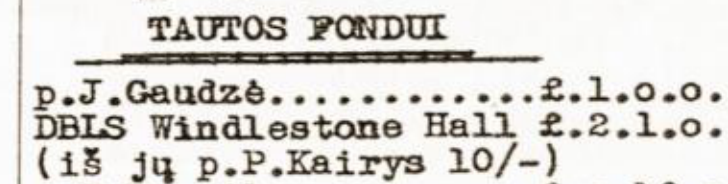
On 9 December 1948, Britanijos Lietuvis recorded a contribution of £2, 1 shilling and no pence from the Windlestone Hall branch of the Lithuanian association to the National Fund. Ten shillings of that total came from P. Kairys.
The modest entry places Windlestone within organised Lithuanian community life in Britain. Residents were not only finding employment and accommodation: they were also contributing to collective causes and remaining connected through their own press.
The December 1948 contribution
| Contributor | Amount as printed | Relationship |
|---|---|---|
| Windlestone Hall Lithuanian branch | £2.1.0 | Total contribution |
| P. Kairys | 10/- | Included within the branch total |
Sources for this section
After the hostel
Plans to convert the hall followed quickly. A Ministry of Education special schools file covering 1950 to 1955 is titled Windlestone Hall proposed Special School for Delicate Children, which places the change of use in the years immediately after the hostel. Historic England’s account records the hall and a smaller area of land passing to Durham County Council, while much of the wider estate continued in separate uses.
The school that opened took children with chronic illness rather than displaced adults. The Northern Echo records a residential school for 130 children with chronic health conditions, predominantly asthma, from 1958 to 1984, with doctors and nurses on the premises; a former pupil, Malcolm Miles of South Shields, arrived in 1969 at the age of nine and stayed until he was sixteen. From 1984 to 1998 the hall took children with behavioural problems. Durham County Council’s residential school closed in 2006, and the empty hall was later sold.
Admission registers and log books for the school, covering 1958 to 1983, survive at the county record office in Durham. Nothing comparable has been traced for the hostel years, which is why the residents of that phase are still known largely through photographs kept in their own families.
The DiCamillo Companion dates the county council’s purchase of the house to 1954, and its sale, after the school closed, to 2011 for £240,000. The span it gives for Windlestone Hall School, 1957 to 2006, begins a year earlier than the Northern Echo’s, and the admission registers at the county record office begin in 1958.
Recorded uses of the hall
| Phase | Dated by | Source scope |
|---|---|---|
| Eden family country house, rebuilt about 1835 | Listed building entry 1160327 | Architectural designation |
| German prisoners of war, 210 reported | Father William Malone’s 1945 letter | One priest’s report, one date |
| Hostel for European Voluntary Workers | Ukrainian hostel directory; Lithuanian branch notice of 9 December 1948; undated family photographs | No administrative file traced |
| Proposed special school for delicate children | Ministry of Education file ED 32/1429, 1950–1955 | Catalogue entry only, file unread |
| Residential school, 130 children with chronic illness | The Northern Echo, 1958 to 1984 | Newspaper nostalgia column |
| Residential school for children with behavioural problems | The Northern Echo, 1984 to 1998 | Newspaper nostalgia column |
| County council residential school closed | Listed building entry, 2006 | Architectural designation |
Sources
- Ukrainians in Scotland: camp and hostel directory
Peter Kormylo / University of Glasgow · 2021
Printed page 323, entry 36: YMCA Hostel, Windlestone, Ferryhill.
- Early accommodation: family photographs of Windlestone Hall
Emily Gilbert / Changing Identities · 9 October 2017
First publication of family-supplied camp photographs in this article; names donors Pauline Szelewski and Sarah Dauksta and identifies their fathers as residents.
- The spiritual welfare of German Catholic prisoners of war in the North East, 1940–1948
Aidan Harrison, Northern Catholic History 37 · 1996
Printed pp. 59 and 64: 1945 diocesan correspondence, including Father William Malone’s Windlestone report. Read as a published transcription of the original letter.
- Windlestone Hall branch donation
Britanijos Lietuvis / Spauda archive · 9 December 1948
Original PDF page 5, Tautos Fondui entry. £2.1.0 including P. Kairys 10/-. Lithuanian group distinguished from Ukrainian residents.
- Windlestone Hall: registered park and garden
Historic England · 1998; edited 2000
Official list entry 1001407: estate setting, historic development and 1950s school conversion. Historical account, not a claim of present school use.
- Windlestone’s war years (Echo Memories)
Chris Lloyd, The Northern Echo · 2015
Read in full from the project source cache; the live page is behind a subscription wall. Dated by its own statement that Sir William Eden died exactly a century earlier. Nostalgia column: used only for the school phases and the pupil’s recollection, not for the hostel years.
- Windlestone Hall, Windlestone: listed building entry 1160327
Historic England, National Heritage List for England · Listed 9 January 1968; minor amendment 12 April 2023
Official list text read through the British Listed Buildings mirror because historicengland.org.uk refuses automated requests. Grade II*. Records the circa 1835 rebuilding, the Doric colonnade and the closure of the county council residential school in 2006. Says nothing about the hostel.
- Discovery catalogue entries for Windlestone Hall
The National Archives · ED 32/1429 covers 1950–1955; E/SW covers 1958–1983
Searched and read at catalogue level on 13 September 2026. ED 32/1429, Windlestone Hall proposed Special School for Delicate Children; E/SW, school admission register and log books at The Story, Durham. Searches for a Windlestone hostel or working camp returned nothing. The files themselves are unread.
- Post-war camps and hostels
Ukrainians in the United Kingdom online encyclopaedia · Read 13 September 2026
National framework only: names the YMCA among the bodies administering British hostels. The page does not mention Windlestone.
- Site details, PRN D6870, Rushyford
Keys to the Past, historic environment record for County Durham and Northumberland · Read 13 September 2026
Settlement and estate record: the old Great North Road crossing, Eden family ownership from the Elizabethan period, and the hall’s later uses. Does not date the camp or hostel phases.
- Windlestone Parish Council
Windlestone Parish Council · Accessed 14 September 2026
Homepage body text read: Eden family ownership from the time of Queen Elizabeth I; Windlestone Hall as the Wayfarers Benevolent Association headquarters from 1920; later use as a prisoner-of-war camp, a refugee centre and a residential school used by Durham County Council; the park laid out in the late eighteenth century. No dates are given for the uses after 1920.
- Windlestone Hall
The DiCamillo Companion · Accessed 14 September 2026
Section “House & Family History” read: the estate as a prisoner-of-war camp during the Second World War; Durham County Council’s purchase of the house in 1954; Windlestone Hall School, a special residential school, between 1957 and 2006; the sale of the house in 2011 for £240,000. The entry cites no primary documentation.
Last researched 13 September 2026