Zwartberg Camp
Displacement in Europe
Zwartberg, Genk · Belgium · 1942–1956
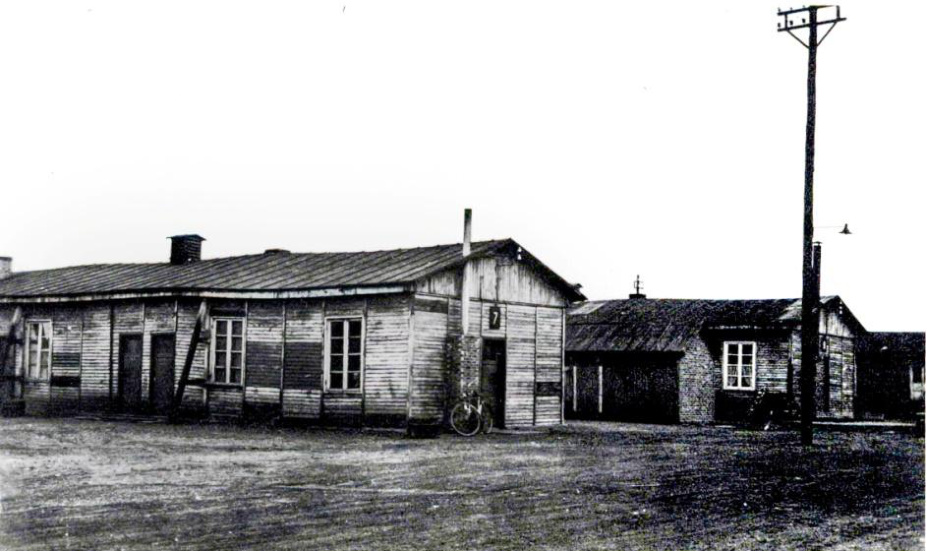
Nineteen wooden huts were put up on Lucien Londotstraat in June 1942 to hold Soviet prisoners for the John Cockerill colliery, and Ukrainian and Russian civilians were among the first people sent there. The camp passed through detention, military occupation and migrant lodging before it was cleared at the end of 1956.
Introduction
Zwartberg’s barracks camp stood on Lucien Londotstraat, east of Sint-Albertuskerk. It served the John Cockerill coal mine. Russian and Ukrainian prisoners were confined here for forced mine work, a history explicitly recognised by the local heritage authority’s account of the 2018 commemoration.
A history in dates
- June 1942Nineteen wooden huts are built on Lucien Londotstraat for 1,400 Soviet prisoners.
- 24 and 28 July 1942257 eastern workers reach Zwartberg and lodge on IJzerstraat; 197 are housed in the barracks camp behind the church.
- 3 September 1942The first Soviet prisoners of war reach Genk; the camps are run by the Wehrmacht as Stalag 304 and the Zwartberg civilians move to Waterschei.
- August 1944The recorded camp strength is 1,386.
- 14 September 1944After the liberation of Genk, arrested collaborators are held in the camp until December.
- End of January 1945American air force personnel occupy the camp and the nearby primary school.
- 1945–1947German prisoners are held under Belgian military supervision.
- 1947Vacated huts become lodging for contracted migrant workers.
- Late 1956The camp is cleared and demolished.
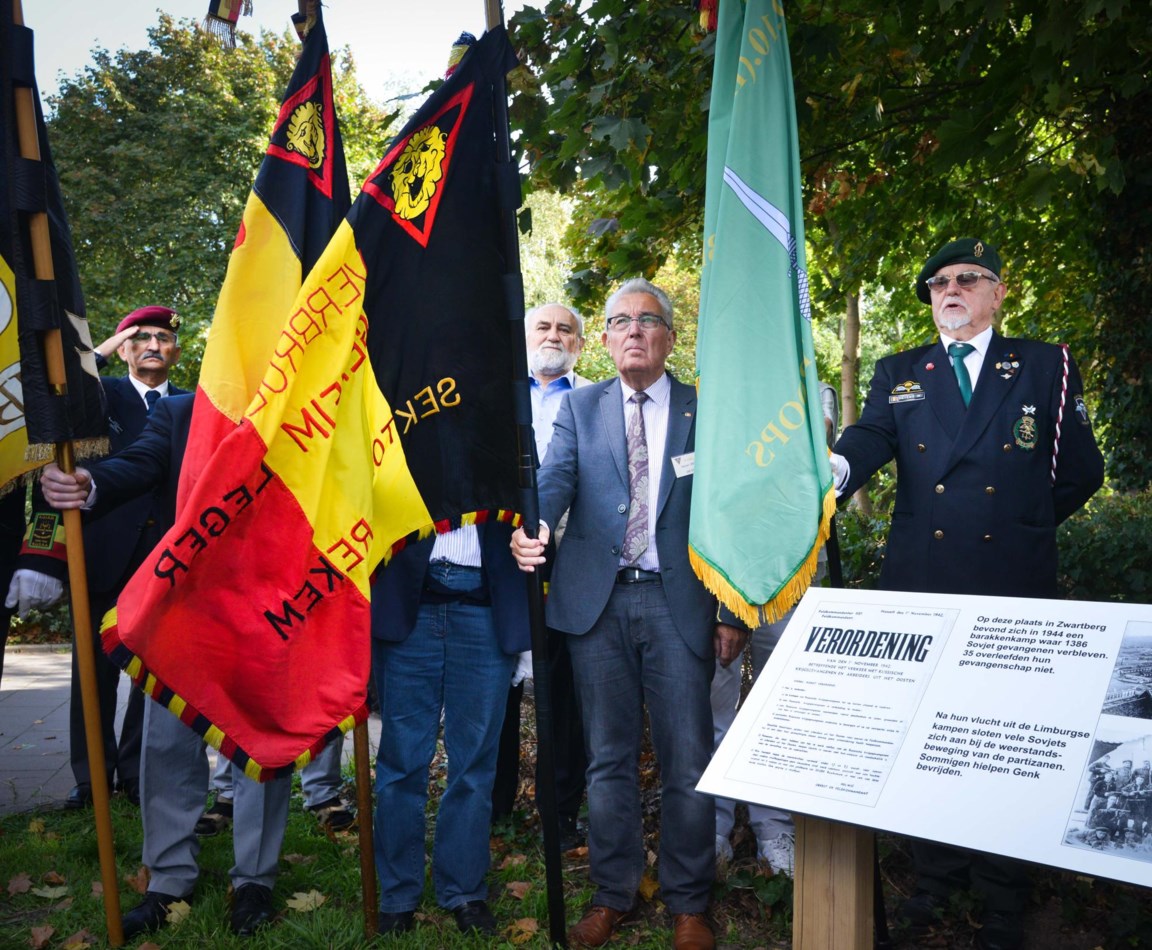
- 14 September 2018A memorial panel is unveiled at the former site.
Forced labour underground
The camp was built in June 1942 on the orders of the German Heeres Unterkunft Verwaltung 101: nineteen wooden huts, meant to hold 1,400 Soviet prisoners of war. The timber merchant De Coene of Kortrijk was requisitioned to supply the huts, which the occupier then made available to the Genk colliery managements free of charge; the collieries in turn supplied free coal for the sleeping quarters and the kitchen stoves.
The first civilian labour convoy to Limburg also included workers allocated to Zwartberg. Jean Put dates that convoy of 1,496 Ostarbeiter to 25 June 1942 and gives 257 of them to Zwartberg, while the local memorial study dates it to July 1942. Regional camp rules permitted music and radio but restricted contact with the Belgian population. Many deportees were young, ill or injured, and poorly suited to heavy mine work. The local memorial study records seven civilian forced workers dying of tuberculosis at Zwartberg between 1942 and 1944.
The 1942 arrivals did not all go straight behind wire. A local account records 257 workers reaching Zwartberg on 24 July 1942 and lodging in empty houses on IJzerstraat, with 197 housed in the barracks camp behind the church on 28 July. On 21 July a first convoy of people judged unfit had already been sent back towards Germany, 56 of them from Zwartberg. When the first Soviet prisoners of war reached Genk on 3 September 1942 the barracks camps were taken over by the Wehrmacht as Stalag 304, and the Ostarbeiter at Zwartberg were moved to the Waterschei camp so that the two groups were kept apart.
Jean Put’s tables give the recorded strength of the Zwartberg camp as 1,138 at the end of 1942, 1,373 at the end of 1943 and 1,386 in August 1944, in a provincial total that reached 6,852. From September 1942 these were prisoners of war rather than civilians.
Recorded camp strength
| Date | Zwartberg | All seven Limburg camps |
|---|---|---|
| 31 December 1942 | 1,138 | 5,301 |
| 31 December 1943 | 1,373 | 6,130 |
| August 1944 | 1,386 | 6,852 |
Deaths in the camp
The heritage account states that 1,400 Soviet citizens were held at Zwartberg and that 36 of them died in the camp between October 1942 and the end of February 1945. Jean Put’s list of deaths by camp gives 35 for Zwartberg. The two figures are close but not identical and neither is a Ukrainian subtotal. Seventy-three of the men who died in the Genk mining camps are buried in a plot of honour on the municipal cemetery, the youngest aged seventeen and the oldest fifty-one.
Sources for this section
Different populations, different regimes
After liberation the buildings were used successively for arrested collaborators, American military personnel and German prisoners of war. Belgian military supervision governed the German prisoner camp from 1945 to 1947. As prisoners left, huts became lodging for contracted workers, including Italians and men arriving from displaced-persons camps in Germany.
The heritage account is precise about the sequence. Collaborators arrested after the liberation of Genk on 14 September 1944 were held at Zwartberg and Waterschei until December 1944; at the end of January 1945 both camps and the primary school beside Sint-Albertuskerk were occupied by officers and men of the American air force. From May 1945 to 1947 Zwartberg was a German prisoner-of-war camp under the regional command of the Limburg prison camps, Bataljon Limburg 1, with new huts of the Belgian Adrian and Elite types built among the surviving German ones. The regime relaxed from October 1946, when German prisoners could be put to work in farming or in forestry cutting pit props, and the men were released in small numbers between 1 May and 1 November 1947. In 1947 the colliery appointed managers from its own staff to run the huts as lodgings for contract workers, chiefly Slavic men from the displaced-persons camps in liberated Germany and Italians.
The camp’s changing role
| Phase | Residents or use |
|---|---|
| June 1942 to September 1942 | Eastern civilian workers, partly lodged on IJzerstraat |
| September 1942 to September 1944 | Soviet prisoners of war, as Stalag 304 |
| September to December 1944 | Arrested collaborators |
| From end of January 1945 | American air force personnel |
| May 1945 to 1947 | German prisoners of war |
| From 1947 | Contracted migrant workers, including men from displaced-persons camps |
| Late 1956 | Cleared and demolished |
Sources for this section
Ukrainian life beyond the barracks
Postwar Ukrainian community organisation extended across the Genk mining districts. The Ukrainian Greek Catholic parish history identifies early communities in Zwartberg, Winterslag and Waterschei around 1949–1950. Clergy travelled between them, initially by bicycle, and services used local churches. This was a wider community network rather than an institution confined to the barracks.
The parish’s account describes families maintaining language and religious traditions through lessons, worship and cultural gatherings. It also records continued emigration overseas, which gradually reduced the number of Ukrainians in the district. The fuller 2016 version adds that Redemptorist fathers founded these first congregations, that mass was said in turn in the parish church at Zwartberg and in the churches at Waterschei and Zolder, and that the number of parish centres was eventually cut to three, of which Zwartberg was not one.
Sources for this section
Demolition and remembrance
The camp was cleared and demolished at the end of 1956.
On 14 September 2018 a commemorative panel was unveiled at the former site. A lecture and illustrated brochure accompanied the event. The heritage grant supported the panel and printing, making the wartime presence of Russian and Ukrainian prisoners part of the neighbourhood’s public history.
Sources
- QR: Barakkenkamp voor Sovjetrussen te Zwartberg
Alex Marut, Taskforce Liberty · 2 December 2018
Text behind the QR code on the commemorative panel: address, construction, contractor, successive uses, deaths in the camp and the 1956 demolition.
- Supported heritage projects: commemoration of the Russian camp
Erfgoedcel Mijn-Erfgoed · 2018 project record
The heritage cell explicitly identifies Russian and Ukrainian prisoners at Zwartberg.
- Herinnering / Pamyat’
Marc Bertrands / Comité II · 2018
Regional memorial study with a captioned photograph of Zwartberg camp, the July 1942 convoy and return figures, tuberculosis deaths and the roll of the 73 graves at Genk.
- History of Ukrainian parishes in Limburg
Ukrainian Greek Catholic Church, Genk · Accessed 2026
Community history identifies postwar Ukrainian organisation at Zwartberg; wider parish activities are not assigned to the barracks itself.
- Ostarbeiter en krijgsgevangenen
Jean Put · Undated
Table of camp strengths at 31 December 1942, 31 December 1943 and August 1944 for the seven Limburg camps.
- Begraven in vreemde bodem
Jean Put · Undated
Numbers of prisoners of war and Ostarbeiter who died, given per camp; Zwartberg 35.
- Ostarbeiter in de mijnstreek van Genk
Alex Marut and Roger Rutten / Comité II · 2020
Page 3 dates the Zwartberg arrivals of 24 and 28 July 1942, the IJzerstraat lodgings, the 3 September 1942 prisoner arrival and the Stalag 304 designation.
- Zorgwekkende fysieke conditie
Jean Put · Undated
Dates the first civilian convoy 25 June 1942 and gives 257 as the Zwartberg allocation; Pamyat dates the same convoy 2 July.
- Oekraïense parochies OGKK in Limburg 1947–2016
Dr J. Koziej, Heilige Sophia vzw, Waterschei-Genk · 29 November 2016
Fuller version of the parish history: founding clergy, the rotation of mass between Zwartberg, Waterschei and Zolder, and the later reduction to three centres.
- Herdenking ‘Russisch Kamp’ — supported heritage projects
Erfgoedcel Mijn-Erfgoed, Genk · Commemoration held 14 September 2018
Photograph published by the heritage cell beside its account of the grant to Comité II for a commemoration on the former site of the Russisch kamp van Zwartberg. Standard-bearers and organisers stand beside the interpretation panel, which reproduces the Feldkommandantur’s Verordening of 1 November 1942 on the left and carries on the right the text: ‘Op deze plaats in Zwartberg bevond zich in 1944 een barakkenkamp waar 1386 Sovjet gevangenen verbleven. 35 overleefden hun gevangenschap niet’, and below it ‘Na hun vlucht uit de Limburgse kampen sloten vele Sovjets zich aan bij de weerstandsbeweging van de partizanen. Sommigen hielpen Genk bevrijden.’ The heritage cell states no reuse licence.
Last researched 13 September 2026