Allington
Arrival and settlement
Allington, near Grantham · Lincolnshire · United Kingdom · 1942–1948
Allington Camp, numbered 51, was built for Italian prisoners in 1942 and became the headquarters of a German working-camp network in Lincolnshire, Rutland and Leicestershire. In July 1948 a Ukrainian return recorded 1,319 men in camps at or near Allington, and the site later disappeared under a caravan park and a residential estate.
Introduction
Allington was one of the Lincolnshire localities where Ukrainian former soldiers lived after their transfer from Italy to Britain in 1947. Their accommodation formed part of a British system of military camps and agricultural employment, followed by the transition towards civilian life.
The principal named site was Allington Camp, numbered 51, near Grantham. Its remains were later absorbed into a caravan park and a residential estate. Official heritage mapping places the camp at the site now known as Allington Gardens Park.
Sources for this section
A history in dates
- Late 1942The camp opens as a working camp for about 500 Italian prisoners, who built it.
- February 1943A Red Cross report gives about 750 Italian prisoners.
- April 1947An inspection counts 2,317 German and Austrian prisoners across the main camp, three hostels and billets.
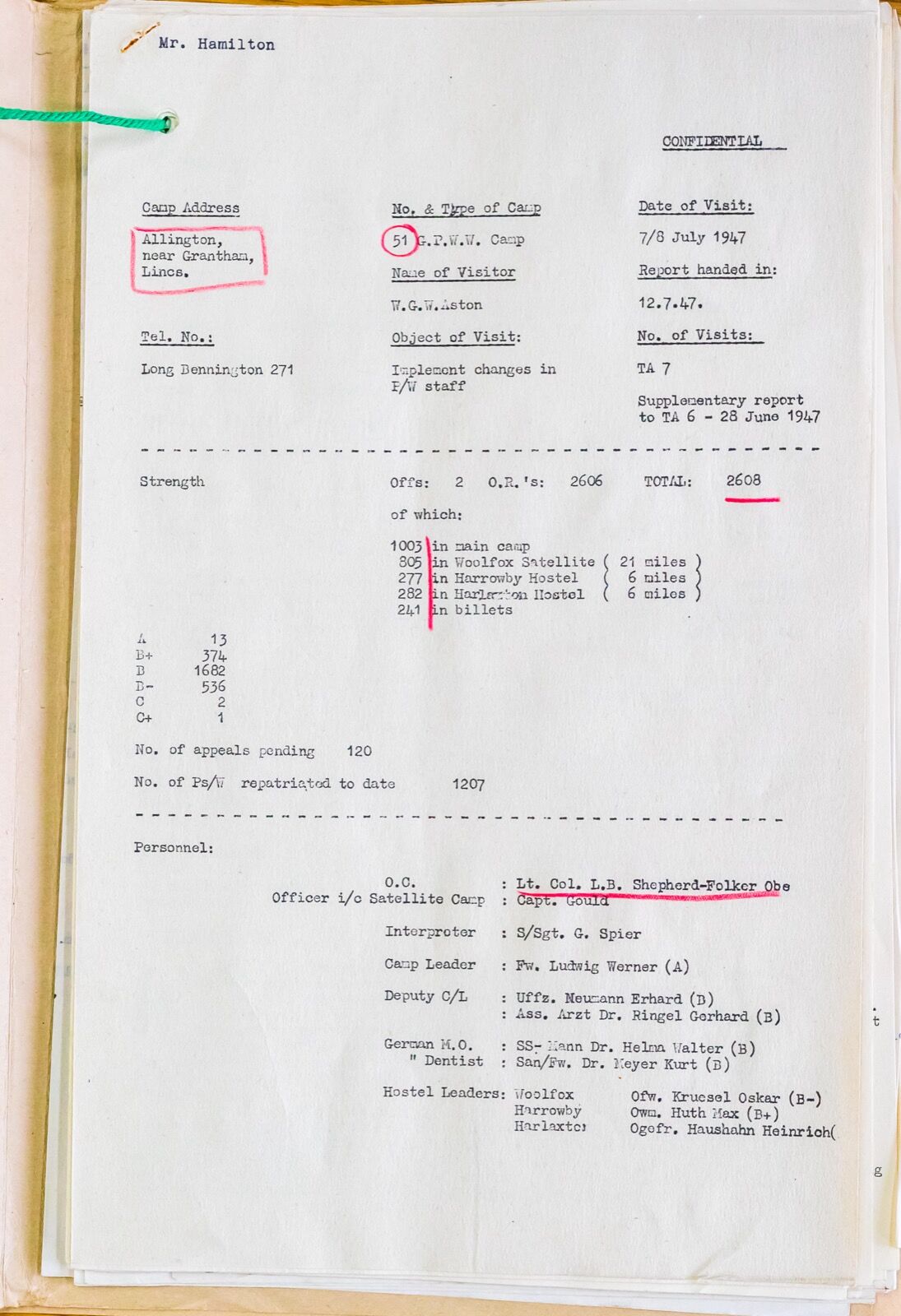
- July 1947The camp administers a network of hostels and billets totalling 2,606 men.
- October 1947The hostel network has changed to Saltby, Buckminster, Edmondthorpe and Redmile.
- December 1947Civilian households invite German prisoners for Christmas.
- 31 March to 2 April 1948An inspection records 1,120 German and Austrian prisoners and four hostels.
- July 1948A return records 1,319 Ukrainian men at or near Allington.
- August to October 1948The Ukrainians are released from prisoner-of-war status into the European Voluntary Workers scheme and the camps become hostels.
- 2020Field research records residential reuse of the former site.
A working camp and its network
The land belonged to Pelham Welby before it was requisitioned. Italian prisoners built the camp in 1942, and the village history records it opening late that year as a working camp for about 500 Italians, with a Red Cross report of February 1943 giving roughly 750. The site subsequently became a German working camp, housing men employed outside the compound as well as supporting smaller accommodation centres. Four bungalows on Sedgebrook Road housed the drivers who carried men to work.
The Foreign Office file for the camp, FO 939/133, covers 1945 to 1948 and records a network whose shape kept changing. In April 1947 an inspector counted 2,317 men: 996 in the main camp, 615 at Woolfox, 275 at Harrowby, 219 at Harlaxton and 214 in billets. In July 1947 the total had risen to 2,606 with 1,003 at Allington itself. By October 1947 Woolfox had gone and Saltby, Buckminster, Edmondthorpe and Redmile appear instead, the last of these hostels lying across the county boundary in Leicestershire. These are figures from the German prisoner administration.
Learning, print and recreation
Education depended heavily on prisoners able to teach. Inspections in 1945 found that transfers had disrupted English lessons and discouraged learners. In April 1947 some 115 men were attending classes across the camp and its hostels under eight teachers, with about 160 more studying alone, and the inspector noted that no space was available for an information room, a mess hut serving as reading room and classroom. Later plans sought more library space and a quiet room adapted from a dining hut. By the spring of 1948 English teaching at the main camp had ceased.
The camp had a library of about 800 volumes and printed its own fortnightly paper, the Lagerpost, at Grantham Publications Ltd in runs of 2,500 so that every man could have a copy. A theatre group of fifteen staged five comedies and a classic, an orchestra of ten played light music and a choir of thirty-five sang folk and homeland songs. Football, boxing between hostels and table tennis were the main sports, and by October 1947 the camp football team was unbeaten against army and local sides. Men attended churches in the surrounding villages and the Methodist church in Grantham, and parties were taken to sittings of Grantham Town Council.
At Christmas 1947, more than a hundred civilian invitations reached Allington for German prisoners. Some came from local households and others from much farther afield. Men remaining in camp had a concert and additional food for the holiday. The report captures a period when contact outside military custody was becoming an important part of camp life.
Ukrainian arrivals and civilian settlement
The German phase was running down as the Ukrainians arrived. An inspection of 31 March to 2 April 1948 recorded 1,120 German and Austrian prisoners in the camp and four remaining hostels, of whom about 400 in the main camp were new arrivals not yet sorted out.
The July 1948 return records 1,319 Ukrainian men in camps at or near Allington. The geographical wording matters: this was a concentration around Allington, not a verified occupancy figure for the main Camp 51 compound. It belongs to the history of the former Galicia Division personnel brought from Italy, rather than to the earlier German prisoner return.
After the change to civilian status, which was carried out between August and October 1948, the camps were taken over by civilian authorities and redesignated as hostels. The wider pattern was continued communal accommodation while men worked and sought private lodgings. Leaving military custody and leaving a hostel were therefore separate steps in settlement.
Counts recorded at Allington and its network
| Date | Figure | Scope |
|---|---|---|
| April 1947 | 2,317 | German return: main camp, three hostels and billets |
| April 1947 | 996 | German return: main camp |
| July 1947 | 1,003 | German return: main camp |
| July 1947 | 2,606 | German return: administrative network |
| October 1947 | 2,317 | German return: main camp, satellite, four hostels and billets |
| 31 March to 2 April 1948 | 1,120 | German return: main camp, four hostels and billetees |
| July 1948 | 1,319 | Ukrainian men at or near Allington |
Sources for this section
A residential landscape
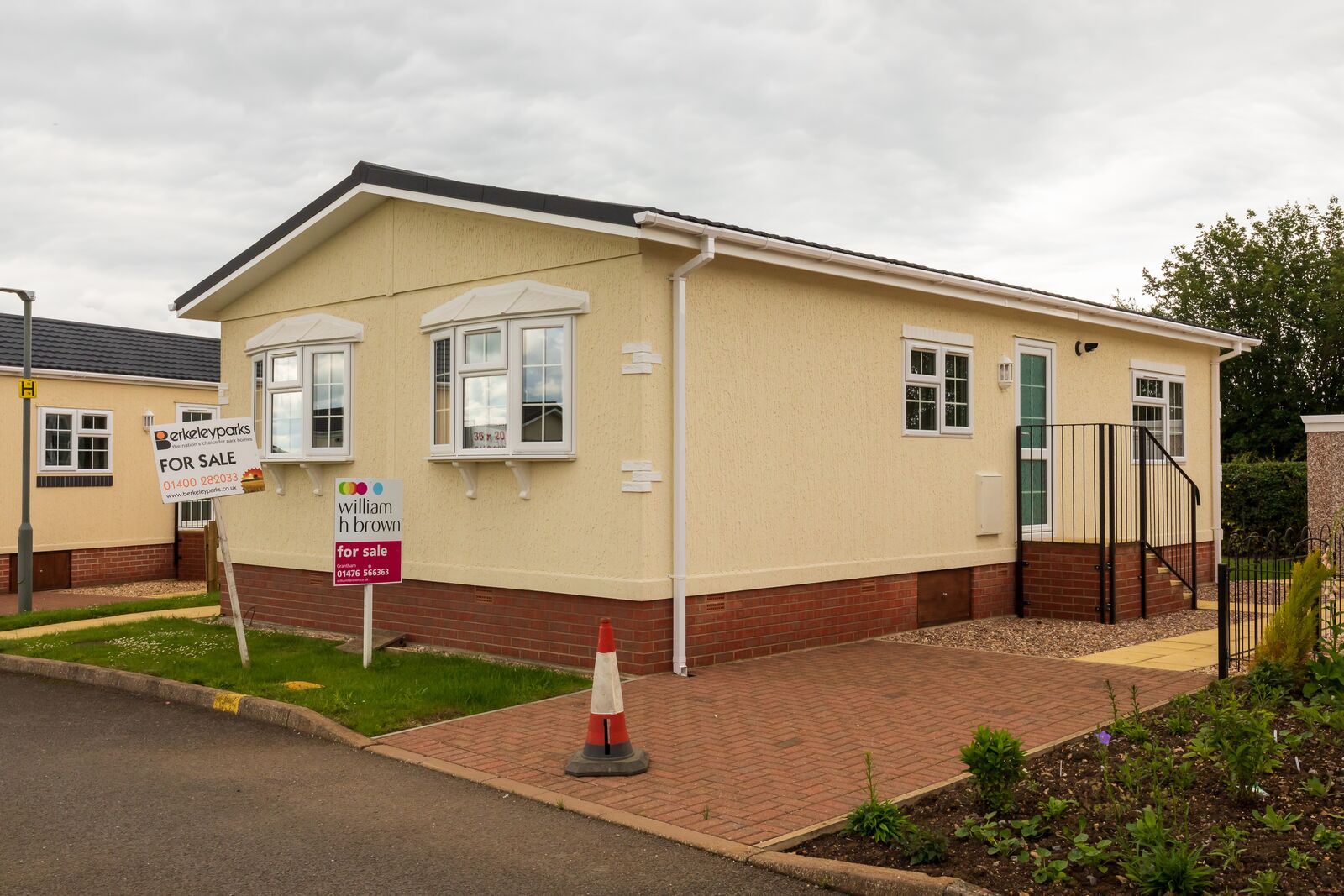
The village history describes the ground being divided after the camp closed: one part went to a pig farm, the rest to static caravans set on the old building bases, with a cattery and a social club following, and park homes eventually replacing the caravans inside the original camp boundary.
A field visit reported in 2020 found prefabricated homes on the former site. The site manager described an earlier division between pig farming and static caravans, followed by more extensive residential development. Older bases remained visible in places, although replacement foundations had also been laid for new homes. The surviving landscape records successive reuse rather than an intact wartime camp.
Sources for this section
Sources
- Post-war camps and hostels
Ukrainians in the United Kingdom Online Encyclopedia · 2013
Describes the transfer from Italy and reports men in camps at or near Allington in July 1948. The figure is a locality total.
- Allington Camp, MLI88524
Lincolnshire County Council · 2021
Identifies Camp 51, its mapped position, standard camp layout and later redevelopment.
- Allington inspection reports, FO 939/133
The National Archives; transcribed by Axis Prisoners of War in Lincolnshire · 1945–1947
Contemporary inspections describe education and the administrative network. German prisoner returns are distinct from later Ukrainian locality figures.
- Homes Opened to P.O.Ws: Hundred Invitations at Allington Camp
Grantham Journal, reproduced in a newspaper transcription collection · 24 December 1947
The report concerns German prisoners and Christmas invitations from civilian households. Grantham Journal, 24 December 1947, p. 1, as transcribed on the newspapers page: “Over 100 letters from civilians, inviting German prisoners of war to spend Christmas Day and Boxing Day at their homes, have been received by the commandant of Allington camp. Some were from Grantham, and others came from as far afield as Suffolk, Norfolk and London... A concert will be provided on the camp with the usual festivities, and a little extra will be provided for dinners.”
- PoW Camp 51 Allington
Repatriated Landscape · 2020
Original field observations, photographs and an interview with the site manager document Allington Gardens Park.
- Axis Prisoners of War in Lincolnshire: historical overview
Axis Prisoners of War in Lincolnshire · Undated
Research overview dates construction by Italian prisoners to 1942.
- The History of Allington Gardens
Allington village website · Accessed 13 September 2026
Requisition from Pelham Welby, opening in late 1942 for about 500 Italians, a Red Cross count of about 750 in February 1943, drivers’ bungalows on Sedgebrook Road, a fourteen-piece orchestra and the postwar division of the site. Its figure of 1,401 Ukrainians is not adopted here; see the note on the counts table.
- 51 Working Camp, Allington Camp, Grantham, Lincolnshire, FO 939/133
The National Archives, Kew · 1945–1948
Catalogue record for the Foreign Office file of inspection and re-education reports, covering dates 1945 to 1948.
- PoW Hostel 51 Edmondthorpe Hall
Repatriated Landscape · 2020 fieldwork
Identifies Edmondthorpe Hall, Leicestershire, as a hostel of Camp 51 documented in FO 939/133. The hall was later destroyed by fire.
- Camp 51 Allington: inspection report, 7–8 July 1947, FO 939/133
The National Archives, Kew; photographed and published by the Repatriated Landscape project (Banged Up Abroad) · 1947
Photograph of the first page of the visitor’s report on 51 German Prisoner of War Working Camp, Allington, near Grantham. Gives the camp address, the date of visit, a strength of 2,608 and the distribution between the main camp, Woolfox, Harrowby, Harlaxton and billets, with the camp staff and hostel leaders named. Crown copyright archival record; the publisher asserts no open licence.
Last researched 13 September 2026