Cunderdin Migrant Centre
Arrival and settlement
Cunderdin, Western Australia, Australia · 1949–1952
Western Australia’s only elementary flying training base, built in the wheatbelt in 1940, was used as a migrant centre for 700 people between 1949 and 1952. Ukrainians were among the displaced people sent there rather than to the Perth hostels.
Introduction
Cunderdin Migrant Centre operated from 1949 to 1952 in the former Royal Australian Air Force base north of town. It belonged to Australia’s arrival and settlement system: people had already migrated from Europe and were being accommodated before moving into employment and longer-term homes. The Ukrainian Association of Western Australia identifies Cunderdin among the camps where Ukrainian newcomers lived.
A history in dates
- About June 1940The site for No. 9 Elementary Flying Training School is selected at Cunderdin.
- October 1940Contracts are let for 47 permanent and 20 temporary buildings.
- Early 1941Flying training begins, although most buildings are unfinished.
- December 1944Flying training ceases; the air force has a surplus of pilots.
- February 1945No. 25 Squadron brings B-24 Liberators to Cunderdin.
- May 1947The care and maintenance unit ends; four civilian watchmen remain.
- 1949The former base becomes a migrant centre, and the airfield passes to the Department of Civil Aviation.
- June 1951A Ukrainian artist describes cramped painting conditions after transfer from Northam.
- 1952The migrant centre closes.
- 1957The Commonwealth begins disposing of former base assets, according to the Shire.
- About 1962The Commonwealth disposes of the main camp buildings to the east, where the agricultural school now stands.
- 1992The runways and tarmac are transferred to the Shire of Cunderdin.
An air-force base becomes accommodation
The base had been built during the Second World War for elementary pilot training under the Empire Air Training Scheme. Hangars and technical buildings occupied the airfield, while the main camp lay farther east. Later wartime operations included heavy bombers. After the war, the existing camp accommodation was adapted for migrants.
The heritage assessment is precise about how the place was made. The site for No. 9 Elementary Flying Training School was chosen about June 1940, and contracts for 47 permanent and 20 temporary buildings were let that October, most unfinished well into 1941 although flying training began early that year. It was the only elementary flying training facility established in Western Australia during the war. Training ceased in early December 1944 when the air force had a surplus of pilots, and in February 1945 No. 25 Squadron brought B-24 Liberators to Cunderdin for long-range work over the Indian Ocean.
The military occupation wound down in stages. No. 25 Squadron was disbanded about July 1946; a care and maintenance unit ran the base until May 1947, after which four civilian watchmen were employed. Apparently during 1949, the whole airfield passed from the Department of Defence to the Department of Civil Aviation. The migrant centre therefore took over buildings that had already been standing empty, or nearly so, for two years.
The heritage assessment gives the migrant centre a capacity of 700 people. This is an accommodation capacity, not a count of Ukrainians or a total of everyone who passed through. The assessment adds that research had not been carried out into what part the tarmac group of buildings played in the migrant centre, though there were some grounds to think they were used for social activities. The accommodation itself was in the main camp farther east, where the agricultural college now stands.
Three uses of the former base
| Period | Use | Scope |
|---|---|---|
| About June 1940 to December 1944 | No. 9 Elementary Flying Training School; 47 permanent and 20 temporary buildings contracted in October 1940 | Airfield and main camp east of it |
| February 1945 to about July 1946 | No. 25 Squadron, B-24 Liberators | Airfield |
| May 1947 to 1949 | Four civilian watchmen; airfield passes to the Department of Civil Aviation | Whole site |
| 1949–1952 | Migrant reception and accommodation | Capacity 700 people; accommodation in the main camp to the east |
| From about 1956 | Glider owners lease tarmac buildings; the Gliding Club of Western Australia arrives about September 1958 | Tarmac group |
| About 1962 | Commonwealth disposal of the main camp buildings | The area where the agricultural school now stands |
| 1992 and 1996 | Runways and tarmac transferred to the Shire; the Bellman hangar sold to the Shire | Airfield |
Sources for this section
Who was sent to Cunderdin
Placement was deliberate rather than accidental. The Northam Army Camp Heritage Association records that British migrants generally went to the centres in the Perth metropolitan area while displaced people and other European assisted migrants were sent to Northam and Cunderdin. Over 12,000 migrants reached Western Australia in 1950 alone, from Poland, Yugoslavia, Latvia, Estonia, Lithuania, Hungary, Ukraine and elsewhere; those figures are for the state, not for Cunderdin.
The Ukrainian Association of Western Australia records the community’s own beginning slightly earlier, with 60 men arriving at Fremantle on the Kanimbla on 11 October 1948 and going to the Kalgoorlie gold mines, the railway lines and the Mundaring Weir works. It names Graylands, Northam and Cunderdin as the hostels and camps where Ukrainians were settled, without giving dates or numbers for any of them.
A history of Dutch migration to Western Australia records that in 1949 the military camps used as initial receiving and training centres for migrants were in the Perth suburbs of Graylands, Swanbourne, Belmont (Dunreath) and Point Walter, and in the Wheatbelt towns of Cunderdin, 157 kilometres from Perth, and Northam, about 98 kilometres from Perth. The joint local planning strategy for the Shires of Cunderdin, Quairading and Tammin describes the former flying school facilities as used for a short time after the war as a staging point for displaced persons eventually sent on to Northam and other areas. Neither account gives dates or numbers for Cunderdin itself.
Learning and working towards a new life
English teaching formed part of life at Cunderdin. A teacher’s papers preserved by the State Library document her work across Northam, Cunderdin and Holden and identify correspondence about migrant education from 1950–51. The teaching network linked these temporary settlements even as their residents moved between them.
The confined accommodation could make it difficult to pursue an established profession. Recent art-historical research follows a Ukrainian painter transferred from Northam to Cunderdin while preparing for a Perth exhibition in 1951. A letter written on her behalf that June described inadequate light and cramped space for painting. The episode shows professional ambitions continuing inside a camp organised around temporary housing and employment placement.
Moves between Australian camps
Cunderdin could be one stage in a longer journey within Australia. A family recollection preserved by the Benalla Migrant Camp project records residence at Northam and then Cunderdin before a move to Benalla in Victoria after two years in Western Australia. Arrival in one state did not necessarily settle where a family would eventually live.
Sources for this section
After the migrant centre
The migrant centre closed in 1952 and the site was divided between new uses. The heritage assessment dates the Commonwealth disposal of wartime buildings to about 1962 and states that those sold were principally the main camp buildings to the east, where the agricultural school now stands; the Shire’s own history places the start of Commonwealth disposals earlier, in 1957. Either way, the accommodation that housed migrants is the part of the base that was sold off and has gone.
Aviation continued on the western part of the site. Glider owners leased tarmac buildings from about 1956 and the Gliding Club of Western Australia moved to Cunderdin about September 1958. The runways and tarmac passed to the Shire of Cunderdin in 1992 and the surviving Bellman hangar was sold to the Shire in 1996. The eastern residential camp and the surviving airfield structures therefore represent related but different parts of the site’s history, and the buildings that survive are flying buildings rather than living quarters.
Sources for this section
Sources
- Register of Heritage Places, Assessment Documentation: Cunderdin Airfield
Heritage Council of Western Australia · 20 September 2002
Full seven-page assessment downloaded and read 13 September 2026. Documentary evidence compiled from the National Trust of Australia (WA) assessment form by the historian Lindsay Peet. Gives the wartime construction and operations, the migrant centre at 1949–52 with a capacity of 700, the note that the tarmac buildings’ migrant-era function had not been researched, and the disposal chronology. Capacity is not a population, and the assessed tarmac group is not the accommodation area.
- Cunderdin Airfield
Shire of Cunderdin · Undated
Official site history distinguishes eastern camp area from airfield movement/hangar areas.
- Ukrainian community history
Ukrainian Association of Western Australia · Undated
Names Cunderdin among Ukrainian arrival camps.
- Citizenship, Art and Aspiration: New Australian Artists in the Post-War Period
Melissa Miles / Monash University · Accepted manuscript
Original scholarly chapter, Cunderdin passage and footnote 88; cites 7 June 1951 letter and recent family interviews.
- Peggy de Jong papers, MN 3395
State Library of Western Australia · 2020
Finding aid confirms English teaching at Cunderdin; underlying correspondence not read.
- Migrant family recollections
Benalla Migrant Camp · Undated
Family account records Northam and Cunderdin residence before Benalla transfer.
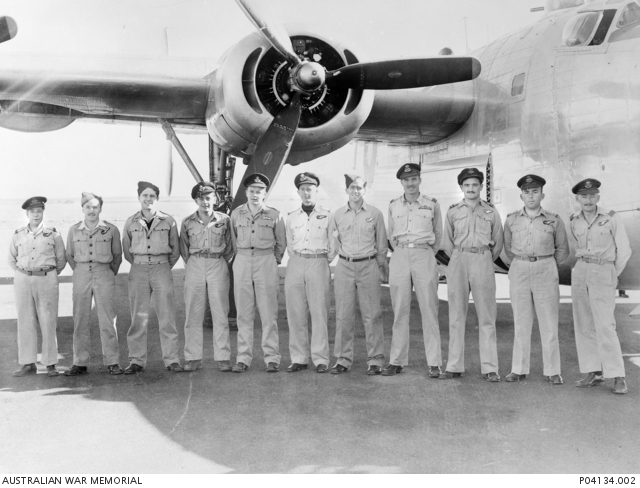
- RAAF aircrew at Cunderdin, P 04134.002
Australian War Memorial · c.1945
Wartime airfield photograph, public domain; not a migrant-camp image.
- Storylines: Migrant
Northam Army Camp Heritage Association · Undated
Read 13 September 2026. Gives the placement policy that sent displaced people and European assisted migrants to Northam and Cunderdin rather than to the Perth centres, and 1950 arrival figures for Western Australia as a whole. The nationality breakdown is a state figure and is not a Cunderdin figure.
- Novel maternity service at migrant centre
The West Australian (Perth), page 7 · 14 August 1950
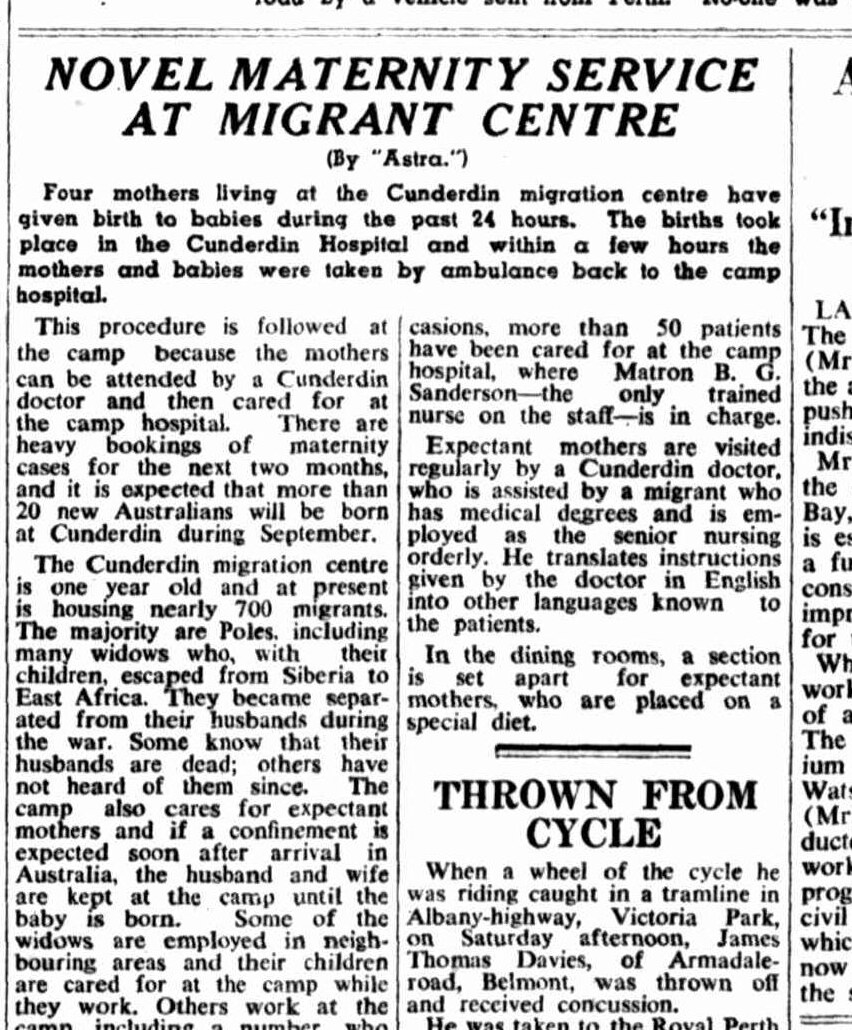
Report on the maternity arrangements at the Cunderdin migration centre: mothers were confined at Cunderdin Hospital and returned by ambulance to the camp hospital within hours, more than twenty births were expected in September, and the camp hospital had cared for more than fifty patients under Matron B. G. Sanderson, its only trained nurse, assisted by a migrant with medical degrees employed as senior nursing orderly who translated the doctor’s instructions. The report gives the centre as one year old and housing nearly 700 migrants, a majority of them Poles, including widows who had escaped with their children from Siberia to East Africa. Digitised by the National Library of Australia; Australian material published before 1955 is out of copyright.
- Shires of Cunderdin, Quairading and Tammin Joint Local Planning Strategy
Department of Planning, Lands and Heritage, Western Australia; endorsed by the Western Australian Planning Commission · Endorsed 10 May 2022
Page 41, Part 2, section 2.2 Shire of Cunderdin, read: the airstrip built early in the Second World War as a bomber and RAAF flying school base, and the school facilities used for a short time after the war as a staging point for displaced persons sent on to Northam and other areas. The same passage dates a new Junior High School to 1948, which has not been reconciled with the heritage assessment’s chronology.
- A Touch of Dutch, chapter twenty-three: Making a Dutch Home in Western Australia from the 1950s
Nonja Peters, Dutch Australian Cultural Centre · c. 2016
Printed page 253 read: the Western Australian military camps used in 1949 as initial receiving and training centres for migrants, named as Graylands, Swanbourne, Belmont (Dunreath) and Point Walter in Perth and the Wheatbelt towns of Cunderdin and Northam, with their distances from Perth. The chapter is about Dutch migration and gives no nationality breakdown for Cunderdin.
Last researched 13 September 2026