Kanimbla
IRO fleet·Displaced-person passages: 1947–1948
Kanimbla was an Australian coastal liner requisitioned in 1939, converted to an armed merchant cruiser and then to a landing ship infantry, and still in naval commission when she carried displaced persons in 1947 and 1948. She took the first Baltic arrivals from Fremantle to Port Melbourne in December 1947 and landed at Fremantle on 11 October 1948 the group the Ukrainian Association of Western Australia counts as the beginning of its community.
Introduction
Kanimbla was not a chartered emigrant ship. She was a warship in Australian naval commission, a converted coastal liner used as a landing ship infantry through the Pacific campaign, and she carried displaced persons because she was available and because the Australian government needed hulls at the moment the resettlement programme began. Her displaced-person work therefore falls into two short episodes at the very start of the programme, before the Sitmar and Norwegian charters had taken over the run.23
For Ukrainians in Western Australia she is the founding ship. The Ukrainian Association of Western Australia dates the beginning of its community to sixty men who came ashore at Fremantle from the Kanimbla on 11 October 1948.4
A history in dates
- 15 December 1935Launched by Harland and Wolff, Belfast, for McIlwraith, McEacharn and Company; completed 1936.2
- 12 June 1936Arrives at Melbourne and begins the Cairns to Fremantle passenger service.2
- 6 September 1939Commissioned into the Royal Navy as HMS Kanimbla after conversion to an armed merchant cruiser.2
- 1943Converted to a landing ship infantry and transferred to the Royal Australian Navy.2
- 7 December 1947Lands at Port Melbourne the first party of displaced persons, brought from Fremantle after their arrival there on 28 November aboard the General Stuart Heintzelman.5
- 1948
- 11 October 1948
- 12 October 1948429 people are recorded as landed in Western Australia from the arrival.1
- 25 March 1949Pays off at Sydney, ending her displaced-person work.2
- 13 December 1950Returned to her owners after reconversion by Cockatoo Docks and Engineering.2
- 1961Sold to the Pacific Transport Company and renamed Oriental Queen; scrapped in 1973.2
A coastal liner in naval service
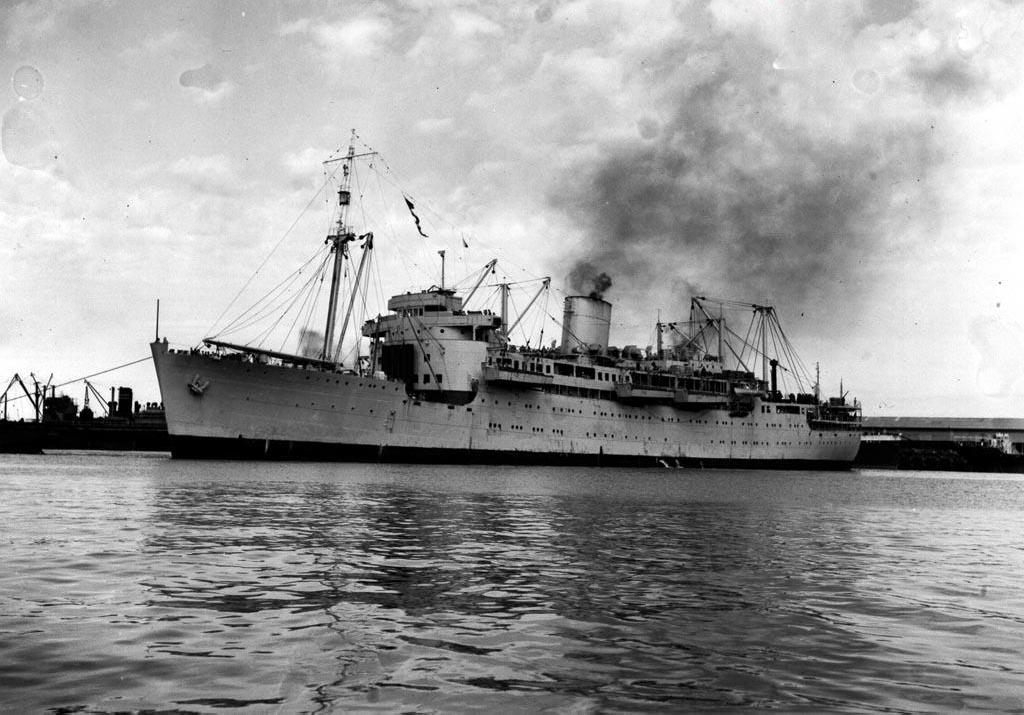
The ship was built by Harland and Wolff at Belfast for McIlwraith, McEacharn and Company, launched on 15 December 1935 and completed the following year. She reached Melbourne in June 1936 and ran a passenger service between Cairns and Fremantle with berths for 203 first-class and 198 cabin-class passengers. She registered 10,985 tons, measured 468.8 feet with a beam of 66.3 feet, and made nineteen knots on diesels of 10,000 horsepower.2
She was requisitioned on 5 September 1939, converted at Garden Island in Sydney and commissioned into the Royal Navy the next day as HMS Kanimbla, with a largely Australian crew. She patrolled Asian waters, boarded ships of occupied Europe, and led the amphibious force that captured Bandar Shahpur in August 1941. In 1943 she became a landing ship infantry and transferred to the Royal Australian Navy, serving through the South West Pacific until the war ended. As a transport she could carry 1,380 military personnel, and it was that capacity, not her prewar passenger accommodation, that made her useful in 1947.2
The ship
| Measure | Detail |
|---|---|
| Builder | Harland and Wolff, Belfast |
| Launched | 15 December 1935; completed 1936 |
| Owner | McIlwraith, McEacharn and Company |
| Tonnage | 10,985 tons |
| Dimensions | 468.8 feet in length, 66.3 foot beam |
| Machinery and speed | Diesel, 10,000 horsepower, 19 knots |
| Prewar accommodation | 203 first class and 198 cabin class |
| Capacity as a military transport | 1,380 personnel |
| Naval service | HMS Kanimbla from 6 September 1939; landing ship infantry and HMAS from 1943; paid off 25 March 1949 |
| Returned to owners | 13 December 1950 |
| Later names and fate | Oriental Queen from 1961; scrapped in Taiwan, 1973 |
Sources for this section
How the passages worked
The Australian displaced-person scheme began before Australia had ships of its own on the European run. Selection took place in the camps of the western zones, applicants signed a two-year labour contract and passed medical and security screening, and the first parties were carried out by American transports arranged through the Preparatory Commission for the International Refugee Organisation. Kanimbla's role in 1947 was the last leg: she took the arrivals from Fremantle round to Port Melbourne so that they could be entrained for Bonegilla.5
One of the Baltic passengers on that December 1947 leg recorded that after four days at Perth they boarded the Australian warship Kanimbla, which looked much worse than the American ship they had crossed on, but that the Australians seemed much friendlier, and that the passage to Melbourne took a week. The Australians produced a daily newspaper on board and asked passengers to translate it for those without English. It is the only description of conditions aboard her as a displaced-person carrier that has been read.5
The 1948 voyage was different in kind. On 11 October 1948 she landed passengers at Fremantle directly, and the group included men who had come from Germany. The transcribed roll for the arrival records nationality against each name, which the rolls of most later ships do not.34
Dated passages
The first Australian party of displaced persons, 839 Estonians, Latvians and Lithuanians, reached Fremantle on 28 November 1947 aboard the American transport General Stuart Heintzelman. Four days later they transferred to Kanimbla, and she landed them at Port Melbourne on 7 December 1947, where the Minister for Immigration met them before they went by train to Bonegilla. The Royal Australian Navy's unit history describes the same passage as the first group of European post-war refugees to arrive in Australia being transported from Fremantle to Melbourne.56
The second episode is the arrival at Fremantle recorded by the passenger roll as 11 October 1948 and by the Western Australian landing table as 12 October 1948, with 429 people landed in the state. It stands between the two Heintzelman arrivals and the run of large chartered ships that began in 1949.31
Kanimbla paid off at Sydney on 25 March 1949 and her displaced-person work ended there. She was reconverted by the Cockatoo Docks and Engineering Company and handed back to her owners on 13 December 1950.2
The Royal Australian Navy's unit history adds an episode between the two dated arrivals. In 1948 Kanimbla carried personnel and stores to the United Kingdom for the commissioning of HMAS Sydney, and returned with British personnel who had enlisted in the Royal Australian Navy together with 432 displaced persons. A commercial ship history gives the same account.68
An article held by the Naval Historical Society of Australia records the outward leg of such a voyage: Kanimbla sailed from Devonport on 9 September, called at Gibraltar and reached Genoa, where she embarked displaced persons being brought to Australia. The excerpt available gives no year and does not name the Australian port of landing.7
Displaced-person passages recorded in the sources read
| Passage | Date | Number recorded | Source scope |
|---|---|---|---|
| Fremantle to Port Melbourne, carrying the party landed from the General Stuart Heintzelman | Boarded at Perth about 2 December 1947, arrived Port Melbourne 7 December 1947 | 839 arrived at Fremantle on 28 November 1947 | The 839 is the Heintzelman's complement, Estonian, Latvian and Lithuanian. Other accounts of the same voyage give 843. |
| Arrival at Fremantle | 11 October 1948 by the passenger roll; 12 October 1948 by the Western Australian landing table | 429 landed in Western Australia; 60 Ukrainian men in the group | 429 covers all nationalities landed in the state. 60 is the Ukrainian Association of Western Australia's own count of the Ukrainian men. |
Ukrainians on board
The 11 October 1948 roll is one of the very few from an Australian displaced-person arrival that records nationality. Of 129 transcribed entries, 35 are recorded as Ukrainian, second only to Polish at 39, with Latvian at 18, Lithuanian at 13 and Estonian at 8. The second name on the list, Ilia Apostoluk, is recorded as Ukrainian. The transcription is partial and the landing table gives 429 people put ashore in Western Australia from this arrival, so the 35 is a count within the surviving transcription rather than a total.31
The Ukrainian Association of Western Australia records the same arrival as a group of sixty men from Germany, politely welcomed by the state authorities. They formed a dancing group and a choir and gave what the association describes as the first Ukrainian concert held in Western Australia, then were split into three work parties: twenty to the Kalgoorlie gold mines, others to the railways, others to the construction of the Mundaring Weir. Some of the Kalgoorlie men later moved to Mundaring Weir, which became the largest concentration of Ukrainians in the state. As further arrivals followed they were housed at Graylands, Northam and Cunderdin.4
The community that grew from that group organised quickly. A first committee was elected in October 1949 with thirty-six people present, the first annual meeting in February 1950 drew seventy-eight, and the Ukrainian Association of Western Australia was formally incorporated on 1 September 1951.4
Nationalities recorded on the Fremantle roll, 11 October 1948
| Nationality | Entries |
|---|---|
| Polish | 39 |
| Ukrainian | 35 |
| Latvian | 18 |
| Lithuanian | 13 |
| Estonian | 8 |
| Czechoslovakian | 7 |
| Yugoslavian | 5 |
| Greek | 1 |
| Austrian | 1 |
| Stateless | 1 |
| Unknown | 1 |
| Total entries counted | 129 |
Afterwards
Returned to McIlwraith, McEacharn in December 1950, Kanimbla went back to commercial passenger work, carrying European migrants to Australia and later Australian tourists to Japan and elsewhere in Asia. In 1961 she was sold to the Pacific Transport Company and renamed Oriental Queen, ran Pacific liner routes, and was sold to Taiwanese breakers in 1973.2
Her importance to this history is out of proportion to the two voyages. The December 1947 passage delivered the first party of the scheme to Bonegilla, and the October 1948 arrival is the point from which Ukrainian organised life in Western Australia dates itself, tied to the hostels at Graylands, Northam and Cunderdin and to the work camps at Kalgoorlie and Mundaring Weir.54
Sources
- Polish and other migrants in Wyalkatchem 1950-1970
Joseph Poprzeczny / Polish Museum and Archives in Australia, Rocznik tom V · 2012
Table 'Ships Reaching Western Australia 1948-50' read in full. It lists Kanimbla on 12 October 1948 with 429 landed, between the General Stuart Heintzelmann entry of 13 February 1948 with 125 and the Amapoora entry of 19 April 1949 with 617. The column is headed 'Total landed' and is a Western Australian figure.
- HMAS Kanimbla (C78)
Wikipedia, drawing on Bastock, Cannon and Osborne, Spong and Grover · Accessed 13 September 2026
Article extract read in full through the MediaWiki API: the Harland and Wolff build and 15 December 1935 launch, the Cairns to Fremantle service and passenger berths, tonnage and dimensions, the 1939 requisition and commissioning as HMS Kanimbla, Bandar Shahpur, the 1943 conversion to a landing ship infantry, capacity for 1,380 military personnel, the paying off on 25 March 1949, the return to owners on 13 December 1950, and the later career as Oriental Queen to 1973.
- SS Kanimbla, Fremantle, 11 October 1948: passenger list
Immigrant Ships Transcribers Guild, International Refugee Organisation group resettlement to Australia · Accessed 13 September 2026
Header and full transcription read. Arrival Fremantle 11 October 1948, departure port and date unknown. Nationality column present. 129 transcribed entries tallied: Polish 39, Ukrainian 35, Latvian 18, Lithuanian 13, Estonian 8, Czechoslovakian 7, Yugoslavian 5, with single entries for Greek, Austrian, Stateless and Unknown.
- History of the Association
Ukrainian Association of Western Australia · Accessed 13 September 2026
Read for the 11 October 1948 Kanimbla arrival of sixty Ukrainian men from Germany, the dancing group, choir and first Ukrainian concert in the state, the split into work parties for Kalgoorlie, the railways and Mundaring Weir, the later settlement at Graylands, Northam and Cunderdin, and the association's founding meetings of October 1949 and February 1950 and its incorporation on 1 September 1951.
- First Transport to Australia: why the first transport, and Beginning life in Australia
Ann Tundern-Smith; memoir by Viltis Salyte-Kruziene translated by Daina Pocius · Accessed 13 September 2026
Read for the arrival of 839 Baltic refugees at Fremantle on 28 November 1947 aboard the General Stuart Heintzelman, the organisation of the voyage by the Preparatory Commission for the IRO, the Bonegilla reception arrangement, and a passenger's account of transferring to the Kanimbla at Perth four days later, the week-long passage to Melbourne, the ship's poorer condition and friendlier crew, and the daily newspaper produced on board.
- HMAS Kanimbla (I)
Sea Power Centre Australia, Royal Australian Navy · Accessed 13 September 2026
Unit history read in full: the December 1947 carriage of the first group of European post-war refugees to arrive in Australia from Fremantle to Melbourne, and the 1948 voyage to the United Kingdom with personnel and stores to commission HMAS Sydney, returning with British personnel who had enlisted in the Royal Australian Navy and 432 displaced persons.
- HMAS Kanimbla I
Naval Historical Society of Australia · Accessed 13 September 2026
Article excerpt on the society's archive index read: Kanimbla sailing from Devonport on 9 September, calling at Gibraltar and reaching Genoa to embark displaced persons for Australia. The excerpt breaks off and gives no year; the full article was not read.
- MS Kanimbla - Oriental Queen
Reuben Goossens, ssMaritime · Accessed 13 September 2026
Page One, 'War Time Duties' section read: the 1948 voyage to the United Kingdom with personnel and stores to commission the new HMAS Sydney and the return with British personnel enlisted in the Royal Australian Navy and 432 displaced persons. A secondary ship history carrying an all-rights-reserved statement; cited for fact only.
Last researched 13 September 2026