Dunning Hostel
Arrival and settlement
Dunning, Perthshire, Scotland · Documented 1950–1951
Dunning Hostel was a Perthshire hostel used by Ukrainian European Voluntary Workers after the Second World War. Its staffing is documented at the end of 1950, but its buildings and operating dates are not yet established.
Introduction
Dunning Hostel was part of the network of Scottish accommodation used by Ukrainians after the Second World War. The Ukrainian settlement directory names the hostel in Perthshire; its accompanying map identifies it as an EVW hostel.
The directory was compiled by Peter Kormylo from lists held by the Association of Ukrainians in Great Britain and the Ukrainian Catholic Church in Scotland. Kormylo describes an AUGB database of the camps and hostels where, in the late 1940s, Ukrainians formed formal branches of the association, and he located 43 such locations in Scotland. Dunning is entry 22 in his appended list of Scottish and northern English hostels that held significant numbers of ethnic Ukrainians.
Sources for this section
A history in dates
- 1940An army camp was established in the manse glebe at Dunning as part of the defence of Strathearn.
- March 1944A Royal Artillery regiment arrived at the established camp; it left just after D-Day.
- 19 August 1947Samuel Winston, an agricultural labourer at Thorntree Court, Dunning, is naturalised.
- Spring 1947Recruitment of Ukrainian European Voluntary Workers began under the Westward Ho! scheme.
- 1947 to 1948Most Ukrainian EVWs arrived in Britain and were housed in hostels near their work.
- 30 December 1950An assistant warden of Dunning Hostel was naturalised, giving the hostel as his address.
- 16 and 20 March 1951The naturalisation entry naming Dunning Hostel appeared in the London Gazette and the Edinburgh Gazette.
- April 2012The Dunning Parish Historical Society published Dunning’s Prisoners of War in newsletter 79; the article has not yet been read.
- 6 April 1949Michal Dudek, a labourer of Perth Road, Dunning, is naturalised.
- 2 October 1970Kazimierz Jan Pobog Lenartowicz, of The Square Inch, Dunning, records his change of name.
- January 2005The Dunning Parish Historical Society publishes ‘The Glebe camp’ in newsletter 50.
Sources for this section
- The Army in Dunning during the Second World War
- Naturalisation list, page 391
- European Voluntary Workers
- Naturalization list, page 138
- Naturalisation list, page 1432
- Magazine Index Part 2 and Newsletter Index
- Naturalisation list, page 232
- Name-change notice, page 12873
- Newsletter index: ‘The Glebe camp’, Newsletter 50
The hostel record
The directory records the accommodation under the following name and locality.
At a glance
| Detail | Record |
|---|---|
| Name | Dunning Hostel |
| County | Perthshire |
| Accommodation category | EVW hostel |
| Directory entry | 22 |

Sources for this section
A staffed hostel at the end of 1950
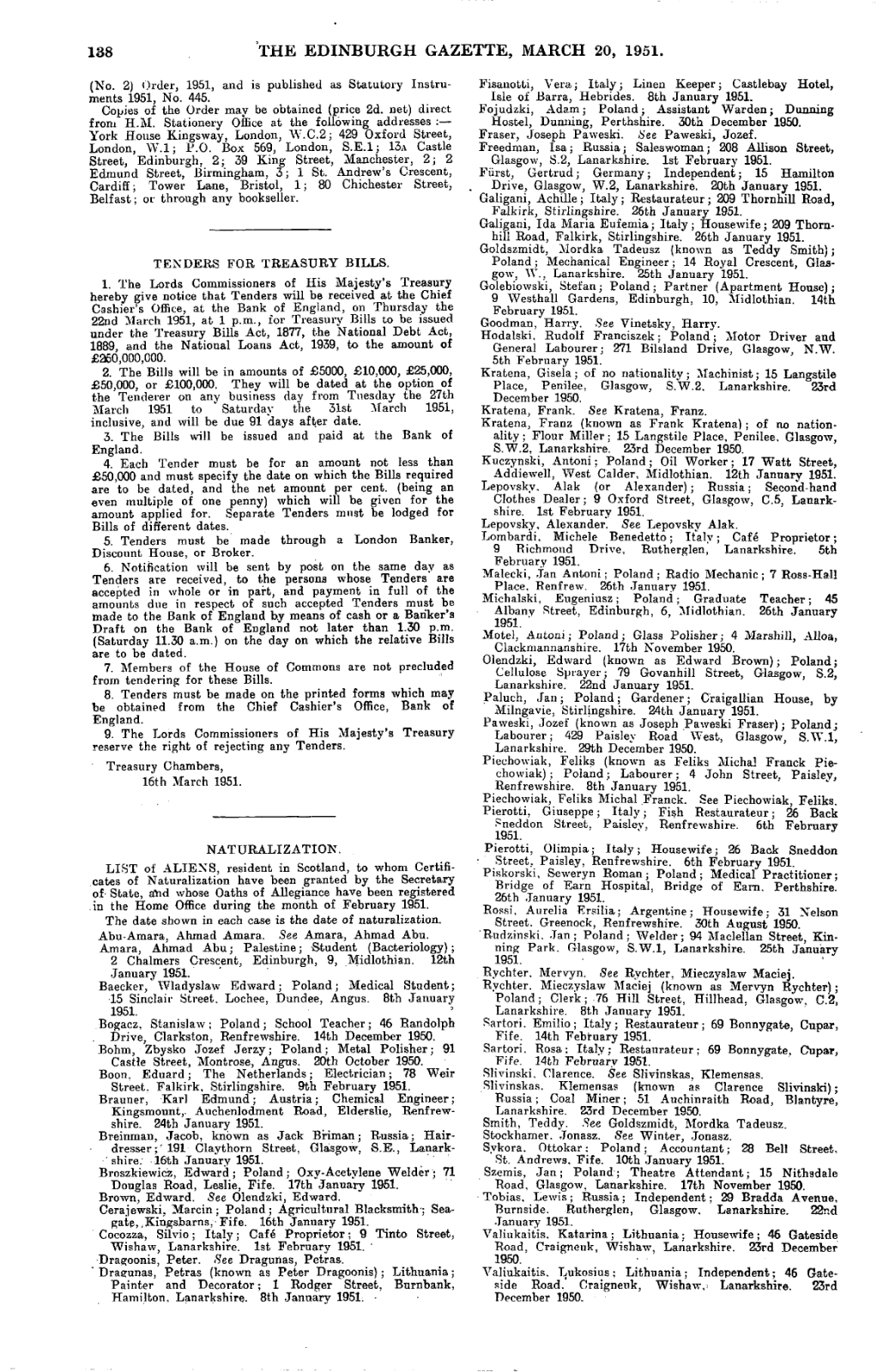
When one member of the hostel staff became a British citizen at the end of 1950, he gave Dunning Hostel, Dunning, Perthshire as his address. The Edinburgh Gazette of 20 March 1951 records his occupation as assistant warden and his previous nationality as Polish, with naturalisation on 30 December 1950. The London Gazette of 16 March 1951 carries the same entry.
The entry shows that Dunning Hostel was an operating institution with a warden’s staff at the end of 1950, and that its staff included people who were themselves recent arrivals from the Continent.
The 1951 naturalisation entry
Sources for this section
Dunning at war: the army camp
A reminiscence published by the Dunning Parish Historical Society describes an army camp in the village from 1940, when the first troops came to re-muster after Dunkirk. It formed part of the defence of the Strathearn valley, with camps set up along the strath at Auchterarder, Strathallan, Blackford and Crieff. The camp stood in the manse glebe, the area now called The Glebe, and consisted of Nissen huts with one large hutment inside the wall at Auchterarder Road that served as the sergeants’ mess. The present houses follow more or less the layout of the camp.
When a Royal Artillery regiment arrived in March 1944 the camp was well established. Buildings across the village had been requisitioned: the Dunning Hotel was the officers’ mess, Burnbank House held the regimental offices, the Masonic Hall was the quartermaster’s store and several houses served as signal stores. Local women ran a canteen in the village hall, dances were held there twice a week, and the regiment left just after D-Day for the campaign in Holland and Germany.
An evacuee who spent the war years in the village remembered the same camp from the other side of the fence. A troop of Royal Artillery gunners with six anti-tank guns, limbers and vehicles rolled in one Sunday and took up residence in the glebe of the Reverend MacKinnon’s manse. Over the eighteen months or so of their stay they became part of village life, invited into homes and filling the Friday and Saturday concerts in the town hall, where the benches were cleared afterwards and the dancing went on into the small hours to a local band led by the accordionist Bob Malcolm.
The gunners were not the only foreign or military presence within reach of Dunning. The same account describes a large hutted camp at Gask, a few miles to the north west, holding hundreds of Polish soldiers who came over to the dances and concerts in the village hall, and recalls the day General Sikorski flew in on a tour of inspection, an airstrip standing near the camp at the time. Historic Environment Scotland records that airfield at Findo Gask, photographed by the RAF on 9 September 1943, with its accommodation camp spread through Mayfield Wood in three groups of huts; the Ordnance Survey still marked it ‘Camp Site (Disused)’ in 1968.
These accounts end with the war. The wartime camps and the postwar hostel are treated here as separate phases until a record connects them.
The wartime army camp as remembered
| Element | Detail |
|---|---|
| Established | 1940, troops re-mustering after Dunkirk |
| Site | Manse glebe, now The Glebe |
| Buildings | Nissen huts; large hutment at Auchterarder Road as sergeants’ mess |
| Requisitioned premises | Dunning Hotel, Burnbank House, Masonic Hall, houses used as signal stores |
| Last unit described | Royal Artillery regiment, March 1944 to just after D-Day |
Findo Gask airfield and its accommodation camp in the national record
| Element | Detail |
|---|---|
| Airfield | NO 0066 2160, recorded as site NO02SW 31 |
| Accommodation camp | Mayfield Wood, in three main groups at NO 0180 2053, NO 0155 2025 and NO 0190 2094 |
| Hut types | Larger huts and stores in one group; Nissen huts in the others |
| Aerial cover | RAF vertical photographs flown 9 September 1943 |
| Record plan | Airfield and dispersed sites, 1:2500, dated July 1946 |
| Ordnance Survey | Marked ‘Camp Site (Disused)’ on the 1:2500 map of 1968 |
Names in the village record
Three further Gazette entries place continental workers at Dunning addresses. In August 1947, before the first Ukrainian European Voluntary Workers reached Perthshire, Samuel Winston, formerly Samuel Goldfein and of former nationality Russia, was naturalised as an agricultural labourer at Thorntree Court in the village. In April 1949 Michal Dudek, a labourer, was naturalised from Perth Road, Dunning. In October 1970 Kazimierz Jan Pobog Lenartowicz, who had taken the name Lenart, gave The Square Inch, Dunning, as his address.
Read with the warden’s entry, these show a small continental presence in the parish running from the last year of the war through the hostel years and on into the 1970s, at ordinary village addresses rather than at the hostel itself. For a family tracing a Dunning connection, the printed lists are often the only place where an individual, a trade and a street appear together.
Dunning addresses in the Gazette
| Date | Name | Former nationality | Occupation | Address |
|---|---|---|---|---|
| 19 August 1947 | Samuel Winston, formerly Samuel Goldfein | Russia | Agricultural labourer | Thorntree Court, Dunning |
| 6 April 1949 | Michal Dudek | Poland | Labourer | Perth Road, Dunning |
| 30 December 1950 | Adam Fojudzki | Poland | Assistant warden | Dunning Hostel, Dunning |
| 2 October 1970 | Kazimierz Jan Pobog Lenartowicz, known as Kazimierz Jan Lenart | Poland | Not stated | The Square Inch, Dunning |
The EVW scheme and Perthshire
Ukrainians were recruited under the Westward Ho! scheme from displaced persons camps in Germany and Austria from the spring of 1947. Most Ukrainian EVWs came to Britain in the second half of 1947 and the first half of 1948, with the last arrivals in 1949; official figures give 20,912 Ukrainian EVWs in total. They were accommodated in hostels close to their place of work and received the same wages and conditions as British workers, and just over half of the men were first placed in agriculture. In the autumn of 1948 former soldiers of the Galicia Division, released from prisoner of war status, joined the scheme.
These are national figures.
Sources for this section
A lead not yet read
The Dunning Parish Historical Society’s magazine index lists an article in newsletter 79 of April 2012, pages 3 to 5, headed Dunning’s Prisoners of War, based on a resident’s memories, with further photographs on page 10. Issues from number 41 onwards are not online and are supplied by the society on request. Whether the article concerns the wartime camp, a prisoner of war presence or the later hostel is unknown until it is read.
The same index lists ‘The Glebe camp’ by Betty Taylor in newsletter 50 of January 2005, page 3. Neither issue is published online, and both are supplied by the society on request.
Sources for this section
Sources
- In which ways is the Ukrainian community in Scotland a diaspora?
Peter David Kormylo, University of Glasgow · 2021
Original directory printed 322–323 and map printed 100; archival lists attributed to AUGB and Ukrainian Catholic Church in Scotland. Printed pp 139–140 describe the AUGB database of camp and hostel sub-groups from which the list derives.
- Naturalization list, page 138
The Edinburgh Gazette · 20 March 1951
Original full text read: assistant warden, Dunning Hostel, Dunning, Perthshire, former nationality Poland, naturalised 30 December 1950. Name withheld on this page.
- Naturalisation list, page 1432
The London Gazette · 16 March 1951
Original page read; the same entry as the Edinburgh Gazette.
- The Army in Dunning during the Second World War
Dunning Parish Historical Society, Newsletter 22, reminiscence by Joe Taylor · January 1998
Full article read: camp in the manse glebe from 1940, Nissen huts, requisitioned buildings, Royal Artillery regiment March to June 1944. Says nothing about postwar use.
- European Voluntary Workers
Ukrainians in the United Kingdom online encyclopaedia · Accessed 12 September 2026
National account of recruitment, arrival dates, totals and placement; does not name Dunning.
- Magazine Index Part 2 and Newsletter Index
Dunning Parish Historical Society · Accessed 12 September 2026
Index entry only for newsletter 79, April 2012, pages 3–5 and 10. Article not online; cited as a lead.
- The Edinburgh Gazette, 20 March 1951, page 138
The Gazette (TSO, on behalf of His Majesty’s Stationery Office) · 20 March 1951
Page facsimile carrying the Home Office list of aliens resident in Scotland granted certificates of naturalisation, including Adam Fojudzki, assistant warden, of Dunning Hostel, Dunning, Perthshire. Crown copyright, reproduced under the Open Government Licence version 3.0; The Gazette notes that the licence does not extend to the re-use of personal data.
- Naturalisation list, page 391
The Edinburgh Gazette, issue 16475 · 23 September 1947
Entry read in the Gazette’s full-text search: Samuel Winston, formerly Samuel Goldfein, former nationality given as Russia, agricultural labourer, Thorntree Court, Dunning, Perthshire, 19 August 1947.
- Naturalisation list, page 232
The Edinburgh Gazette, issue 16649 · 24 May 1949
Entry read in the Gazette’s full-text search: Michal Dudek, Poland, labourer, Perth Road, Dunning, Perthshire, 6 April 1949. The same entry appears in the London Gazette of 20 May 1949, issue 38616, page 2475.
- Name-change notice, page 12873
The London Gazette, issue 45237 · 24 November 1970
Entry read in the Gazette’s full-text search: Kazimierz Jan Pobog Lenartowicz, known as Kazimierz Jan Lenart, Poland, The Square Inch, Dunning, Perthshire, 2 October 1970.
- Reminiscences of a Dunning Evacuee, part three
Dunning Parish Historical Society, Newsletter 8, reminiscence by Ron Freeland · July 1994
Full article read. Royal Artillery gunners with six anti-tank guns taking up residence in the glebe of the manse and staying some eighteen months; village hall concerts and dances; a large hutted camp at Gask holding hundreds of Polish soldiers; General Sikorski’s visit of inspection, and an airstrip near that camp.
- Findo Gask Airfield (NRHE 87770) and its accommodation area (NRHE 87771)
Historic Environment Scotland, National Record of the Historic Environment · Accessed 14 September 2026
Both site records read. The Second World War airfield at NO 0066 2160, with runways, T2 and blister hangars, technical and dispersal areas visible on RAF vertical air photographs flown on 9 September 1943; the accommodation camp spread through Mayfield Wood in three main groups at NO 0180 2053, NO 0155 2025 and NO 0190 2094, the first of larger huts and stores and the others of Nissen huts; marked ‘Camp Site (Disused)’ on the Ordnance Survey 1:2500 map of 1968. A 1:2500 record site plan of the airfield and its dispersed sites, dated July 1946, is held with the J Guy Report.
- Newsletter index: ‘The Glebe camp’, Newsletter 50
Dunning Parish Historical Society · Accessed 14 September 2026
Index entry read: ‘The Glebe camp’ by Betty Taylor, Newsletter 50 (Winter 2004 Dunningite), January 2005, page 3. The issue is not published online.
Last researched 14 September 2026