Girvan Hostel
Arrival and settlement
Near Girvan, Ayrshire, Scotland · Postwar; related Maidens notice 1948
An EVW hostel near Girvan appears in the Ukrainian settlement directory, and Kormylo’s map places an Ayrshire EVW hostel at Maidens. A 1948 church notice confirms a Ukrainian Orthodox visit to Maidens Hostel, but the hostel’s building and dates remain unidentified.
Introduction
The European Voluntary Workers’ hostel near Girvan was one of the Ayrshire addresses associated with postwar Ukrainian settlement. Kormylo’s directory records it by its proximity to Girvan; his Scottish camp map uses the name Maidens for an Ayrshire EVW hostel, grouped with Kingencleugh, Doonfoot and Beith.
Maidens is a coastal village beside the wartime Turnberry airfield, whose road to Turnberry runs through the former airfield. The airfield’s accommodation was the largest group of huts in the district, and that setting is the most likely reason a hostel came to bear the village’s name.
A history in dates
- 1942Turnberry airfield reopens for wartime training.
- November 1945Operational units leave and the airfield closes.
- 1946Prisoner-of-war use of the airfield accommodation ends and most huts are cleared, according to an enthusiast history; the National Service Hostels Corporation takes on EVW accommodation nationally.
- PostwarAn EVW hostel near Girvan is included in the Ukrainian hostel directory; the map names Maidens.
- By August–September 1948Ihor Hubarzhevsky has visited Maidens Hostel; his public thanks appear in Brotherhood’s Letter.
- 1949The former airfield is sold by the Ministry to a private owner.
- 1 January 1951EVWs with three years’ residence may apply for release from directed employment.
Maidens and the Turnberry airfield
Turnberry airfield had first opened in 1917 and closed after the First World War. It was revived as an anti-aircraft landing ground in the 1930s and reopened during 1942, but the cramped ground between the shore and the hills made expansion impossible, and it closed in 1945. The Maidens road runs through the site. When Historic Environment Scotland visited in 2001, the runways were still extant, many other buildings survived and the former control tower was a private house; an earlier account of 1983 had recorded that most of the wartime buildings were demolished.
A local talk reported in 2026 put the number of airmen housed by the aerodrome complex and nearby Maidens at up to 7,000 at one time. An enthusiast history of the airfield adds that after the operational units left in November 1945, the accommodation was used for a time to house prisoners of war until 1946, after which most of it was cleared, and that the airfield was sold by the Ministry in 1949.
Whether the EVW hostel at Maidens occupied part of this accommodation, or another site altogether, is not established. The airfield history is given here as the setting, not as an identification of the hostel.
Turnberry airfield chronology
| Date | Event | Source |
|---|---|---|
| 1917–1918 | First aerodrome opens and closes | Canmore |
| 1930s | Revived as anti-aircraft landing ground | Canmore |
| 1942 | Airfield reopens | Canmore |
| 1945 | Airfield closes; units leave in November | Canmore; Secret Scotland |
| 1946 | Prisoner-of-war use ends; most accommodation cleared | Secret Scotland |
| 1949 | Airfield sold by the Ministry | Secret Scotland |
Hostels for European Voluntary Workers
The National Service Hostels Corporation, set up in 1941 to run hostels for war workers, had its powers extended in 1946 to include accommodation for European Voluntary Workers. Most Ukrainian EVWs arrived in the second half of 1947 and the first half of 1948; they were housed in hostels close to their work and signed an undertaking to work only as directed by the Ministry of Labour, a restriction from which they could apply for release after three years from 1 January 1951.
Kormylo notes that work locations were generally outside the camps and hostels, that men were restricted to forestry, farming or mining, and that in every Scottish camp the Association of Ukrainians in Great Britain managed to register a branch with a chairperson, secretary, treasurer and cultural officer. Whether the Girvan hostel had such a branch, and what work its residents did, has not been found.
A pastoral visit to Maidens
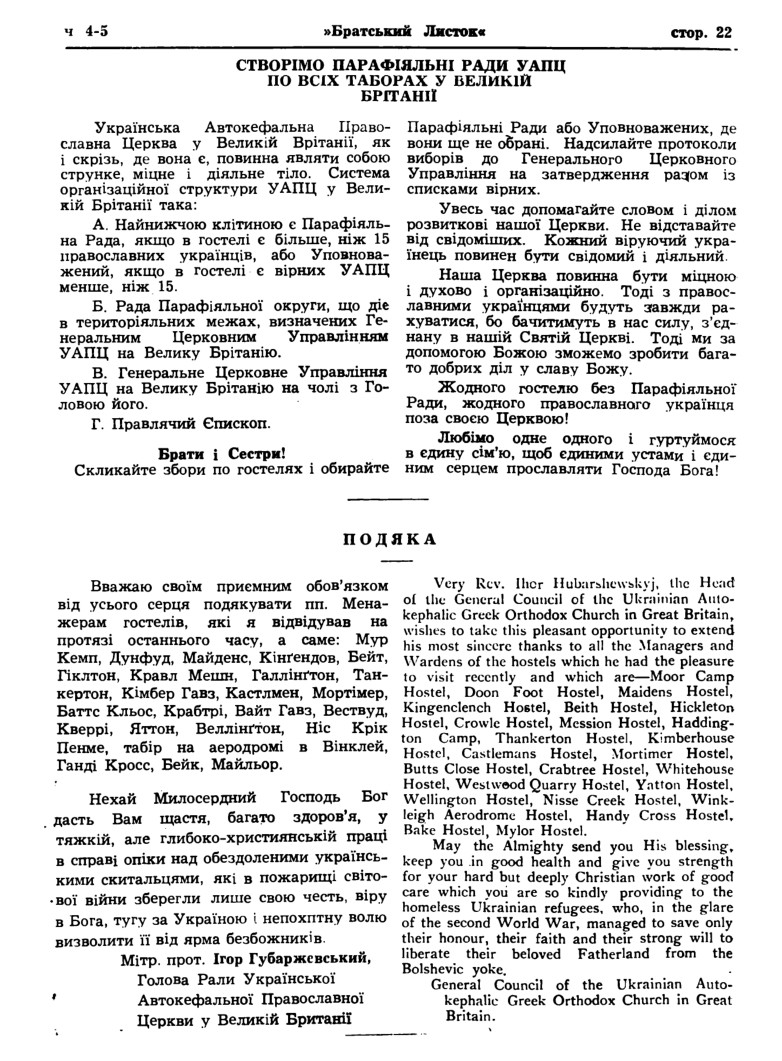
In August–September 1948, the Ukrainian Orthodox periodical Brotherhood’s Letter printed a message thanking hostel managers and wardens who had recently welcomed the Very Reverend Ihor Hubarzhevsky. Maidens Hostel appears by name in its English-language list.
Hubarzhevsky was head of the General Council of the Ukrainian Autocephalous Orthodox Church in Great Britain. His message thanked staff for their care of displaced Ukrainians. Published in both Ukrainian and English, it connected the residents’ religious life with the people managing their accommodation.
Sources for this section
Building a dispersed church community
The same page encouraged Orthodox residents to organise locally: hostels with more than fifteen believers were to elect a parish council, while smaller groups were to choose a representative. This was a national organisational appeal, not evidence of Maidens’ population or proof that it had a separate church building.
Sources for this section
Girvan and Maidens in the records
The surviving names are kept together here as related records from the same part of Ayrshire. The directory and map do not provide a street address that conclusively identifies the Girvan entry with a particular Maidens building. The 1948 notice directly documents Maidens and its pastoral visit.

Sources for this section
Sources
- In which ways is the Ukrainian community in Scotland a diaspora?
Peter David Kormylo, University of Glasgow · 2021
Printed pages 100 and 323, appendix xii entry 14; hostel life and AUGB branches printed 178. Girvan and Maidens names compared without claiming exact-building equivalence.
- Brotherhood’s Letter, no.4–5
St Michael’s Ukrainian Orthodox Brotherhood in Great Britain · August–September 1948
Original cover and page 22 inspected. Bilingual thanks names Maidens Hostel. Parish council appeal on same page is national, not a local population count.
- Turnberry Airfield, site 94164
Historic Environment Scotland, Canmore / trove.scot · Record entries 1983 and 2001; accessed 2026
Airfield dates 1917, 1930s, 1942, 1945; Maidens road through the site; buildings largely demolished; control tower a private house. Setting only; no hostel named.
- Turnberry Airfield
Secret Scotland · Site visit March 2010; accessed 2026
Enthusiast wiki: units left November 1945; accommodation housed prisoners of war until 1946 then mostly cleared; airfield sold 1949. Used only for this postwar sequence and labelled as secondary.
- The Wartime History of Turnberry Airfield
Rotary Club of Ayr, report by Douglas Haddow of a talk by Tony Morrell · 14 January 2026
States that the aerodrome complex and nearby Maidens housed up to 7,000 airmen at one time. Wartime figure, not a hostel figure.
- National Service Hostels Corporation
House of Commons, Hansard written answers · 10 July 1956
Corporation set up in 1941; powers extended in 1946 to include European voluntary workers.
- European Voluntary Workers
Ukrainians in the United Kingdom online encyclopaedia · Accessed 2026
Arrival dates 1947–1949; hostels close to work; Ministry of Labour undertaking; release from 1 January 1951.
Last researched 12 September 2026