ICI Hostel, St Boswells
Arrival and settlement
St Boswells, Scottish Borders, Scotland · Postwar
The ICI Hostel at St Boswells is recorded as accommodation for Ukrainians in Roxburghshire, its name pointing to the wartime incendiary bomb factory at Charlesfield. The factory, its postwar naval depot and the Ukrainian hostel are distinct phases whose exact relationship is not yet documented.
Introduction
ICI Hostel at St Boswells appears in the directory of Scottish and northern English hostels that housed significant numbers of ethnic Ukrainians. The entry places it in Roxburghshire and preserves the ICI name, but supplies no street address or resident total.
Sources for this section
A history in dates
- 1942Government opens the ICI-operated incendiary bomb factory at Charlesfield; a workers’ halt opens on the Waverley route.
- January 1943 to May 1945Bomb production at Charlesfield; Dent’s total is 25,754,529 incendiary bombs.
- 1945Production ceases; the site passes to the Royal Navy as an armaments store.
- 1946The Mears regional survey proposes the depot as a prefabricated housing assembly plant.
- 1947Over 170 male workers still employed at the depot; Trades Councils campaign for an industrial future.
- 1948 to 1963RNAD Charlesfield operates as a Royal Navy Armaments Depot.
- PostwarICI Hostel, St Boswells, is recorded as Ukrainian accommodation.
- From 1951Employment restrictions lifted for EVWs with three years in Britain; most hostels closed by the mid-1950s. National pattern, not a St Boswells date.
- 1959 to 1961Charlesfield Halt last used in late 1959 and closed in 1961.
- 1970sThe former depot becomes an industrial estate.
- 1990 to 1995John Dent records the surviving buildings and organises the VE Day anniversary exhibition and reunion.
Sources for this section
- Charlesfield Munitions Factory
- Charlesfield Incendiary Bomb Munitions Factory, St Boswells
- ICI St Boswells (Charlesfield): a World War II incendiary bomb factory
- County Planning in the 1940s and 1950s: Roxburghshire County Council
- In which ways is the Ukrainian community in Scotland a diaspora?
- Post-war camps and hostels
The surrounding industrial landscape
St Boswells had a substantial wartime industrial presence. Archaeologist John Dent records that the ICI factory at Charlesfield produced incendiary bombs from January 1943 to May 1945. When he began investigating in 1990, former workers were still available to explain their jobs and the surviving buildings.
The factory was a wartime creation. Government opened it in 1942, with ICI (through its Nobel explosives business) as operator under the Ministry of Aircraft Production, and it was one of only two plants making the 4 lb thermite incendiary bomb; the other was at Bowhouse near Kilmarnock. A freight siding came in from the Kelso branch to the east and a wooden passenger halt for workers was opened on the Waverley route a quarter of a mile to the west. About 1,300 people worked there at the peak. Three figures are given for what it made, and they measure different things. Dent’s total for the whole production run, from January 1943 to May 1945, is 25,754,529 bombs, which over about twenty-nine months averages some 890,000 a month. A planning history of the county puts peak output at over a million bombs a month, which is what an average of that size implies. The rate of 100,000 a week is Dent’s caption to a 1945 photograph of “men and women of a Bomb Assembly shift”, and describes the output of the shift in the picture rather than of a factory that worked three shifts round the clock.
Dent organised an exhibition and reunion in May 1995. His archive brought together photographs, workers’ accounts and building records, preserving the industrial community around St Boswells. This factory history provides local context; the hostel directory does not establish which Charlesfield building, if any, accommodated its Ukrainian residents.
Charlesfield in figures
| Measure | Figure | Source scope |
|---|---|---|
| Incendiary bombs produced, January 1943 to May 1945 | 25,754,529 | Dent |
| Average monthly output over the run | about 890,000 | Arithmetic on Dent’s total |
| Peak monthly output | over 1,000,000 | Hope |
| Output of one bomb assembly shift, 1945 | about 100,000 a week | Dent, 1945 photograph caption |
| Peak workforce | about 1,300 | Furnevel |
| Workers on each of three shifts | about 200 | Cessford recollection, 2000 |
| Male workers at the naval depot | over 170 | Hope, for 1947 |
| Admiralty depot staff, later | about 100 | Hope, into the 1960s |
Sources for this section
- ICI St Boswells (Charlesfield): a World War II incendiary bomb factory
- Memories of working at the munitions factory at Charlesfield during the Second World War: Anne Cessford talking to Anne Melrose
- County Planning in the 1940s and 1950s: Roxburghshire County Council
- Charlesfield Munitions Factory
- Charlesfield Incendiary Bomb Munitions Factory, St Boswells
- In which ways is the Ukrainian community in Scotland a diaspora?
Working at Charlesfield in wartime
An oral history recorded for St Boswells Village Hall in May 2000 gives the texture of factory life. The interviewee, a St Boswells woman who served as an Aeronautical Inspection Directorate inspector checking ICI’s output shed by shed, described three shifts, six to two, two to ten and ten to six, with about two hundred people on each. Police at the gate checked that nobody carried matches. Inspectors wore white coats and turbans; ICI workers wore close-fitting boiler suits and were on piece work. The AID and ICI had separate canteens serving meals through the night, and the whole site was camouflaged and unlit, so that on night shift you found your way to the canteen by moonlight.
She remembered workers coming from all over, from Stornoway in the Outer Hebrides and from Newcastle and other places over the Border, with ICI staff from Ardeer sent to train the new hands. After a night shift the first stop was the bakers in the village for hot rolls and milk. There was a fire in one of the sheds, and one foggy blackout morning the workers’ bus went over the parapet at Mertoun bridge and two people were killed. Lighter memories were of Workers’ Playtime broadcasts and dances in ICI’s huge mess room, a visit by Lord Beaverbrook, and film shows after the factory had finished.
This is the wartime factory, not the Ukrainian hostel.
After production ended
The archaeological record describes a change of function after 1945: part of the former production site became a Royal Navy store for small arms and guns. Later uses included farming storage and light industry. These changes belong to the Charlesfield complex and do not supply an opening or closure date for the Ukrainian hostel.
Local planning history fills in the years that matter for the hostel. Sir Frank Mears’s 1946 regional survey suggested the munitions depot as a possible assembly plant for prefabricated houses. Production had ceased in 1945 and the site became a Royal Navy Armaments Depot for small arms and guns, known as RNAD Charlesfield from 1948 until 1963. In 1947 it still employed over 170 male workers, and the Hawick and Galashiels Trades Councils campaigned to secure it as an industrial site. It continued as an Admiralty storage, maintenance and repair facility, employing about a hundred men and women, into the 1960s.
The rail siding was disconnected shortly after the war; the halt was last used in late 1959 and closed officially in 1961, and the depot’s military use ended in 1963. After some years of agricultural storage the site became an industrial estate in the 1970s, which the 1968 Central Borders Plan had already marked for new industry in the longer term. None of these dates is a date for the hostel.
Where the Ukrainian hostel fits
Kormylo’s directory lists the ICI Hostel at St Boswells among Scottish hostels that held significant numbers of ethnic Ukrainians, and the name is the only firm clue to its origin. The national pattern makes an industrial hostel plausible: the encyclopaedia of Ukrainians in the United Kingdom records that EVW hostels included wartime industrial and agricultural hostels as well as former camps, run by bodies from the National Service Hostels Corporation to private firms, and that most residents could leave only after employment restrictions were lifted from the beginning of 1951, with most hostels closed by the mid-1950s.
The factory, the naval depot and the Ukrainian hostel are therefore treated as three phases that shared a name and a place, not as one institution.
Sources for this section
The hostel record
The hostel’s individual directory entry distinguishes it from nearby accommodation at Kelso and Selkirk. Retaining its recorded industrial name allows references to ICI Hostel in family papers to be recognised without replacing that name with an unproven building identification.
The hostel in the records
| Record | What it establishes |
|---|---|
| Recorded name | ICI Hostel |
| Locality | St Boswells |
| Historic county | Roxburghshire |
| Ukrainian connection | Included in the directory of hostels with substantial Ukrainian residence |

Sources for this section
Sources
- In which ways is the Ukrainian community in Scotland a diaspora?
Peter David Kormylo, University of Glasgow · 2021
Printed page 322, appendix xii entry 11.
- ICI St Boswells (Charlesfield): a World War II incendiary bomb factory
John Dent, Strickland Dent Associates · Updated 2023
Archaeologist’s first-person account of recording the factory and interviewing workers, with two captioned photographs; original text read 12 September 2026.
- St Boswells, Charlesfield, Incendiary Bomb Munitions Plant and Depot
Historic Environment Scotland · Archaeological notes 1999 and 2006
Full archaeological description read in an earlier pass; the page was blocked on refetch on 12 September 2026 and no new claims are drawn from it. Not treated as identification of the Ukrainian hostel footprint.
- Memories of working at the munitions factory at Charlesfield during the Second World War: Anne Cessford talking to Anne Melrose
St Boswells Village Hall oral history archive (draft transcription) · Recorded 17 May 2000
Full transcript read. Wartime factory recollections by an Aeronautical Inspection Directorate inspector; no hostel or Ukrainian reference.
- County Planning in the 1940s and 1950s: Roxburghshire County Council
Douglas Hope, History of Planning in the Scottish Borders · 1 August 2018, updated 8 November 2024
Full post read. Gives 1947 and later employment at the Charlesfield depot, the Trades Councils’ campaign and the 1946 Mears plan; also the 1968 Central Borders Plan. Employment totals, not hostel counts.
- Charlesfield Munitions Factory
John Furnevel, Railscot · 14 February 2017
Full article read. Halt, siding, peak workforce, naval depot to 1963 and later industrial estate.
- Charlesfield Incendiary Bomb Munitions Factory, St Boswells
James T M Towill, Geograph Britain and Ireland (shared description) · 1 April 2014
Shared description read. RNAD Charlesfield 1948 to 1963, Ministry of Aircraft Production control, Nobel/ICI operation and the Glasgow Herald report of 28 May 1945.
- Post-war camps and hostels
Ukrainians in the United Kingdom: online encyclopaedia · Accessed 12 September 2026
Full entry read. Describes the national hostel system, its administering bodies and the 1951 lifting of employment restrictions; it does not name this hostel.
- Derelict Building At Charlesfield
James T M Towill, Geograph Britain and Ireland, via Wikimedia Commons · 30 March 2014
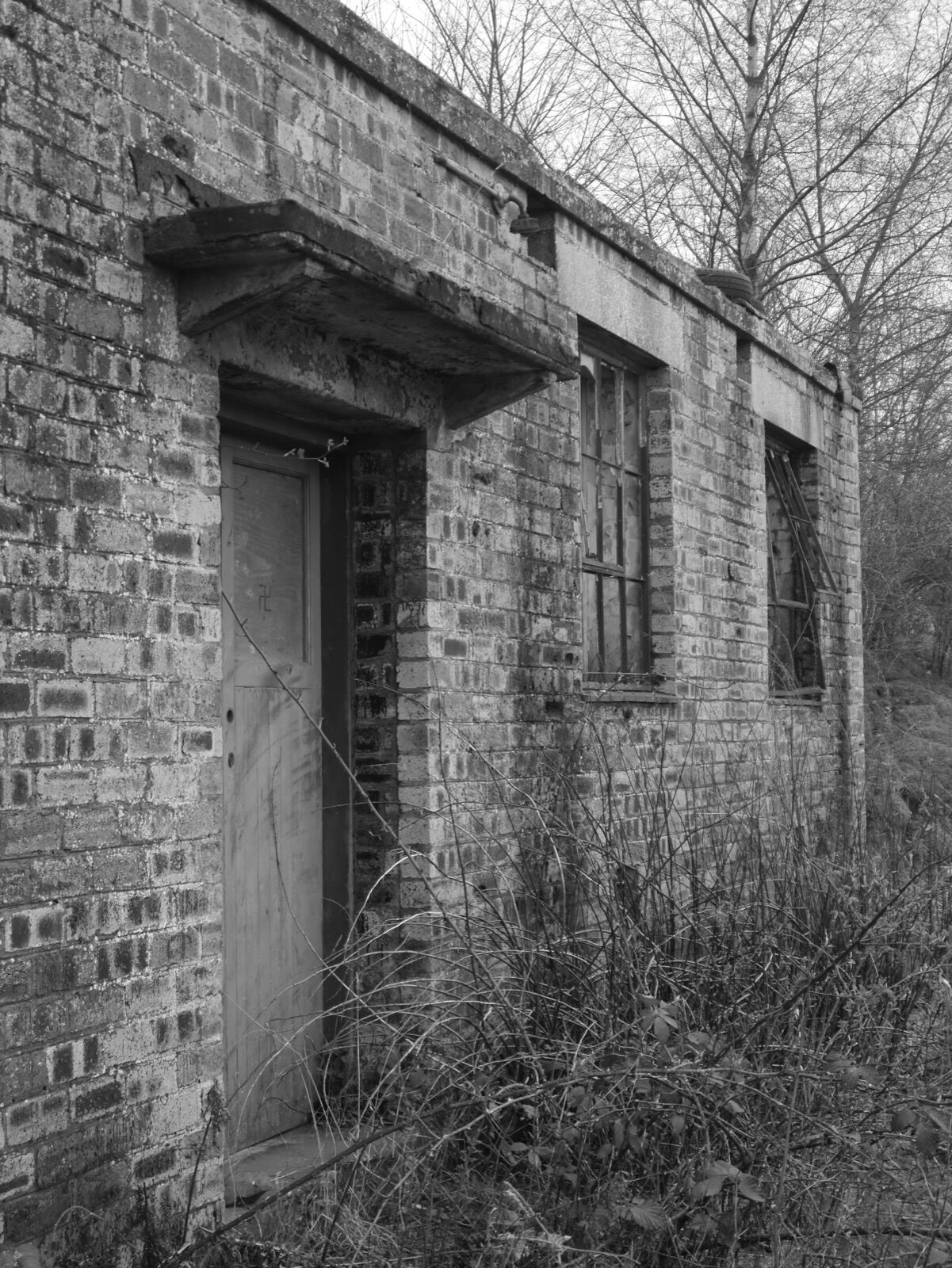
Photograph of a surviving brick building on the former ICI Charlesfield site at St Boswells, taken in March 2014. Licensed under the Creative Commons Attribution-ShareAlike 2.0 Generic licence.
Last researched 12 September 2026