Macmerry Hostel
Arrival and settlement
Macmerry, near Tranent, East Lothian, Scotland · Documented 1948–May 1951
An agricultural workers’ hostel on a former East Lothian airfield, where 212 Ukrainians ran their own classes, library, chapel and dances, and helped buy a church house in Edinburgh.
Introduction
Macmerry Hostel stood beside the village of Macmerry in East Lothian, a few miles east of Tranent, and housed Ukrainian men working mainly on the farms of the county. Camp leader Vasyl Popadynets recalled 212 former soldiers of the Galicia Division living there. His account describes a working community with its own Ukrainian administration, classes, library and chapel, alongside the Scottish officials responsible for the hostel.
Peter Kormylo’s survey of the Ukrainian community in Scotland lists the place twice: as ‘Macmerry Camp, Tranent, E.Lothian’ on his map of Ukrainians in displaced persons camps in Scotland between 1946 and 1951, compiled from the archives of the Association of Ukrainians in Great Britain and the Ukrainian Catholic Church in Scotland, and as ‘Ukrainian Macmerry Hostel, Nr.Tranent’ in his directory of hostels that held significant numbers of Ukrainians.
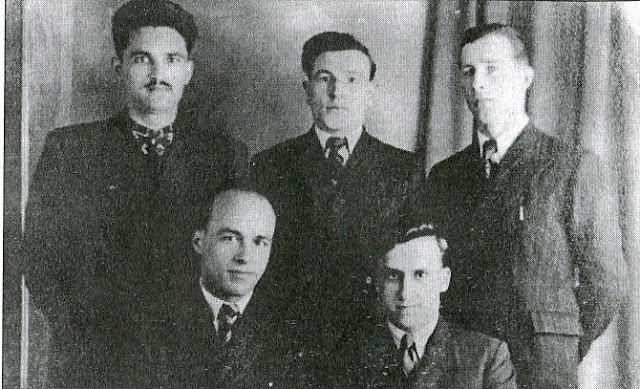
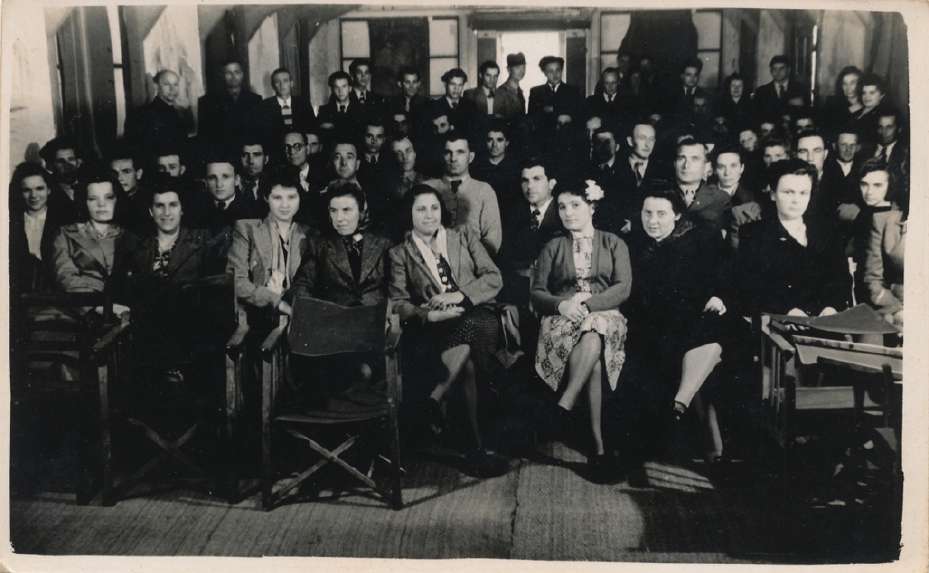
A photograph dated summer 1948 shows members of the Ukrainian administration. Another, dated 1949, records men and women gathered for a lecture. These images capture different parts of the hostel’s life: the people organising it and the wider community drawn to its events.
Sources for this section
A history in dates
- 1914–1918Work is carried out at Penston Aerodrome, later known as Macmerry Airfield.
- From 1947Responsibility for the wartime camps passes from the War Office to civilian bodies, among them the Ministry of Agriculture.
- Summer 1948Members of the Ukrainian camp administration are photographed together.
- 29 March 1949A certificate of naturalisation is granted to a Polish agricultural worker living at Macmerry Hostel, Tranent.
- 1949Ukrainian European Voluntary Workers gather for a lecture at Macmerry Hostel.
- 1949The Ukrainian Greek Catholic Church registers 900 families in Scotland.
- May 1951The camp closes, according to camp leader Vasyl Popadynets.
- April 1952Some 1,200 Ukrainians are identified as resident in Scotland at the AUGB annual general meeting in Edinburgh.
- 27 June 1959Omelan Hajduk, living at 9 Merryfield Avenue, Macmerry, gives notice of a change of name.
Sources for this section
The airfield before the hostel
The hostel occupied part of an airfield. The site north-east of Macmerry village is recorded as Macmerry Airfield, also known as Penston Aerodrome, at NT 4374 7345 in the parish of Gladsmuir. Work was carried out at Penston Aerodrome during the First World War, and East Lothian Council’s heritage service places it, with Drem and East Fortune, among the airfields that defended the county’s coastline in that war.
The Second World War station left a scatter of buildings across the fields: pillboxes, dispersal bays, a fuel depot and, at the accommodation camp south of the runway, a cinema, a chapel and a gymnasium. It was this accommodation camp, rather than the flying field, that could be turned over to housing agricultural workers once the aircraft had gone.
The airfield site in the national record
| Field | Record |
|---|---|
| Name | Macmerry Airfield; also Penston Aerodrome, Tranent |
| Record number | NRHE 90069; site number NT47SW 46 |
| Grid reference | NT 4374 7345 |
| Parish | Gladsmuir, East Lothian |
| Sub-sites recorded | Pillboxes, dispersal bays, buildings, and a cinema, chapel and gymnasium |
| Condition noted 1997 | Accommodation camp within the Macmerry Industrial Estate; fuel depot, shelters and dispersal bays upstanding |
Sources for this section
A hostel with two administrations
The hostel came under the Ministry of Agriculture for Scotland. From 1947 responsibility for the wartime camps was passing from the War Office to civilian bodies, and the Ministry of Agriculture was among the organisations that took hostels over. Popadynets describes two parallel teams at Macmerry: Scottish officials handling the camp’s management and Ukrainian residents taking responsibility for employment administration, welfare, finance, education and the kitchen.
He names the commandant as Erick MacDonald, whom the account calls a former colonel of the British air force. F. Mactaggert represented the agricultural ministry, assisted by A. Maclean; an official named Ramsey dealt with food. Within the Ukrainian team, Popadynets served as camp leader and Ostap Sokolskyi ran the employment office. Levko Babii, given as Lev Babii in the source's photograph caption, assisted the camp doctor, Yaroslav Pelekh handled finance and cultural education, and Petro Krainyk supervised the kitchen.
The London Gazette gives the hostel’s official style. In its naturalisation list of 20 May 1949 a Polish agricultural worker, Antoni George Stanislawski, is recorded at ‘Macmerry Hostel, Tranent, East Lothian’, with 29 March 1949 as the date of his certificate. The entry shows both the address by which the hostel was known to government and that its residents were not all Ukrainians.
Ukrainian administration
| Person | Responsibility |
|---|---|
| Vasyl Popadynets | Camp leader; literacy teacher |
| Ostap Sokolskyi | Employment office; English teaching |
| Levko Babii | Camp doctor’s assistant |
| Yaroslav Pelekh | Finance and cultural education |
| Petro Krainyk | Kitchen |
| Ivan Demchyshyn | English teaching |
The Scottish staff named in the camp leader’s account
| Person | Responsibility |
|---|---|
| Erick MacDonald | Commandant; described as a former colonel of the British air force |
| F. Mactaggert | Ministry of Agriculture |
| A. Maclean | Assistant to Mactaggert |
| Ramsey | Food |
Agricultural work and education
Most residents worked on farms. Popadynets gives their weekly pay as £3.50, expressed that way in his retrospective account. Ministry visitors from Edinburgh took an interest in both employment and the hostel’s cultural activities, and were sometimes guests at its celebrations and services.
Two courses met at the hostel. Popadynets taught residents with limited literacy, while Sokolskyi and Ivan Demchyshyn led English classes. The English course also attracted people from outside the camp. The cost of the courses and of the cultural and educational work was met by the agricultural officer in Edinburgh, and Popadynets credits the commandant with helping to secure that public funding.
Work, learning and community facilities
| Item | Recorded detail |
|---|---|
| Residents | 212 former Galicia Division soldiers in Popadynets’s account |
| Main employment | Agriculture |
| Weekly farm pay | £3.50 as written in the retrospective account |
| Library | 260 books, plus newspapers and magazines |
| Classes | Literacy and English |
| Chapel services | Every two weeks |
Sources for this section
The reading room and social life
A large communal room, known to the residents as the reading room, provided space for meetings, commemorative gatherings and dances. Dances took place almost every other Saturday, bringing Ukrainian women from nearby camps together with local Scottish women. Popadynets remembered that more than half the men married Scotswomen, and that some of their wives came to speak Ukrainian well.
The room also held a library of 260 books, together with magazines and newspapers received from Europe, Canada and America. Visitors included Bohdan Panchuk, a captain in the Canadian air force, the engineer Dmytro Andriievskyi, professors Hryhorii Vashkovych and Volodymyr Yaniv, and Dr Vasyl Kushnir from Canada. These visits connected the hostel with Ukrainian cultural and organisational life abroad.
Officers of General Anders’s Second Polish Corps living in Edinburgh and the surrounding district also came. Popadynets names Colonel Volodymyr Yankovskyi, from Stanyslaviv, who spoke Ukrainian; Lieutenant-Colonel Janusz Wierzbicki from Kalush; Captain Vasyl Ziemba, an airman from Lviv; and a nursing lieutenant, Nataliia Obukh, a Ukrainian from Sniatyn.
The 1949 lecture photograph shows a crowded interior with men and women seated in rows and others standing behind them. Its caption identifies the gathering as Ukrainian European Voluntary Workers at Macmerry Hostel.
Sources for this section
Worship and remembrance
The communal room contained a chapel where services were held every two weeks. Father Oleksander Babii travelled from Edinburgh as the principal visiting priest; other clergy also came from London and elsewhere.
In the middle of the camp the residents put up a tall cross with a trident. In summer, memorial services for fallen soldiers were held beside it. Ministry visitors and the commandant sometimes attended celebrations and religious services, according to Popadynets.
Sources for this section
Building a community beyond the hostel
Macmerry residents helped finance a Ukrainian church house on Mansion House Road in Edinburgh. A first-generation respondent interviewed by Peter Kormylo recalled that the men at Macmerry Camp gave a shilling a week from their wages towards the purchase. The house became a community centre with a small chapel inside it, and a second-generation respondent remembered travelling from Tranent to reach that chapel.
The scale of the wider community can be measured against those contributions. The Ukrainian Greek Catholic Church registered 900 families in Scotland in 1949, and at the Association of Ukrainians in Great Britain’s annual general meeting in Edinburgh in April 1952 some 1,200 Ukrainians were identified as resident in Scotland. The hostel’s visitors, dances, classes and church contributions show how a residential workforce became part of that network.
Sources for this section
Closure and afterwards
Popadynets dates the dissolution of the camp to May 1951. His recollections emphasise the relationships formed during the hostel years, and the marriages to Scottish women that outlasted it.
Some of the men stayed in the parish. In June 1959 Omelan Hajduk, by then a British subject living at 9 Merryfield Avenue in Macmerry, advertised in the Edinburgh Gazette that he would take the name Philip Morrison. Kormylo counts Tranent among the places where a Ukrainian community settled in Scotland.
The airfield buildings had a longer afterlife than the hostel. Many of the perimeter structures and dispersal bays were demolished when the new dual carriageway of the A1 was cut across the site, but a number survive between the A1 and the A199, and the accommodation camp itself now lies within the Macmerry Industrial Estate, where many of its original buildings still stand.
Sources
- In which ways is the Ukrainian community in Scotland a diaspora?
University of Glasgow; Peter David Kormylo · 2021
Figure 1-6, printed p. 15 (PDF 31), lecture photograph; printed p. 100, figure 4-2, the map of Ukrainians in displaced persons camps in Scotland 1946–51, drawn from the archives of the Association of Ukrainians in Great Britain and the Ukrainian Catholic Church in Scotland, which lists ‘Macmerry Camp, Tranent, E.Lothian’; printed p. 208, Tranent among the Ukrainian settlements of Scotland; printed p. 254 (PDF 270), interview G1/N3 on contributions towards the Mansion House Road church house, and interview G2/N29 on travelling from Tranent to the Mansion House Road chapel; printed p. 255, the church registrations of 1949 and the Scottish total of April 1952; printed p. 322, appendix xii entry 3, ‘Ukrainian Macmerry Hostel, Nr.Tranent’. The interview’s approximate daily wage is not used as a pay statistic.
- Табір Макмеррі — Macmerry camp
Вісті комбатанта; Vasyl Popadynets · May 2011 online posting
Full Ukrainian-language retrospective account read in the original. Population, wages, administration, classes, library, worship, marriages, visitors and the May 1951 closure are attributed to this former camp leader, rather than independently established administrative totals. The first photograph caption identifies the Ukrainian administration in summer 1948; its caption spells the camp doctor’s assistant ‘Лев Бабій’ while the body of the text spells him ‘Левко Бабій’, and both forms are reproduced here as the source gives them. The second photograph is Rimini 1946 and is not used as a Macmerry image. Scottish personal names retain the source’s Latin spelling.
- Certificates of Naturalisation, list of names
The London Gazette, issue 38616, p. 2484 · 20 May 1949
Original page image read. The entry reads ‘Stanislawski, Antoni George; Poland; Agricultural Worker; Macmerry Hostel, Tranent, East Lothian. 29 March, 1949.’ An official record of the hostel’s name, address and occupational character; the man named is Polish, and the notice says nothing about the Ukrainian residents.
- Macmerry Airfield, NRHE 90069
Historic Environment Scotland, National Record of the Historic Environment · Record consulted 2026
Site record and archaeology notes read in full. Gives the alternative names Penston Aerodrome and Tranent, the grid reference NT 4374 7345 in Gladsmuir parish, the sub-sites including a cinema, chapel and gymnasium, and the notes of 1996, 1997 and 2003 recording that the accommodation camp lies within the Macmerry Industrial Estate and that buildings survive at Penston farm. The record does not mention the hostel.
- The Remains of War – East Lothian during World Wars I and II
John Gray Centre, East Lothian Council · Accessed 14 September 2026
Local-authority heritage page read in full. Places Penston Aerodrome among the First World War airfields of East Lothian and records that Penston Aerodrome, or Macmerry Airfield, partly lies within the Macmerry Industrial Estate, that many airfield buildings were demolished when the A1 was built, and that others survive between the A1 and the A199.
- Notice of change of name, Omelan Hajduk
The Edinburgh Gazette, issue 17729, p. 385 · 30 June 1959
Original page image read. ‘I, OMELAN HAJDUK, a British subject residing at 9 Merryfield Avenue, Macmerry hereby give notice that as from this date I intend to assume the name of Philip Morrison in lieu of my present name. Dated this 27th day of June 1959.’ The notice does not say that he had lived in the hostel.
- Post-war camps and hostels
Ukrainians in the United Kingdom: online encyclopaedia · Accessed 14 September 2026
Full entry read. Describes the transfer of the camps from the War Office to civilian bodies from 1947 and names the Ministry of Agriculture among the organisations that administered hostels. It does not name Macmerry.
Last researched 12 September 2026