Moorby
Arrival and settlement
Moorby, near Revesby · Lincolnshire · United Kingdom · Prisoner-of-war camp about 1940 to 1948; workers’ hostel from 1948
Camp 79 at Moorby stood in isolated country between Horncastle and Boston, run from 1946 as a large German working camp with a satellite of Ukrainians attached by March 1948. It was handed over that August for Lindsey’s agricultural hostel programme, appears as a Ukrainian postal address in 1949, and ended as a poultry farm.
Introduction
Moorby was a former prisoner-of-war camp in rural Lincolnshire that became accommodation for Ukrainian newcomers and agricultural workers. Known as Camp 79, it stood near Claxby Pluckacre and was also described using the nearby place-name Revesby. Its postwar history links military custody, civilian employment and the search for relatives scattered across countries.
The Lincolnshire historic environment record places the camp at TF 29845 63719, in a compound of about 205 by 226 metres straddling the parishes of Claxby Pluckacre and Moorby. It classes it as a standard camp and a German working camp, and gives it two periods of use: a prisoner-of-war camp from about 1940 to 1948, and a workers’ hostel from about 1948 into the 1970s.
Sources for this section
A history in dates
- 27 November to 6 December 1946A re-educational survey records 2,941 men across the main camp, the Tattershall satellite and seven hostels.
- 16 February 1947The camp choir and orchestra give a sacred concert at St Mary’s church, Horncastle.
- September 1947A club room for prisoners visiting from Moorby opens at Horncastle.
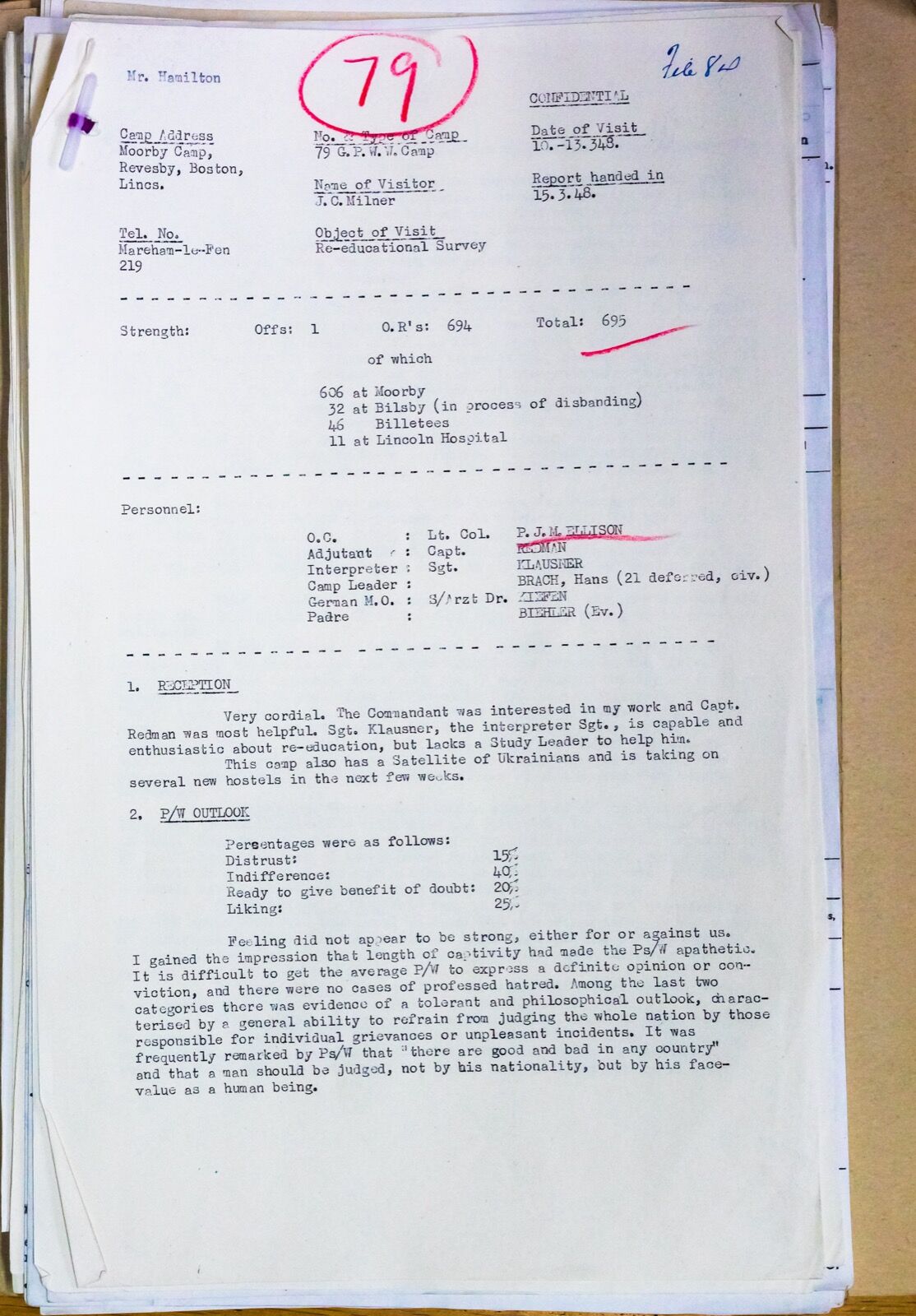
- 10 to 13 March 1948A camp inspection records 695 men and notes a Ukrainian satellite.
- July 1948The locality return lists 1,264 Ukrainian men in camps at or near Moorby.
- 20 August 1948Moorby is named as an ex-prisoner-of-war camp in course of preparation as a Lindsey farm hostel.
- 27 September 1948A court report describes a Ukrainian resident of the camp as three days from civilian status.
- April 1949Hromada prints a Moorby Hostel correspondence address.
- Mid-1950sOrdnance Survey mapping shows an agricultural workers’ hostel on the site.
- By 2002Mapping records poultry houses belonging to a farm on the former camp site.
The camp and its changing population
The camp was originally built by Italian prisoners, subsequently housed Germans, and later accommodated Ukrainian displaced people. This sequence was clarified in a correction published by the Society for Lincolnshire History and Archaeology in 2005. It prevents the camp’s different populations being treated as a single unchanging community.
At its largest the camp was the head of a network. The survey of 27 November to 6 December 1946 put one officer and 2,940 other ranks under Lieutenant-Colonel P. J. M. Ellison: 900 in the main camp at Moorby, 1,100 in the satellite at Tattershall, and the rest in hostels at Tumby, Sibsey, Addlethorpe, Boothby, Bilsby and Skegness or in billets. By the inspection of 10 to 13 March 1948 the same command had shrunk to 695 men, of whom 606 were at Moorby.
That March inspection is also where the Ukrainians enter the file. The visiting officer noted in a single sentence that the camp “also has a Satellite of Ukrainians”. Nothing else in the transcribed reports describes them. Separately, a July 1948 return counted 1,264 Ukrainian men in camps at or near Moorby. Those men were former soldiers of the Galicia Division brought from Italy in 1947 and still held as prisoners; the figure covers a locality, not the population inside Camp 79.
Camp 79 strength returns
| Location | 27 November to 6 December 1946 | 10 to 13 March 1948 |
|---|---|---|
| Main camp, Moorby | 900 | 606 |
| Satellite, Tattershall | 1,100 | not listed |
| Hostel, Bilsby | 451 | 32 (disbanding) |
| Hostels at Tumby, Sibsey, Addlethorpe, Boothby and Skegness | 274 in total | not listed |
| Billetees | 216 | 46 |
| Lincoln Hospital | not listed | 11 |
| Total | 2,941 | 695 |

Work and an isolated setting
The March inspection describes an isolated camp with limited transport. Men working at a Boston canning factory left at seven in the morning and returned at half past eight at night, though not on Fridays and Saturdays, and Boston was fifteen miles away. The report records one hot tap for six hundred men and an inadequate coal allowance, alongside a camp newspaper and organised lectures. These observations concern the inspected German camp, not a separate account of Ukrainian living conditions.
The 1946 survey found a camp that an inspector called education minded and well off. It had a printing press issuing 250 copies of a twelve-page magazine every fortnight, a library of some 3,000 books circulating between the main camp and the hostels, weekly discussion groups, films from the YMCA and the British Film Unit, and 150 men studying English, Spanish, Russian and technical subjects. An orchestra and a theatrical group travelled out to the hostels.
Some of that reached the surrounding villages. In February 1947 the camp choir and orchestra gave a sacred concert at St Mary’s parish church in Horncastle, whose vicar had himself been a prisoner in Germany, and over a year of such visits to churches and chapels in east Lincolnshire the musicians raised 80 pounds 13 shillings for the Save Europe Now fund. In September 1947 a room behind Church Lane in Horncastle was opened as a club for prisoners visiting the town from Moorby.
Sources for this section
The handover to the hostel programme
By August 1948, Moorby was being prepared for use in Lincolnshire’s agricultural hostel programme. The Lindsey Agricultural Executive Committee was recruiting Irishmen, Poles, Ukrainians, Hungarians, unemployed men from Merseyside, Hull and Grimsby, former prisoners of war, schoolchildren and European Voluntary Workers to overtake arrears of farm work. Moorby and Brigg were named as ex-prisoner-of-war camps then in course of preparation, among 23 permanent farm hostels the committee hoped to have open by the end of the year. The committee complained that the Ministry of Works had provided about half the accommodation promised.
A report of 27 September 1948 shows the transition under way at Moorby itself: a Ukrainian resident of the camp, prosecuted at Horncastle over a theft of tea, was said to be three days from civilian status.
Sources for this section
A postal address in a scattered community
In April 1949, the Ukrainian periodical Hromada printed a tracing notice carrying a Moorby Hostel address near Revesby and Boston. Such notices connected people across the postwar diaspora through named places where letters could reach them. Here the surviving address gives direct contemporary evidence that the hostel was part of Ukrainian correspondence networks after the military-camp period.
The notice does not provide a population total or describe a local organisation. Its significance is more immediate: Moorby remained a usable point of contact for someone seeking a missing relative. The hostel address carried that search beyond Lincolnshire to the readership of a Ukrainian publication issued in Paris.
Moorby in dated records
| Record | What it establishes |
|---|---|
| March 1948 inspection | A Ukrainian satellite attached to Camp 79 |
| July 1948 return | 1,264 Ukrainian men in camps at or near Moorby, a locality figure |
| 20 August 1948 press report | Moorby in course of preparation as a Lindsey farm hostel |
| 27 September 1948 court report | A Ukrainian resident three days from civilian status |
| April 1949 Hromada | Moorby Hostel used as a postal address |
| Mid-1950s mapping | Agricultural workers’ hostel on the camp site |
Sources for this section
Agricultural hostel and later farm use
The Ordnance Survey six-inch map of the mid-1950s shows an agricultural workers’ hostel on the former camp site, and the county record carries that use to about 1970. By 2002 the mapping records poultry houses belonging to a farm there. The site’s reuse as a turkey farm is also recorded in the 2005 local-history correction, completing a sequence from wartime accommodation through postwar labour housing to agricultural buildings.
No source read gives an opening or closing date for the Ukrainian hostel phase, the name of the body that administered it, or a count of the people who lived in it.
Sources
- Post-war camps and hostels
Ukrainians in the United Kingdom Online Encyclopedia · 2013
Reports 1,264 Ukrainian men in camps at or near Moorby in July 1948.
- Moorby Camp, MLI90571
Lincolnshire County Council · 2021
Monument record read in full. Gives TF 29845 63719, about 205 by 226 metres, parishes of Claxby Pluckacre and Moorby, a standard camp numbered 79, and two periods: prisoner-of-war camp about 1940 to 1948 and workers’ hostel about 1948 to 1970, with poultry houses by 2002. Its spelling ‘Ravensby’ is a misreading of Revesby.
- Moorby inspection reports, FO 939/159
The National Archives; transcribed by Axis Prisoners of War in Lincolnshire · 1946–1948
Transcriptions of FO 939/159 read in full from the page source. The March 1948 report separately mentions a Ukrainian satellite in one sentence; its return of 695 men, and the 1946 survey’s 2,941, belong to the German camp administration. The original National Archives file was not consulted. On frequency, section 6 ‘Re-educational Activities’ reads: “Discussion Groups: The Main Camp and the seven hostels each have a fairly good discussion programme. Regular once a week discussions are held on a variety of subjects – e.g. ‘Democracy and how to apply it to Germany’”.
- Agricultural hostel plans and the transition to civilian status
Lincolnshire Echo, reproduced in a newspaper transcription collection · 20 August and 27 September 1948
Contemporary reports place Moorby in the hostel-conversion programme and identify a Ukrainian resident nearing civilian status.
- Hromada, numbers 7–8
Hromada, Paris · April 1949
An original tracing notice gives a Moorby Hostel address. Only the place-name line is reproduced; personal names are omitted.
- Postscript to Prisoner of War Camps in Lincolnshire
John T. Turner, Lincolnshire Past & Present, number 59 · Spring 2005
Page 11 corrects the earlier article: Moorby housed Italians, Germans and then Ukrainian displaced persons before becoming a turkey farm. The PDF has no text layer; the page was rendered at 250 dpi and read with OCR.
- Moorby camp reports in the Lincolnshire Echo, 1947 to 1948
Lincolnshire Echo, transcribed by Axis Prisoners of War in Lincolnshire · 1947–1948
Transcribed newspaper items read in full. Used here for the February 1947 concert at St Mary’s Horncastle, the 80 pounds 13 shillings raised over a year of church concerts, and the September 1947 club room at Horncastle. The original newspapers were not seen.
- Camp 79 Moorby: re-educational survey, 10–13 March 1948, FO 939/159
The National Archives, Kew; photographed and published by the Repatriated Landscape project (Banged Up Abroad) · 1948
Photograph of the first page of J. C. Milner’s re-educational survey of 79 German Prisoner of War Working Camp. Heads the camp address as Moorby Camp, Revesby, Boston, Lincs., gives a strength of 695 with 606 at Moorby, and records in the reception paragraph that the camp “also has a Satellite of Ukrainians” and is taking on several new hostels. Crown copyright archival record; the publisher asserts no open licence.
Last researched 13 September 2026