Newbattle Miners’ Hostel
Arrival and settlement
Dalkeith, Midlothian, Scotland · Documented 1948–1953
A miners’ hostel in the hutted camp at Newbattle Abbey, connecting postwar migration with the Midlothian coalfield. Public records name residents and their occupations, while surviving huts recall the estate’s earlier military life.
Introduction
Newbattle Miners’ Hostel was one of the Scottish hostels in which Ukrainians lived after the Second World War. Located at Newbattle Abbey near Dalkeith, it belonged to the world of employment and settlement: accommodation close to work in the Midlothian coalfield. Naturalisation notices place miners at the hostel from the late 1940s to the early 1950s, giving names to a community otherwise easily reduced to a dot on a map.
A history in dates
- 1939–1945Newbattle serves as a military training base, with huts built across the college grounds.
- 15 April 1946Air photographs record the camp at its full extent: about 140 huts across some nineteen hectares of parkland.
- 1945–1948An army education programme prepares service personnel for civilian life.
- May 1948A witness to a legal notice gives his address as Newbattle Miners’ Hostel, the earliest published use of the name traced here.
- July 1948A count records 958 former Galicia Division soldiers in camps at or near Dalkeith.
- 24 May 1949Newbattle Hostel is mentioned in Parliament during a debate about miners’ housing.
- 1949–1953Naturalisation notices record an electrician, a colliery haulageman and coal miners living at the hostel.
- June 1953A Lithuanian miner at the hostel gives notice of a change of name.
- 2007About twenty-three wartime huts are recorded as surviving in use as part of the hostel.
- 2017–2018A community fundraising campaign supports restoration of a surviving wartime hut as the Bee Academy.
Sources for this section
- Newbattle’s wartime past and the Big Dig
- Newbattle Abbey Hostel, Military Camp
- Sequestration notice witnessed at Newbattle Miners’ Hostel
- Post-war camps and hostels
- Scottish Coalfields (Conditions)
- Naturalisation notice: Wladyslaw Sedzikowski
- Naturalisation notice: Leon Pfeiffer
- Naturalisation notice: Michael Wollanski / Michael Wilson
- Naturalisation notice: Wladyslaw Tadeusz Sierpinski
- Naturalisation notice: Piotr Bohdanowicz
- Notice of change of name: Pranas Pukinskas
- The Bee Academy: restoring a wartime hut
Before the miners: a military estate
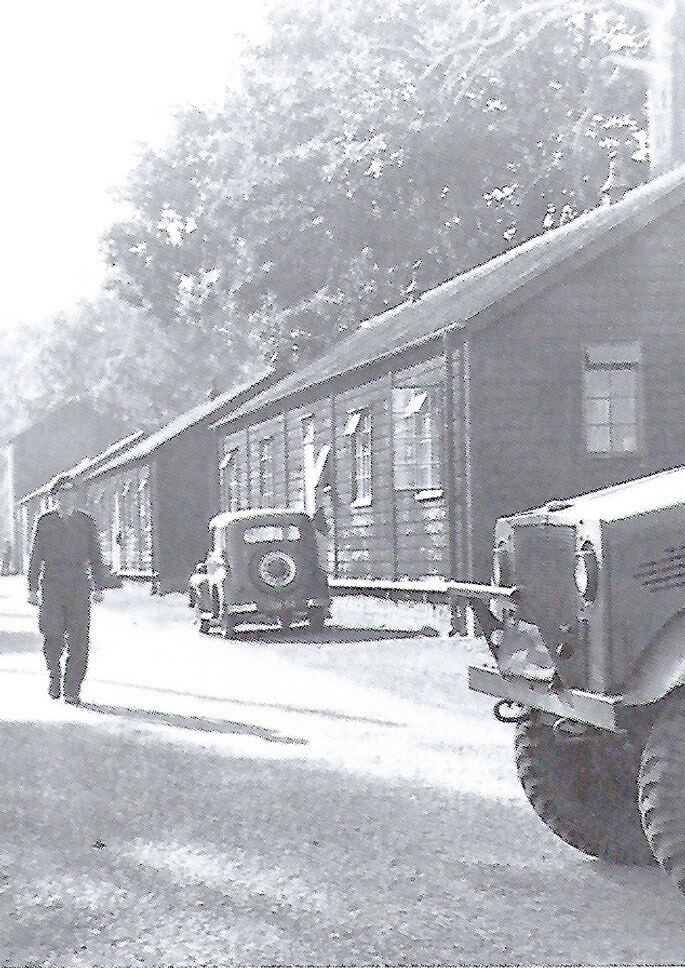
The estate had already undergone a dramatic change during the war. Newbattle Abbey College became a training base for the Auxiliary Territorial Service—the women’s army—and the Royal Army Medical Corps. Recruits stayed for three to six weeks, and huts spread through the grounds to accommodate up to 2,000 trainees.
After 1945, an army education programme offered returning service personnel classes ranging from mathematics and commerce to crafts and domestic science. These military and educational uses preceded the miners’ hostel; the wartime capacity describes trainees, not Ukrainian residents.
Sources for this section
The shape of the camp
The national record of the historic environment carries the site as Newbattle Abbey Hostel, Military Camp, at NT 3335 6628 in the parish of Newbattle. Vertical air photographs flown on 15 April 1946 show the camp at its full extent, occupying about nineteen hectares of parkland within the Newbattle estate and running from a point just south-west of the Maiden Bridge to ground later covered by the housing at Kirk Bank, north of Barondale House.
The photographs show about eighty-four huts north-east of the Newbattle Road and a further fifty-six to the south-west, many of them with camouflaged roofs, together with a sewage filtration plant and a long practice trench. When the record was compiled in 2007 about twenty-three of the wartime huts survived and were in use as part of the Newbattle hostel, in an area north of Newbattle Abbey House; the ground to the south-west had by then been built over with new housing.
The camp on the 1946 air photographs
| Feature | Recorded |
|---|---|
| Area | About 19 hectares of parkland in the Newbattle estate |
| Huts north-east of Newbattle Road | About 84 |
| Huts south-west of Newbattle Road | 56 |
| Roofs | Many camouflaged |
| Other structures | Sewage filtration plant; a long practice trench and two shorter ones |
| Surviving in 2007 | About 23 huts, in use as part of the hostel |
Sources for this section
The hostel system
Newbattle belonged to a national network. Almost all of the 21,000 Ukrainian European Volunteer Workers and their 860 dependants brought to Britain between 1947 and 1950 lived in hostels: former military and prisoner-of-war camps, wartime industrial and agricultural hostels, and buildings converted after the war. They were run by bodies such as the National Service Hostels Corporation, the Ministry of Agriculture, the National Coal Board, the YMCA, local authorities and private firms. Hostels usually held workers of more than one nationality, though many had sizeable Ukrainian groups.
Men and women were housed separately at first, and married couples were only later able to live together or nearby. Most residents could leave a hostel only after the beginning of 1951, when employment restrictions began to be lifted from those who had been in the country three years; by the mid-1950s most of the hostels had closed. Outside working hours the Ukrainians ran English classes and lectures, kept libraries and reading rooms, produced news sheets, formed choirs, dance, drama and instrumental groups, and played football, volleyball, table tennis and chess, competing with other hostels and in local leagues. Representatives of the Association of Ukrainians in Great Britain visited, bringing books and newspapers and arranging for Ukrainian priests to hold services.
Ukrainians were already in the district before the hostel took its later name. When the 8,500 former soldiers of the Galicia Division were moved to Britain from Italy in May and June 1947 they were held in prisoner-of-war camps, chiefly in eastern England and southern Scotland. A count of July 1948 puts 958 of them in camps at or near Dalkeith, the fifth largest such concentration in the country. After their release from prisoner-of-war status between August and October 1948 the camps holding them passed to civilian authorities and were redesignated hostels.
Sources for this section
A home near the coalfield
Newbattle appears in Peter Kormylo’s directory of camps and hostels used by Ukrainians in Scotland, as entry 40, Newbattle Miners’ Hostel, Dalkeith, Midlothian. The name also appears independently in contemporary public records, which call it both Newbattle Miners’ Hostel and the Miners’ Hostel at Newbattle Abbey. Together, these sources establish the hostel’s place in the postwar settlement landscape.
The earliest of those references is from May 1948, when a witness to a Scottish legal document gave his address as Newbattle Miners’ Hostel, Dalkeith. The name was therefore in ordinary use within a year of the first European Volunteer Workers reaching Britain.
The published addresses connect accommodation directly with employment. Residents included coal miners, a colliery haulageman and an electrician. The notices record Poland as the former nationality of most of them and Lithuania in one case; they do not establish the men’s ethnic identities. Their inclusion here describes the wider hostel community alongside its documented Ukrainian connection.
Sources for this section
- Ukrainians in Scotland: camp and hostel directory
- Naturalisation notice: Wladyslaw Sedzikowski
- Naturalisation notice: Leon Pfeiffer
- Naturalisation notice: Michael Wollanski / Michael Wilson
- Sequestration notice witnessed at Newbattle Miners’ Hostel
- Naturalisation notice: Wladyslaw Tadeusz Sierpinski
- Naturalisation notice: Piotr Bohdanowicz
- Notice of change of name: Pranas Pukinskas
Residents recorded by name
Naturalisation notices preserve useful details for family research: an original surname, sometimes an adopted name, an occupation and an address at a particular point in time. Six notices between 1949 and 1953 identify residents at Newbattle. Michael Wollanski, for example, is also recorded as Michael Wilson—a valuable link when following a family through later records.
A change of name could be announced separately and years before naturalisation. In June 1953 Pranas Pukinskas, a miner living at Newbattle Miners’ Hostel, gave public notice that he intended to assume a new name; when he was naturalised in October 1957, by then living in Edinburgh, the register entered him as Pukinskas, Pranas, known as Frank Paterson, a coal miner of Lithuanian former nationality. The pairing shows how a Newbattle address can be the link between an original name and the anglicised one a family later used.
The dates below are the dates attached to naturalisation entries and to the name-change notice. They establish documented residence around that process, rather than arrival dates or the length of each person’s stay.
Residents in naturalisation records
| Name in the record | Occupation | Record date | Recorded former nationality | Source |
|---|---|---|---|---|
| Wladyslaw Tadeusz Sierpinski | Electrician | 28 July 1949 | Poland | London Gazette 38718, p. 4506 |
| Piotr Bohdanowicz | Coal miner | 29 March 1950 | Poland | Edinburgh Gazette 16753, p. 241 |
| Wladyslaw Sedzikowski | Colliery haulageman | 20 March 1951 | Poland | Edinburgh Gazette 16858, p. 263 |
| Leon Pfeiffer | Coal miner | 6 November 1952 | Poland | London Gazette 39714, p. 6494 |
| Pranas Pukinskas, later Frank Paterson | Miner | 17 June 1953 | Lithuania | Edinburgh Gazette 17084, p. 342 |
| Michael Wollanski, also Michael Wilson | Coal miner | 6 August 1953 | Poland | Edinburgh Gazette 17118, p. 540 |
Sources for this section
- Naturalisation notice: Wladyslaw Sedzikowski
- Naturalisation notice: Leon Pfeiffer
- Naturalisation notice: Michael Wollanski / Michael Wilson
- Naturalisation notice: Wladyslaw Tadeusz Sierpinski
- Naturalisation notice: Piotr Bohdanowicz
- Notice of change of name: Pranas Pukinskas
- Naturalisation notice: Pranas Pukinskas, known as Frank Paterson
Work did not immediately mean a family home
The hostel also enters a parliamentary debate about housing in the Scottish coalfields. On 24 May 1949, local MP David Pryde described Douglas Forrest, a skilled mining machine operator, living in lodgings while his wife worked at Newbattle Hostel. His account shows how employment and the shortage of suitable homes could keep a couple’s daily lives divided.
In the same debate, the government explained plans to move miners from declining Lanarkshire pits into developing coalfields, including the Lothians. Newbattle’s story therefore sits within two overlapping movements: migration into Britain and the relocation of workers within Scotland.
Sources for this section
The huts that remain
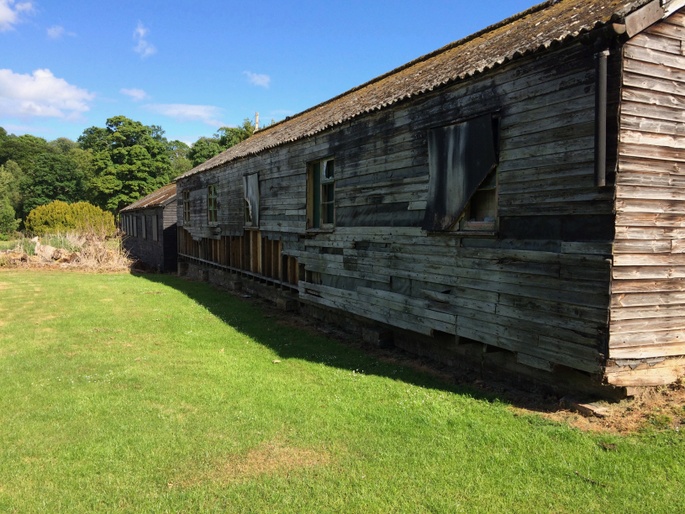
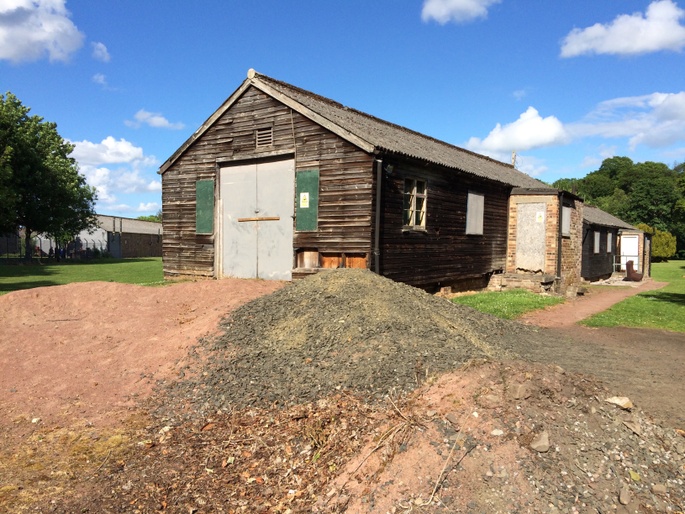
Parts of the wartime hut complex have survived through new uses. Archaeology Scotland identifies huts incorporated into Newbattle Business Park. Another timber building was restored by Newbattle Beekeepers Association as its Bee Academy, preserving a piece of the estate’s military fabric for community learning.
The beekeepers’ project began fundraising in July 2017 and had raised more than £30,600 by mid-May 2018. Its photographs document the wooden buildings before refurbishment. They show the wider Newbattle camp landscape; an individual hut’s use as Ukrainian sleeping accommodation is not established.
Sources for this section
Sources
- Ukrainians in Scotland: camp and hostel directory
Peter Kormylo / University of Glasgow · 2021
Printed page 323, directory entry 40: Newbattle Miners’ Hostel, Dalkeith, Midlothian. The thesis text was searched; Newbattle appears only in this directory.
- Newbattle’s wartime past and the Big Dig
Archaeology Scotland · 2024
Military training in 1939–1945, army education in 1945–1948 and surviving huts.
- Scottish Coalfields (Conditions)
UK Parliament, Hansard · 24 May 1949
David Pryde’s account names Douglas Forrest and his wife’s employment at Newbattle Hostel; government response explains coalfield transfers.
- Naturalisation notice: Wladyslaw Sedzikowski
The Edinburgh Gazette · 25 May 1951
Page 263: colliery haulageman at Miners’ Hostel, Newbattle Abbey; entry dated 20 March 1951. Also printed in The London Gazette, issue 39233, page 2813, 22 May 1951.
- Naturalisation notice: Leon Pfeiffer
The Edinburgh Gazette · 12 December 1952
Page 714: coal miner at Miners’ Hostel, Newbattle Abbey; entry dated 6 November 1952. Also printed in The London Gazette, issue 39714, page 6494, 9 December 1952.
- Naturalisation notice: Michael Wollanski / Michael Wilson
The Edinburgh Gazette · 16 October 1953
Page 540: coal miner at Newbattle Miners’ Hostel; entry dated 6 August 1953. Also printed in The London Gazette, issue 39986, page 5451, 13 October 1953.
- The Bee Academy: restoring a wartime hut
Newbattle Beekeepers Association · Undated; describes 2017–2018
First-hand restoration account, historical hut photograph credited to Imperial War Museum, and photographs before refurbishment.
- Post-war camps and hostels
Ukrainians in the United Kingdom: online encyclopaedia, Association of Ukrainians in Great Britain · Accessed September 2026
Entry read in full: the 21,000 Ukrainian European Volunteer Workers and 860 dependants, the bodies that administered the hostels, separate accommodation for men and women, the lifting of employment restrictions from 1951, hostel closures by the mid-1950s, the cultural and sporting life of the hostels and AUGB visits, and the July 1948 count of 958 former Galicia Division men in camps at or near Dalkeith.
- Newbattle Abbey Hostel, Military Camp
National Record of the Historic Environment, Historic Environment Scotland · Description compiled by RCAHMS, March 2007
Site NT36NW 202, NRHE 178743, NT 3335 6628. Full descriptive account read: the camp’s extent on vertical air photographs of 15 April 1946, about nineteen hectares, 84 huts north-east and 56 south-west of the Newbattle Road, camouflaged roofs, the sewage filtration plant and practice trenches, the twenty-three surviving huts in use as part of the hostel, and the later housing on the south-western ground.
- Naturalisation notice: Wladyslaw Tadeusz Sierpinski
The London Gazette · 20 September 1949
Page 4506: electrician at Newbattle Abbey Hostel, Dalkeith, Midlothian; entry dated 28 July 1949.
- Naturalisation notice: Piotr Bohdanowicz
The Edinburgh Gazette · 23 May 1950
Page 241: coal miner at Newbattle Miners’ Hostel, Dalkeith, Midlothian; entry dated 29 March 1950.
- Notice of change of name: Pranas Pukinskas
The Edinburgh Gazette · 19 June 1953
Page 342: “I, Pranas Pukinskas, Miner, residing at Newbattle Miners’ Hostel, Dalkeith, Midlothian, hereby give notice that as from this date I intend to assume the name…”
- Sequestration notice witnessed at Newbattle Miners’ Hostel
The Edinburgh Gazette · 28 May 1948
Page 250: a witness signature given with the address Newbattle Miners’ Hostel, Dalkeith. The earliest published use of the hostel’s name found in a search of the Gazette from 1946 to 1962.
- Naturalisation notice: Pranas Pukinskas, known as Frank Paterson
The Edinburgh Gazette · 15 October 1957
Page 610: “Pukinskas, Pranas (known as Frank Paterson); Lithuania; Coal Miner; 13 Annandale Street, Edinburgh, 7, Midlothian.” By this date he had left the hostel.
Last researched 14 September 2026