Pahīatua Reception and Training Centre
Arrival and settlement
Pahīatua, North Island, New Zealand · 1949–1952
After the journey from Europe, Pahīatua gave displaced families a temporary home while they learned English and prepared for work across New Zealand. Ukrainians were among the newcomers to this busy reception centre, the third community to occupy a camp built for wartime internment.
Introduction
Pahīatua was a reception and training centre for people who had already been accepted for resettlement in New Zealand. Ukrainians formed part of its international community. In 1949, the government described a selected group consisting mainly of Baltic refugees, alongside Ukrainians, Czechs, Poles and other nationalities, who would begin their New Zealand lives at the centre.
The purpose was practical: language instruction, an introduction to citizenship and local customs, and preparation for employment. The 1949 plan anticipated a stay of at least four weeks before people moved into the wider community.
Sources for this section
A history in dates
- Early 1943The purpose-built civilian internment camp opens on part of the former Pahīatua racecourse.
- 1 November 1944838 Polish refugees, children and accompanying adults, arrive at the camp.
- 1946The New Zealand government takes over the whole cost of running the Polish camp after support from the Polish government in exile ends.
- 1949The site becomes a reception centre for displaced people accepted for New Zealand resettlement.
- 1949–1953Official drafts bring 4,584 displaced persons to New Zealand under the arrangement with the International Refugee Organisation.
- 19 October 1950The Hellenic Prince arrives in Wellington with a group destined for Pahīatua.
- 1951Three sailings of the Goya bring displaced persons to the camp.
- 14 August 1951Camp staff prepare a detailed reception programme for the second Goya group.
- 1952The displaced-persons centre closes.
- 1 November 2024New interpretation panels commemorate all three phases of the camp.
Sources for this section
- Unveiling the Commemoration Panels
- Photo of Pahiatua, and Life at the Camp
- Department of Labour and Employment annual report, 1949
- Immigration: Post-1944
- Different Pasts With A New Future: Displaced Persons Arrive For Pahiatua Camp
- Pahīatua camp photographs and the Holland teachers’ archive
- Reception arrangements for the second Goya draft
One site, three different chapters
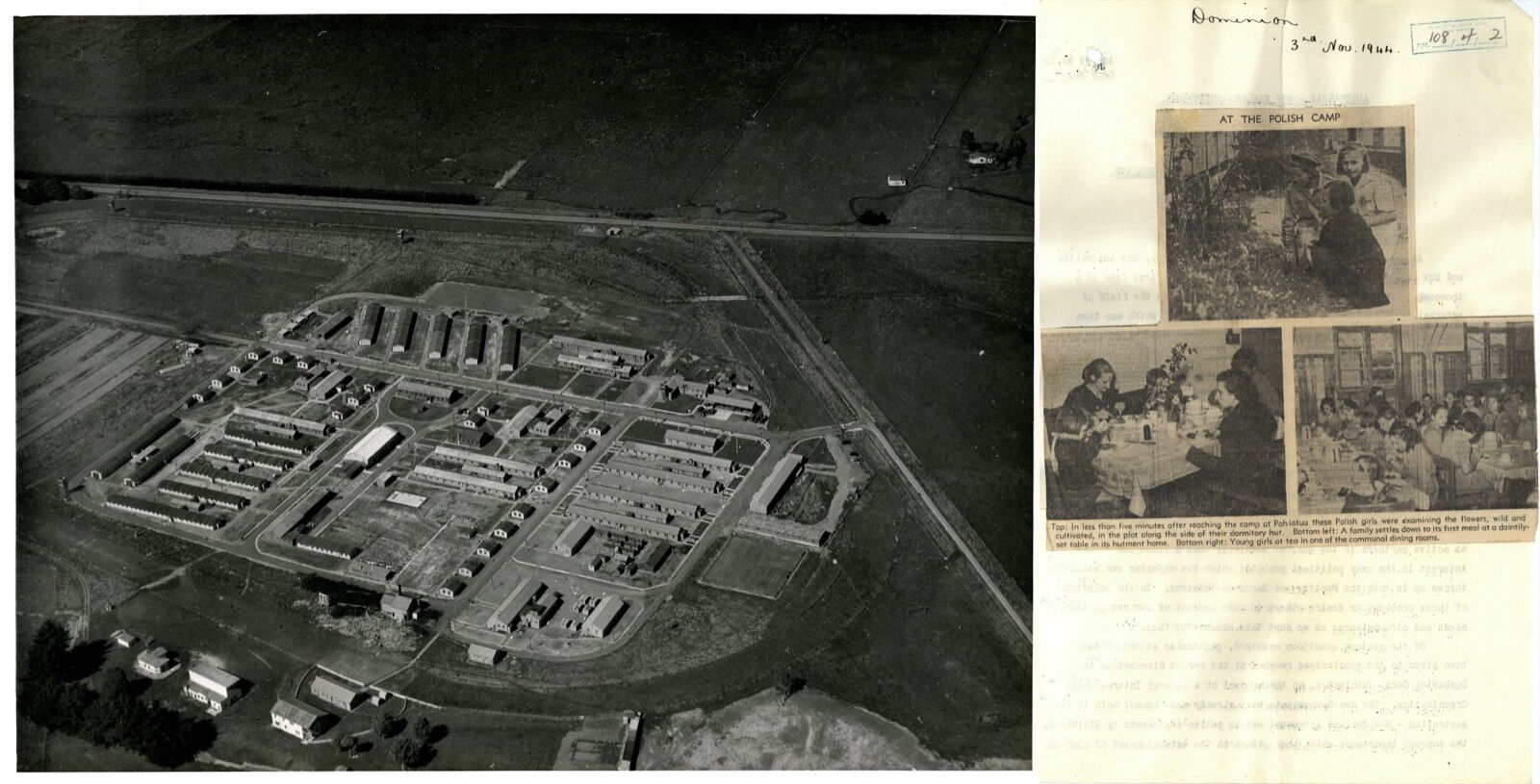
The land on State Highway 2 south of Pahīatua had been part of the Pahīatua racecourse. The camp built on it was purpose-built for wartime civilian internment in early 1943, to hold people classed as enemy aliens. In November 1944 it became a refuge for Polish children and their accompanying adults: 838 Polish refugees arrived on 1 November 1944. When that community left in 1949, the buildings entered a third phase as accommodation for displaced people arriving from Europe.
The displaced persons inherited a camp already equipped for communal life. It had a hospital, a chapel, a theatre used for performances, concerts and film shows, playing fields for football, basketball and volleyball, a kitchen and canteen, dormitories, cottages, a school and a laundry block. Its staff establishment had included a camp commandant, administration clerks, a doctor with a visiting medical officer from the town, nurses, teachers, a cook, a fire master, a boot-repair instructor and drivers. The theatre and the kitchens reappear in the reception instructions written for the displaced-persons drafts.
These successive uses explain why the site is often remembered as the Polish Children’s Camp. The postwar reception centre served a different, multinational intake. A 2024 account of the museum’s interpretation panels gives approximately 4,000 displaced people passing through this final phase before closure in 1952.
The New Zealand displaced-persons scheme
The intake was one of the first substantial movements from Europe to New Zealand after the war, arranged by the government with the International Refugee Organisation and running from 1949 to 1953. Arrivals in the official drafts totalled 4,584, with some 250 further fare-paying and sponsored people alongside them.
The principal countries of origin or last residence were Romania with 918, Poland 847, Latvia 545, Yugoslavia 504, Czechoslovakia 336, Hungary 280, the USSR 275, Lithuania 242, Bulgaria 199, Estonia 189 and Ukraine 179, with smaller numbers of Albanians, Austrians and Germans. Those are countries of origin or last residence, not statements of ethnicity: a Ukrainian from Galicia could be counted under Poland and one from Volhynia under the USSR, so the 179 recorded against Ukraine is a floor rather than a total.
The programme was framed as skilled migration rather than humanitarian relief, intended to help New Zealand’s postwar economic growth, and it ran against a government policy of assimilation. That framing shaped the camp: the point of the stay was English, local law and custom, and placement in a job.
Displaced persons admitted to New Zealand, 1949 to 1953, by country of origin or last residence
| Country | People |
|---|---|
| Romania | 918 |
| Poland | 847 |
| Latvia | 545 |
| Yugoslavia | 504 |
| Czechoslovakia | 336 |
| Hungary | 280 |
| USSR | 275 |
| Lithuania | 242 |
| Bulgaria | 199 |
| Estonia | 189 |
| Ukraine | 179 |
| Official drafts, all countries | 4,584 |
From the ship to the camp
On 19 October 1950 the Hellenic Prince reached Wellington after a voyage from Bremerhaven. The following day’s newspaper reported 973 passengers bound for the Pahīatua reception process, including 95 described in the contemporary classification as Polish-Ukrainians. The passenger figures describe one arrival, rather than the camp’s total population.
By 1951, the camp was also receiving people from three sailings of the Goya. Further arrivals came in early 1952; most of these had sailed to Australia on ships registered to the International Refugee Organisation and then travelled onward to New Zealand by ship or, in some cases, by plane. Pahīatua connected the overseas journey with the next move: a job and a new home somewhere in New Zealand.
The Hellenic Prince arrival, October 1950
| Measure | Reported number | Scope |
|---|---|---|
| Passengers | 973 | One ship arrival at Wellington |
| Polish-Ukrainians | 95 | The newspaper’s category within that arrival |
How arrival day worked
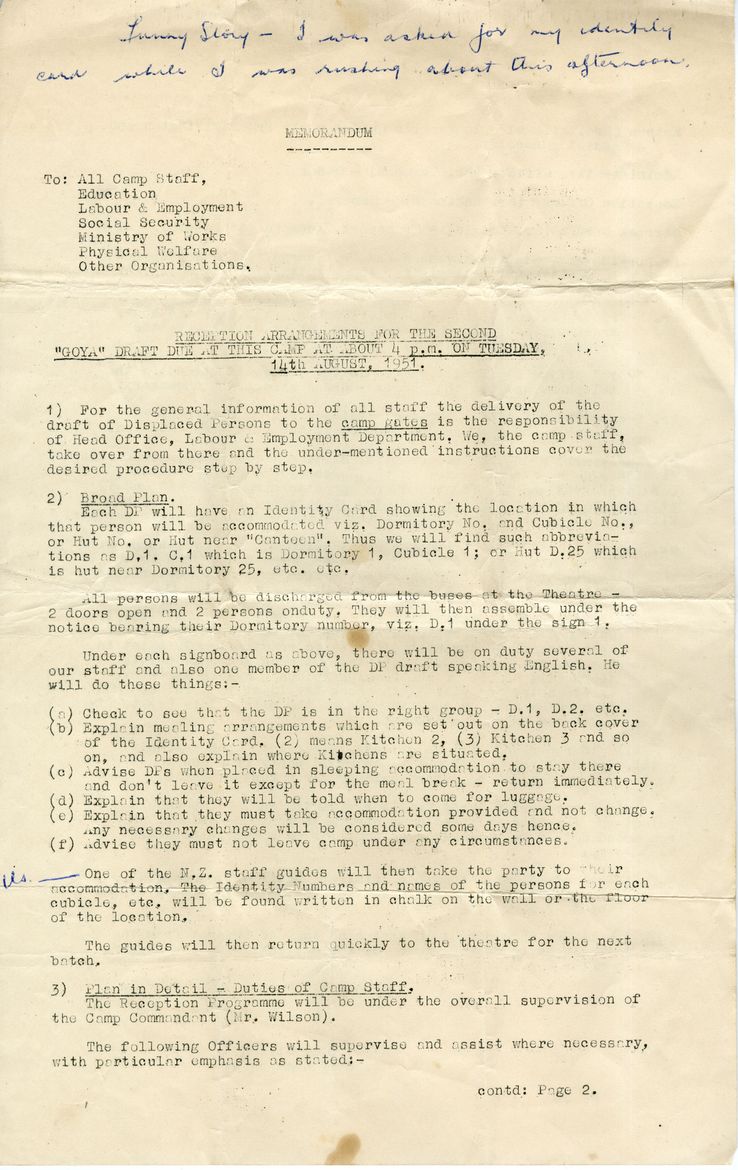
A surviving memorandum sets out the reception planned for the second Goya draft, due at the camp at about four in the afternoon on Tuesday 14 August 1951. It was circulated to all camp staff and to the education, labour and employment, social security, Ministry of Works and physical welfare officers, and it made the division of responsibility plain: delivering the draft to the camp gates was the Labour and Employment Department’s head office, and the camp staff took over from there.
Everyone was to be discharged from the buses at the theatre, with two doors open and two staff on duty. Each person held an identity card giving a dormitory and cubicle number, or a hut number, written in the camp’s shorthand — D.1 C.1 for dormitory 1, cubicle 1, or Hut D.25 for the hut near dormitory 25. Arrivals assembled under the notice board bearing their dormitory number.
At each signboard several staff waited together with one member of the incoming draft who spoke English. They were to check that people were in the right group, explain the meal arrangements printed on the back of the identity card and point out which kitchen each number meant, and say when luggage would be given out. The instructions were firm about movement: people were to stay in their sleeping accommodation and leave it only for meals, to take the accommodation provided and not change it, with any changes considered some days later, and not to leave the camp under any circumstances.
New Zealand staff guides then walked each party to its quarters, where the identity numbers and names for each cubicle had been written in chalk on the wall or the floor, before hurrying back to the theatre for the next batch. The whole programme ran under the camp commandant, Mr Wilson. Behind the mass arrival was a carefully ordered sequence of buses, signboards, chalked names and meals.
Reception arrangements, 14 August 1951
| Step | Arrangement |
|---|---|
| Arrival | Buses unload at the theatre; two doors open, two staff on duty |
| Grouping | Arrivals assemble under the notice board bearing their dormitory number |
| Accommodation | Identity card gives dormitory and cubicle, or hut, in the form D.1 C.1 or Hut D.25 |
| Meals | Kitchen number printed on the back of the identity card and explained on the spot |
| Settling in | Guides escort each group to quarters where names are chalked on the wall or floor |
| Rules | Keep the accommodation allotted, leave it only for meals, and do not leave the camp |
Sources for this section
Learning and family life
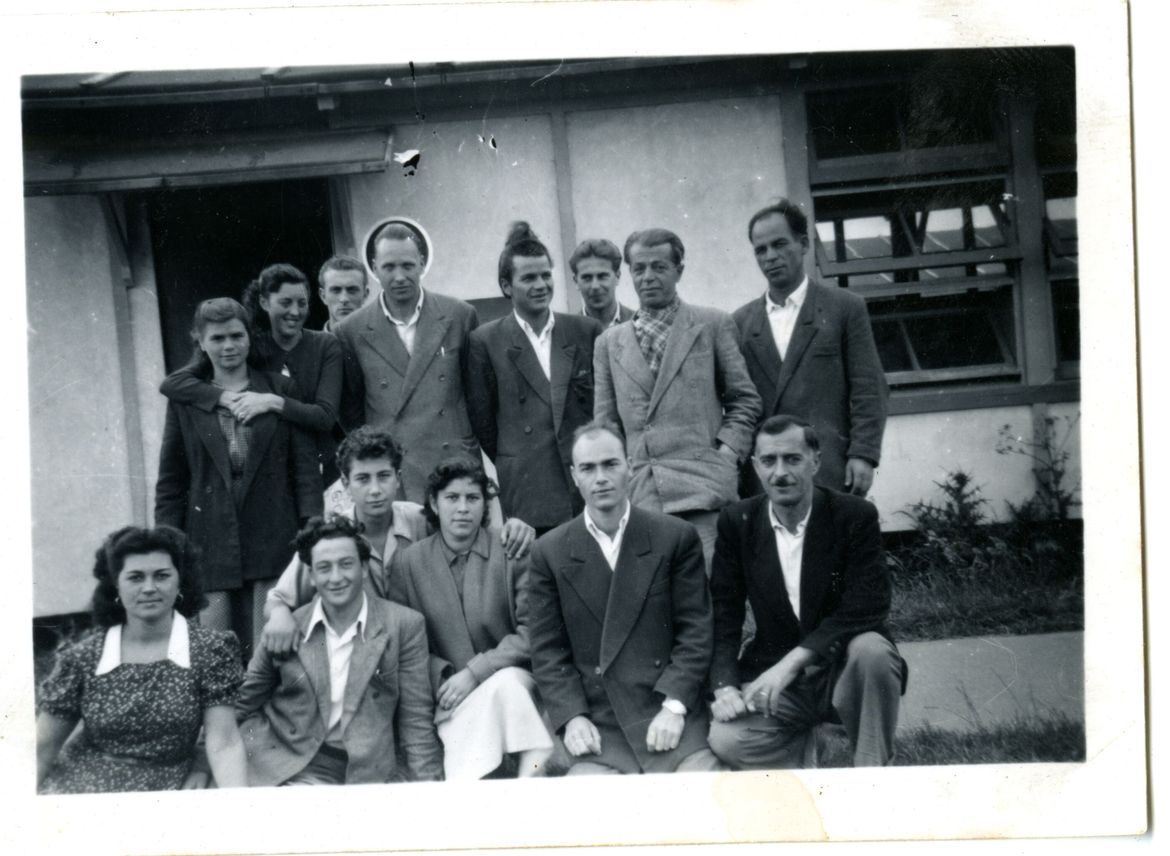
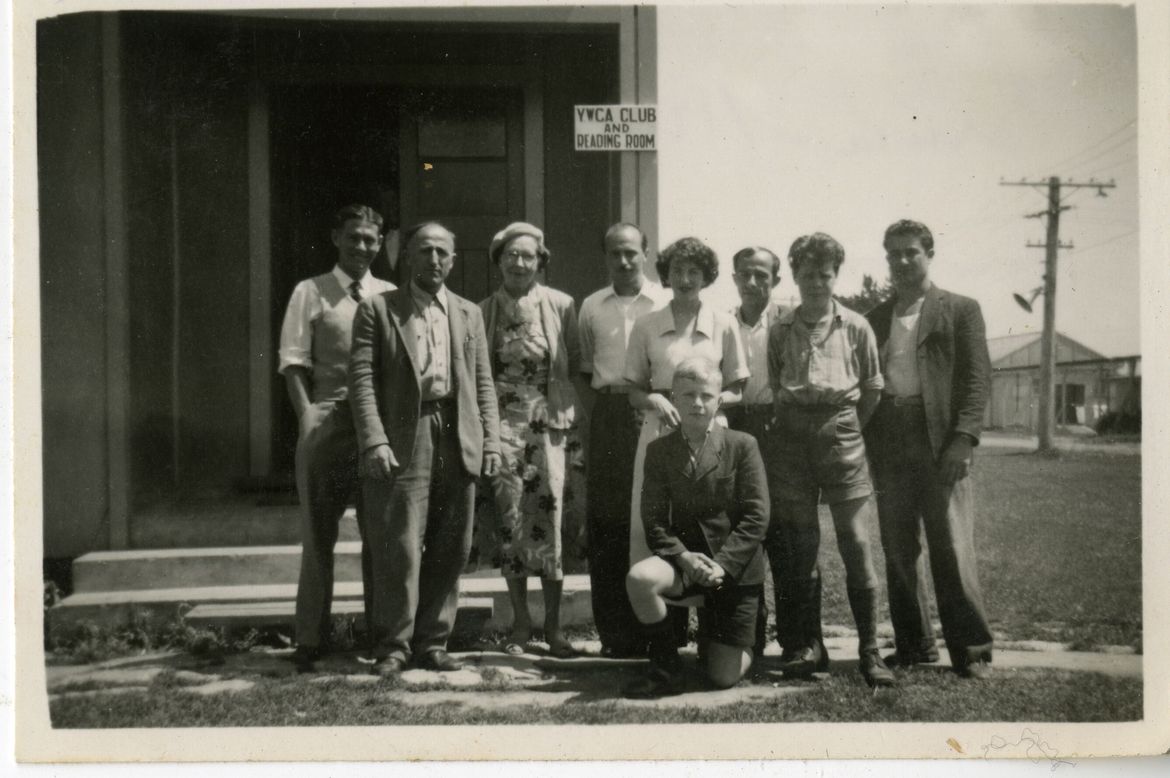
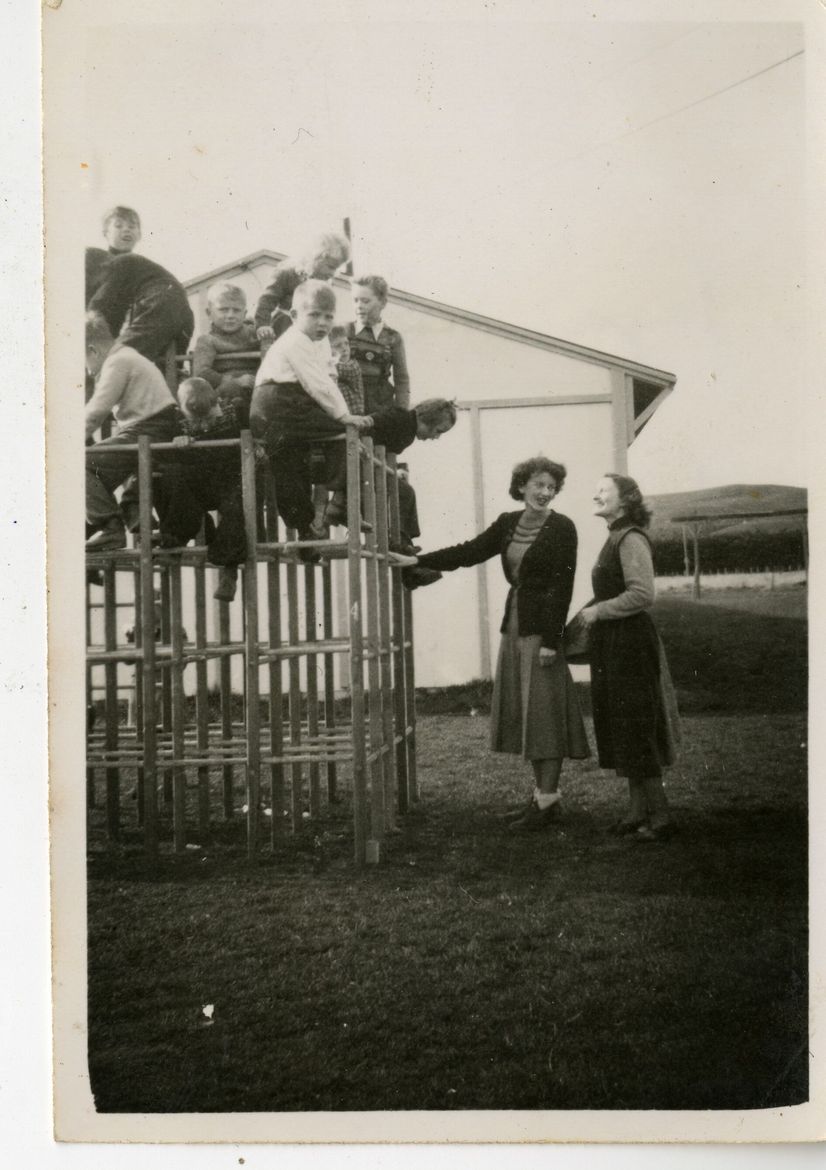
Teachers’ photographs from 1951–1952 show children climbing on playground equipment and adults gathering outside the camp buildings. They record ordinary social life within temporary surroundings: a place where families could pause after their journey while preparing for another move.
The intended programme described in the teachers’ archive lasted about six weeks, but people who were difficult to place in employment could remain for up to a year. Women with children were among those needing longer. Some residents left for forestry or hydroelectric work with only a basic command of English and had to continue learning after departure.
Jack and Beverley Holland, the young teachers whose album records those months, also wrote letters home describing camp life. The album and the letters were deposited together by their family, and they remain the fullest surviving personal account of the displaced-persons phase.
Leaving the camp, remembering the place
The displaced-persons centre closed in 1952. Its history remained part of a wider local story, alongside the earlier internment and Polish refugee phases. New panels unveiled on 1 November 2024 deliberately represented all three communities, restoring the postwar reception centre to the account of the site.
The panels stand at the rest area beside the highway, redeveloped by the Pahīatua Museum for the eightieth anniversary of the Polish children’s arrival. The text for the displaced-persons panel was written separately from the rest, and the panels were unveiled exactly eighty years to the day after the Polish refugees reached Pahīatua.
Local broadcasting has kept the camp in view as well. In May 2024 Manawatū People’s Radio aired the first of a two-part conversation about a project on Second World War displaced persons who settled in Palmerston North; the catalogue record for the programme describes the camp at Pahīatua as the place where many of those who came to New Zealand learned English and New Zealand culture before being placed in jobs.
Sources
- Department of Labour and Employment annual report, 1949
New Zealand Parliament / Papers Past · 1949
Page 17: displaced-person selection and the planned Pahiatua reception centre.
- Different Pasts With A New Future: Displaced Persons Arrive For Pahiatua Camp
Central Hawke’s Bay Press / Papers Past · 20 October 1950
Page 3: Hellenic Prince arrival and reported passenger categories.
- Pahīatua camp photographs and the Holland teachers’ archive
Ian Matheson City Archives / Manawatū Heritage · 1951–1952
Collection 2024-38; digitisation 2024P_IMCA-DigitalArchive_042792. Photograph and collection description.
- Reception arrangements for the second Goya draft
Holland archive / Manawatū Heritage · 14 August 1951
Contemporary camp memorandum, page 1, visually read from the original scan.
- Unveiling the Commemoration Panels
Wiadomości Polskie · December 2024
Adam Manterys, page 5: account by a creator of the new museum interpretation panels.
- Children playing at Pahīatua camp
Jack and Beverley Holland / Manawatū Heritage · 1951–1952
2024P_IMCA-DigitalArchive_042873; photograph and catalogue metadata.
- Group outside a camp building
Jack and Beverley Holland / Manawatū Heritage · 1951–1952
2024P_IMCA-DigitalArchive_042871; photograph and catalogue metadata.
- Photo of Pahiatua, and Life at the Camp
Archives New Zealand · Photograph and clipping of 1944; published online 2013
Aerial photograph of the camp with a Dominion page of 3 November 1944, and the archive’s own description read in full: the site began as a racecourse, was turned into an internment camp for foreign nationals and then adapted for the Polish children; the New Zealand government provided accommodation and equipment while the Polish government in exile funded staff, education and pocket money until 1946; the camp’s facilities and staff establishment are listed; the camp closed in 1949. Licence CC BY-SA 2.0.
- Immigration: Post-1944
An Encyclopaedia of New Zealand, edited by A. H. McLintock; Te Ara · 1966
Section “After the War” read in full: displaced persons admitted by arrangement with the International Refugee Organisation during 1949 to 1953; principal countries of origin or last residence listed (Rumania 918, Poland 847, Latvia 545, Yugoslavia 504, Czechoslovakia 336, Hungary 280, USSR 275, Lithuania 242, Bulgaria 199, Estonia 189, Ukraine 179), with some Albanians, Austrians and Germans; arrivals in the official drafts totalling 4,584 plus about 250 fare-paying and sponsored persons. Text read from the Internet Archive capture of the page.
- Tania Kopytko, Second World War displaced persons, part one, Manawatū Conversations
Manawatū Heritage, Ian Matheson City Archives · 28 May 2024
Catalogue record for a Manawatū People's Radio broadcast, description field read in full. It describes a project on Second World War displaced persons who settled in Palmerston North and records that many who came to New Zealand went to the camp at Pahiatua to learn English and New Zealand culture before being placed in jobs.
Last researched 12 September 2026