Hellenic Prince
IRO fleet·IRO service: 1949–1951
A 1928 Australian seaplane carrier, rebuilt in Wales as an austerity emigrant ship, the Hellenic Prince carried about a thousand displaced persons on each of her voyages from Naples and Bremerhaven to Australia and, once, to New Zealand. Her passengers left the fullest surviving record of complaint about conditions on any of the International Refugee Organisation charters to Australia.
Introduction
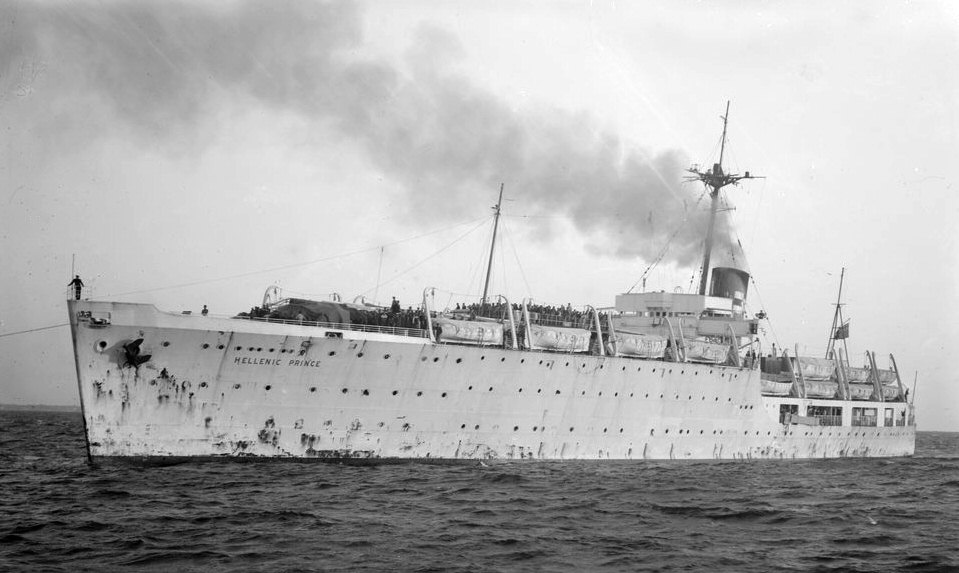
The Hellenic Prince was the only ship on the Australian refugee run that had been built in Australia. She began as HMAS Albatross, a seaplane carrier laid down at Cockatoo Docks in Sydney in 1926 and launched in February 1928. Twenty-one years later, rebuilt as a cheap emigrant carrier under the Hong Kong flag, she came back to Sydney with a thousand displaced persons aboard.12
Between December 1949 and early 1951 she made roughly six voyages under charter to the International Refugee Organisation, carrying Ukrainians among Germans, Hungarians, Russians, Latvians, Poles, Czechs and Romanians. The voyages are remembered chiefly for what went wrong on them.1
A history in dates
- 23 February 1928Launched at Cockatoo Docks, Sydney, as the seaplane carrier HMAS Albatross.2
- 11 August 1944Torpedoed off Normandy as HMS Albatross with more than a hundred casualties.2
- 14 November 1948Bought by the Yannoulatos group for China Hellenic Lines and renamed Hellenic Prince.1
- September 1949Conversion at C. H. Bailey Ltd, Barry, completed; capacity 1,200 in 200 cabins and dormitories.1
- 5 December 1949
- 13 February 1950Second voyage reaches Melbourne four days late after an anchor loss and a boiler breakdown.1
- 20 April 1950
- 10 October 1950Arrives at Fremantle on the voyage that continued to New Zealand.1
- 19 October 1950Reaches Wellington with 973 passengers for Pahiatua, 95 of them recorded as Polish-Ukrainians.5
- 5 January 1951The ship's newsletter Kangaroo carries the master's accusation of mutiny during the thirty-eight day voyage to Melbourne.1
- 11 January 1951The last displaced-persons voyage arrives at Melbourne; a complaint signed by the passengers goes to the IRO and the ship is inspected.1
- 11 May 1951Arrives in Australia with 591 fare-paying passengers; twenty-seven French passengers complain about conditions and a Commonwealth medical officer demands an investigation.8
- August 1951After the arrivals of the Hellenic Prince and the Protea, Immigration Minister Holt restricts Cypriot nomination to close relatives of people in Australia.8
- 17 January 1952Arrives at Fremantle after lying in Limassol Harbour in December 1951 alongside the Corsica and the Ravello.8
- August 1954
From seaplane carrier to emigrant ship
Albatross was commissioned into the Royal Australian Navy in January 1929 and paid off in April 1933. In 1938 she was handed to the Royal Navy in part-payment for the cruiser HMS Apollo. As HMS Albatross she patrolled off West Africa, then served off Normandy as a repair ship, where she repaired 122 vessels at sea before being torpedoed on 11 August 1944 with more than a hundred casualties.2
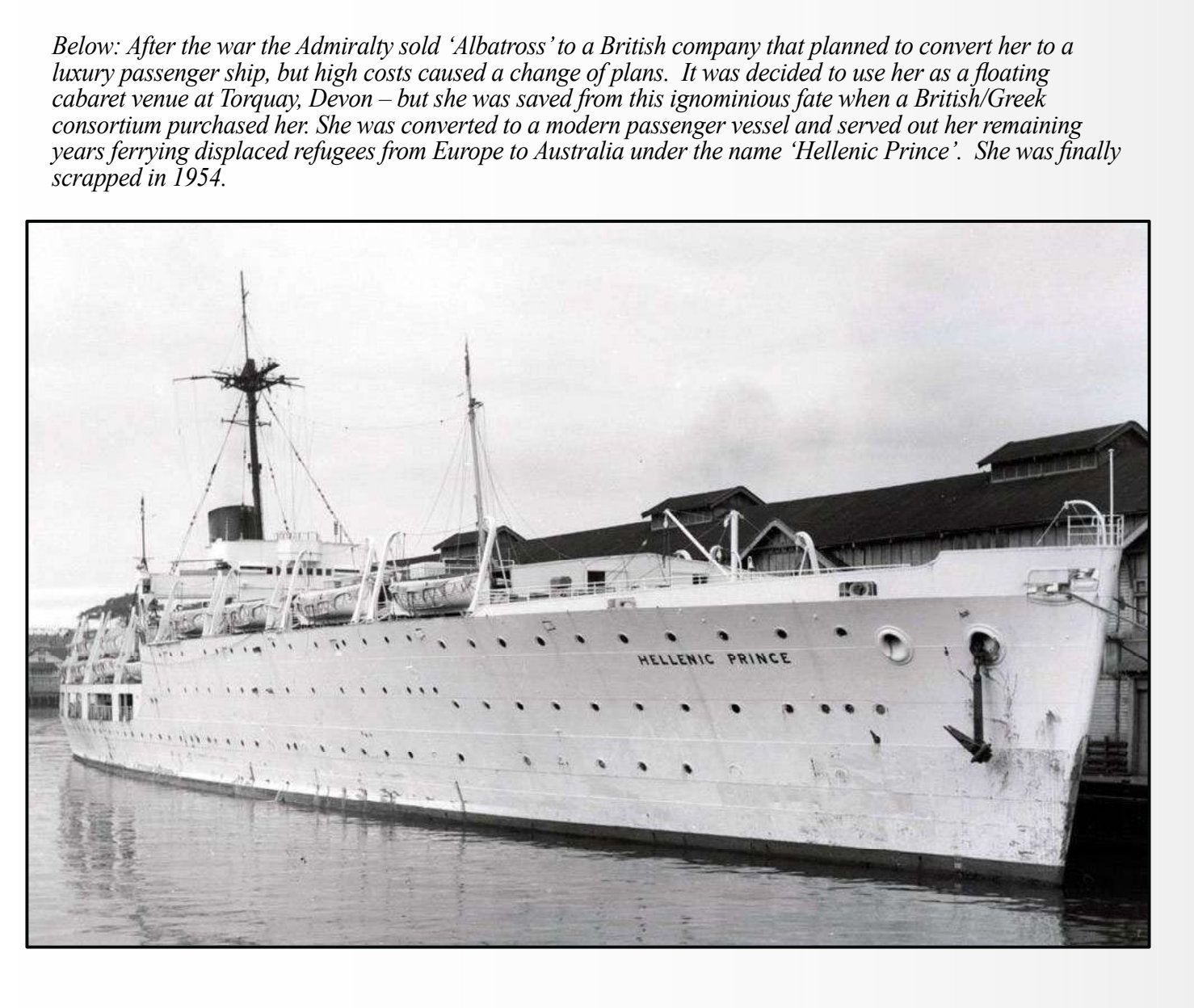
The Admiralty sold her in 1946. A first plan to rebuild her at Chatham was abandoned on cost and she lay at Torquay as a store hulk under the name Pride of Torquay, renamed in preparation for a role as a floating cabaret venue moored at the town. Days before she was to be auctioned in October 1948 the British-Greek Yannoulatos group bought her for their China Hellenic Lines of Hong Kong, and renamed her Hellenic Prince on 14 November 1948. Museum Wales records that the deal was completed on the day Prince Charles was born and that the name was given in his honour. C. H. Bailey Ltd of Barry in south Wales rebuilt her for about 200,000 pounds, six months later than promised, and she was ready in September 1949.12910
The result measured 6,558 gross tons and was described by her own historian as no luxury liner. She carried up to 1,200 people in 200 cabins and dormitories, some sleeping twenty, with air conditioning throughout, a dining room seating 560 that also served as the only lounge, two cinemas, and three hospitals fitted into the bays of the old hangar deck: one for men, one for women and an isolation ward for children.1
The ship as rebuilt in 1949
| Measure | Figure |
|---|---|
| Gross tonnage | 6,558 |
| Length | 443.7 ft / 135.70 m |
| Beam | 61 ft / 18.5 m |
| Service speed | 17 knots |
| Passenger capacity | About 1,000, up to 1,200 maximum |
| Cabins and dormitories | 200, some sleeping 20 |
| Dining room | 560 seats, also the only lounge |
| Hospitals | Three, in the former hangar bays |
| Crew | 250 |
The IRO voyages
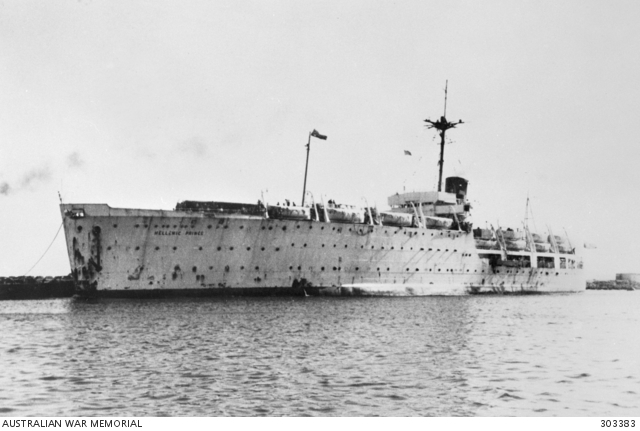
The first voyage left Naples and reached Sydney on 5 December 1949 with 1,000 displaced persons, calling at Port Said, Aden, Colombo and Fremantle. Passages of this kind took twenty-five to twenty-eight days. The ship returned to Europe empty, having no accommodation fit for fare-paying travellers.12
The second voyage, from Naples on 11 January 1950, lost an anchor while embarking passengers by tender off Sicily, waited three days at Port Said for a replacement, then broke a boiler and lay adrift in the Indian Ocean before reaching Melbourne on 13 February, four days late. The third voyage ran without mechanical trouble and arrived at Fremantle on 20 April 1950 and Melbourne on 25 April. On the return leg she lifted Dutch evacuees from Indonesia to Bremerhaven, which then became her European loading port.16
From September 1950 she sailed again by way of Port Said, Aden and Colombo, reaching Fremantle on 10 October 1950 and then crossing to Wellington, the only voyage to extend to New Zealand. She was back at Fremantle on 2 November. The last displaced-persons voyage left Bremerhaven and Naples on 3 December 1950 and took thirty-eight days to Melbourne, arriving on 11 January 1951. By May 1951 her master told a Fremantle newspaper that the ship had carried about 1,000 displaced persons on each of the past five voyages and that this trip carried 591 fare-paying passengers of eight nationalities instead. The transcribed Fremantle landing schedule for August 1951 lists Italian nationals admitted on two-year exemptions rather than displaced persons.14
Voyages under IRO charter
| Voyage | Left | Arrived | Passengers |
|---|---|---|---|
| First | Naples | Sydney, 5 December 1949 | 1,000 displaced persons |
| Second | Naples, 11 January 1950 | Melbourne, 13 February 1950 | About 1,000; four days late |
| Third | Naples, 23 March 1950 | Fremantle 20 April, Melbourne 25 April 1950 | About 1,000 |
| Fourth | Bremerhaven, 25 June 1950 | Australia, late August 1950 | About 1,000 |
| Fifth | September 1950 | Fremantle 10 October, Wellington 19 October, Fremantle 2 November 1950 | 973 landed at Wellington |
| Sixth | Bremerhaven via Naples, 3 December 1950 | Melbourne, 11 January 1951 | About 1,000; 38 days |
Conditions on board
Passengers who kept the ship's newsletter, Kangaroo, described the accommodation as appalling and overcrowded, with 1,200 people in 200 bunk rooms. They were put to work during the voyage on cleaning, cooking and mess duties and in the boiler and engine rooms, and were paid in Woodbine cigarettes. Drinking water ran out before the end of the passage, and bottles could be bought for a United States dollar from passengers working below. A freezer failure spoiled stores. Passengers were refused shore leave at every port, and when fresh food was taken on at Fremantle it went to the crew. Seasickness was constant because a pump fault left the ship unable to shift ballast and rarely level.1
Discontent on the thirty-eight day voyage of December 1950 ended in a hunger strike. The master, Captain P. C. King, a former Royal Navy officer, used the newsletter of 5 January 1951 to accuse the passengers of mutiny; the same issue refers to a passengers' committee that had formed a delegation to him and to a passenger held in the ship's prison for assaulting the escort officer, and carries a passenger's drawing mocking his treatment of them. A letter of complaint signed by the passengers went to the International Refugee Organisation. The passengers learned at the Bonegilla Migrant Reception and Training Centre that the ship had been inspected and that action had been taken against the master and the company.1
King's own view of his passengers survives in the West Australian of 12 May 1951, where he called the habits of Syrian, Lebanese and Cypriot passengers filthy and said that some of them were not even white. He added that the displaced persons had given less trouble because they were well disciplined. The remark is a reminder that the discipline praised on the earlier voyages was the discipline of people with no standing to object.1
The fare-paying voyage of May 1951 brought its own complaints. The ship reached Australia on 11 May 1951 with 591 passengers, mainly Arabs, Cypriots, Italians, Greeks and Poles, and twenty-seven French passengers complained that the prospectus had promised a luxury liner, one of them remarking that she was not even a luxury gaol. A Commonwealth medical officer, Dr J. G. McGlashan, found conditions not to be found in the worst prisons, judged the ship unfit for 250 people let alone the 591 she carried, and demanded an investigation.8
Ukrainians aboard
The ship's own history lists Ukraine among the countries her displaced passengers came from, alongside Germany, Hungary, Russia, Latvia, Poland, Czechoslovakia and Romania. No Ukrainian total for any single voyage survives in the sources read, and Ukrainians travelling on these charters were frequently recorded under Polish or Soviet nationality.1
The one documented figure comes from the New Zealand voyage. When the ship reached Wellington on 19 October 1950 from Bremerhaven, the next day's newspaper reported 973 passengers bound for the reception process at the Pahīatua Reception and Training Centre, of whom 95 were described in the classification of the time as Polish-Ukrainians. That number describes one arrival and not the camp's population. The ship's own historian dates the Wellington call to 16 October; the contemporary newspaper is preferred here.51
Australian arrivals went on from Fremantle, Melbourne and Sydney by train to the reception centres, Bonegilla above all, and then to two years of directed labour. One family who sailed on the April 1950 voyage kept their numbered places on the passenger list, 0533 to 0537, and reached the Benalla Migrant Camp by that route.6
The Wellington arrival, October 1950
| Measure | Reported number | Scope |
|---|---|---|
| Passengers | 973 | One arrival at Wellington |
| Polish-Ukrainians | 95 | The newspaper's category within that arrival |
Afterwards
The refugee charters ended in 1951 and the ship finished her Australian work carrying fare-paying migrants. In 1953 she served as a troopship to Kenya during the Mau Mau emergency. She was broken up at Hong Kong in August 1954, twenty-six years after her launch in Sydney.12
The fare-paying service can be followed into 1952. In August 1951, after the arrivals of the Hellenic Prince and the Protea, the new Liberal Immigration Minister Holt restricted eligibility for Cypriot nomination to wives, fiancées, parents, children, brothers and unmarried sisters of relatives in Australia. In November 1951 the Petrides agency advertised her as leaving for Australia on 22 November and as the fastest way to get there, having taken migrants before in twenty-one days. She lay in Limassol Harbour in December 1951 alongside the Corsica and the Ravello, and reached Fremantle on 17 January 1952.8
Sources
- SS Hellenic Prince 1948-1954, ex HMAS Albatross 1928-1946, Part Two
Reuben Goossens, ssMaritime · Accessed 13 September 2026
Conversion history and specifications, the voyage-by-voyage account of the IRO charters, the Kangaroo newsletter of 5 January 1951 and the Krohnje family's account of conditions, and the full text of the West Australian report of 12 May 1951.
- HMAS Albatross, HMS Albatross and SS Hellenic Prince
Naval Historical Society of Australia · Accessed 13 September 2026
The naval career from the 1926 keel laying to the 1944 torpedoing, the sale and conversion, the IRO charter and the Sydney arrival of 5 December 1949, and the ship's end at Hong Kong in 1954.
- Port side view of the British migrant vessel Hellenic Prince arriving in Australia, 1949
Australian War Memorial, Naval Historical Collection · 1949
Accession 303383. The catalogue description records the alterations made for the migrant service and the record states that copyright has expired and the item is in the public domain.
- TSS Hellenic Prince, Naples to Melbourne, August 1951
Immigrant Ships Transcribers Guild · 8 August 1951
Transcribed voyage header and the Fremantle schedule of alien passengers of 2 August 1951, showing Italian nationals on two-year exemptions rather than displaced persons.
- Different Pasts With A New Future: Displaced Persons Arrive For Pahiatua Camp
Central Hawke's Bay Press, page 3, via Papers Past · 20 October 1950
The Wellington arrival of 19 October 1950 with 973 passengers for Pahiatua, of whom 95 were classified as Polish-Ukrainians. Taken from the site's existing Pahiatua page, where the article was read; Papers Past blocked a refetch on 13 September 2026.
- Their Stories: family accounts of the Benalla Migrant Camp
Benalla Migrant Camp · Accessed 13 September 2026
A family account naming the Hellenic Prince, the Fremantle arrival of 20 April 1950 and the family's numbered places on the passenger list.
- Hellenic Prince, photograph by Allan C. Green
State Library of Victoria, Allan C. Green collection · between 1949 and 1951
Public domain photograph of the ship in her emigrant configuration; the Commons copy is cropped with contrast adjusted.
- Understanding post-war migrant voyages to Australia and the case of the Corsica, 1946–52: 'hell trip on a floating slum'
Andrekos Varnava, Immigrants & Minorities, vol. 43, no. 3, pp. 495–529; open access copy via the Flinders University ResearchNow repository · 2025
Pages 508, 510, 517 to 518 and note 71 at page 524 read: the arrival of 11 May 1951 with 591 passengers and the complaint of twenty-seven French passengers, Dr J. G. McGlashan's inspection and his demand for an investigation, the Petrides agency's advertising of a departure on 22 November 1951, the August 1951 restriction of Cypriot nomination by Immigration Minister Holt, and the Fremantle arrival of 17 January 1952.
- S.S. HELLENIC PRINCE, glass negative
Amgueddfa Cymru, Museum Wales; photograph by Leslie W. Hansen, item number 79.76I/2767 · Negative dated circa 1948; page accessed 13 September 2026
Object description read: the completion of the sale on the day Prince Charles was born, 14 November 1948, and the renaming of the ship in his honour, together with the Barry conversion and the late 1949 IRO charter already recorded on this page.
- The RAN's First Aircraft Carrier
Kim Dunstan, Fleet Air Arm Association of Australia, heritage article V1.0 · No publication date stated; accessed 13 September 2026
Pages 5 and 8 read: the renaming as Pride of Torquay in preparation for use as a floating cabaret venue moored at Torquay, and the purchase by a British and Greek consortium that spared her that fate. The article's naming of the chartering body as the International Relief Organisation is an error and was not used.
Last researched 13 September 2026