Sandyhillock Hostel
Arrival and settlement
Craigellachie district, Banffshire, Scotland · Camp documented 1945–1948; postwar YMCA hostel
A Speyside camp with a library, orchestra and small publishing programme became part of the YMCA hostel network used by Ukrainians. Original inspections reveal its earlier Italian and German prisoner-of-war phases.
Introduction
Sandyhillock, also written Sandy Hillock, was a working camp near Craigellachie and later a YMCA hostel included in the directory of accommodation used by Ukrainians. Its history reaches beyond a single community: an Italian labour battalion occupied the camp in 1945, while German prisoners appear in detailed inspections from 1947 and 1948.
The camp’s paper trail is a single National Archives file, FO 939/148, catalogued as “67 Working Camp, Sandy Hillock Camp, Craigellachie, Banffshire” and covering 1945 to 1948. It belongs to a series of Control Office and Foreign Office German Section papers on the treatment of prisoners of war under British control, about a quarter of which consists of files on particular camps and on lectures given in them.
A history in dates
- 30 September–1 October 1945Grant records an Italian Labour Battalion at Camp 67 under Major Murray-Lyon.
- 26 August 1946A vertical air photograph records the camp’s layout of Nissen huts.
- 15–18 February 1947A German POW inspection records 269 men at headquarters and 638 across the camp’s wider accommodation network.
- 24 April 1947The February inspection report is handed in.
- 24–27 January 1948Miller inspects the camp’s English classes and its outlying hostels.
- PostwarSandyhillock appears in the Ukrainian accommodation directory as a YMCA hostel.
- 14 May 1988Air photographs show hut bases with only a few huts standing.
- August 2019A site survey photographs the former camp in use as a camping ground.
The camp on the ground
The national record of the historic environment records the camp about 275 metres south of Sandyhillock farmsteading, in the parish of Knockando, at NJ 25652 44925 — administratively in Moray, although the wartime and postwar papers give the address as Banffshire. It was identified from a vertical air photograph flown on 26 August 1946.
That photograph shows a fenced rectangular enclosure east of the B9102 containing at least 39 huts, mainly of Nissen type, with about 27 further huts immediately to the north-west that were probably the staff and guard quarters, and some buildings on the south side of the road. There was a recreation area to the south-east and a sewage works to the east. Later Ordnance Survey maps mark the ground as a poultry farm.
The camp as recorded from the air
| Element | Recorded detail |
|---|---|
| Main compound | At least 39 huts, mainly Nissen type, inside a fenced rectangular enclosure |
| Staff and guard quarters | About 27 huts immediately to the north-west |
| Other buildings | On the south side of the B9102 |
| Recreation area | To the south-east of the compound |
| Sewage works | NJ 25915 44875 |
Sources for this section
From Italian labour battalion to German working camp
During a visit on 30 September and 1 October 1945, an inspector named Grant described Camp 67 as an Italian Labour Battalion under Major Murray-Lyon. Much of his report concerned German prisoners at separate locations, Cairnfield House near Buckie and Nethybridge. Their activities should not be assigned to the main Sandyhillock camp.
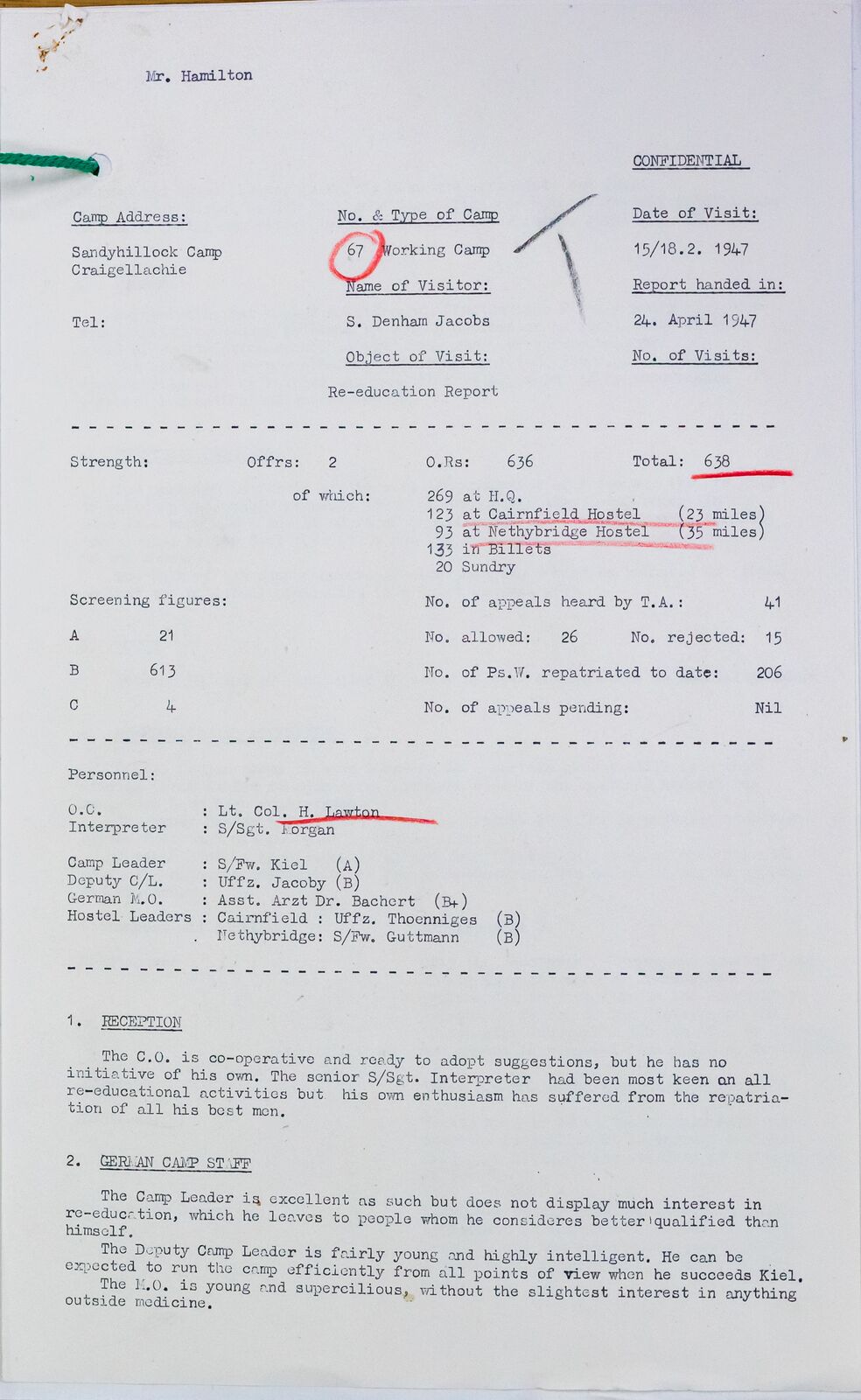
By February 1947 the main camp and its associated accommodation held German prisoners under Lieutenant-Colonel H. Lawton. Inspector S. Denham Jacobs recorded 269 men at headquarters, with others in Cairnfield, Nethybridge, billets and a miscellaneous category. The combined 638 was a distributed total, not the number living in the main camp.
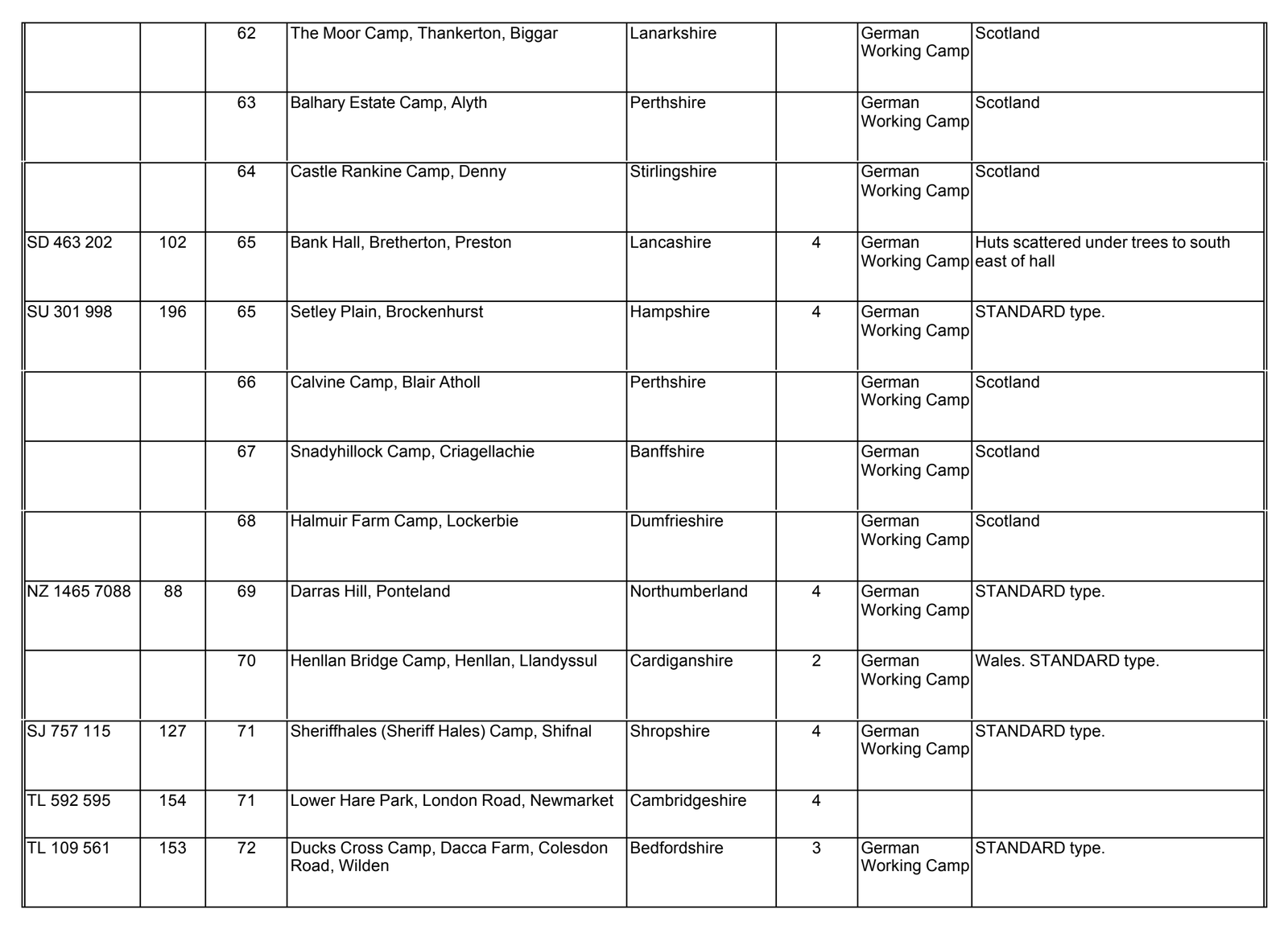
A national gazetteer of prisoner-of-war camps compiled for English Heritage in 2003 lists Camp 67 as “Snadyhillock Camp, Criagellachie” in Banffshire, typed as a German Working Camp in Scotland — apparent misspellings of Sandyhillock and Craigellachie. The row gives no grid reference and no note on survival.
German POW accommodation, February 1947
| Accommodation | Recorded men |
|---|---|
| Headquarters | 269 |
| Cairnfield Hostel | 123 |
| Nethybridge Hostel | 93 |
| Billets | 133 |
| Other category | 20 |
| Combined total | 638 |
Screening and camp staff in 1947
The February 1947 report’s header sets out the camp’s strength as two officers and 636 other ranks. Its screening figures place 21 men in category A, 613 in B and four in C. The tribunal adviser had heard 41 appeals, allowing 26 and rejecting 15, with none pending, and 206 prisoners had been repatriated by that date.
The report also lists the men who ran the camp from inside it. Lieutenant-Colonel H. Lawton commanded, with Staff Sergeant Morgan as interpreter. The German camp leader was Staff Sergeant Kiel and his deputy Corporal Jacoby, the German medical officer was Dr Bachert, and the outlying hostels were led by Corporal Thoenniges at Cairnfield and Staff Sergeant Guttmann at Nethybridge.
Strength, screening and appeals, February 1947
| Heading | Figure |
|---|---|
| Officers | 2 |
| Other ranks | 636 |
| Total strength | 638 |
| Screened category A | 21 |
| Screened category B | 613 |
| Screened category C | 4 |
| Appeals heard | 41 |
| Appeals allowed | 26 |
| Appeals rejected | 15 |
| Appeals pending | None |
| Repatriated to date | 206 |
Sources for this section
Waiting to return home
Jacobs visited during severe winter weather. He reported that morale had risen when repatriation began, then fallen as prisoners realised how slowly departures were proceeding. He credited warmth, recreation and entertainment with helping the situation improve. His account also noted the loss of experienced educational organisers as men went home.
The report’s judgements about prisoners’ intelligence and political outlook were the inspector’s own assessments. The concrete activities he recorded reveal a fuller picture: reading, music, film, discussions and publishing continued while men waited for repatriation.
Sources for this section
Books, music and publishing
In February 1947 the camp library contained 600 books. Weekly discussion groups at headquarters attracted 40–50 men. Melde edited a camp magazine, printed in 120 copies every two months, and prepared a weekly news digest called Die Wandzeitung.
A ten-member orchestra led by Schmitt gave concerts at headquarters and the outlying hostels. There were occasional variety shows in camp theatres. The YMCA and another film provider visited fortnightly. A Protestant padre was starting a youth club.
Activities recorded in 1947
| Activity | Recorded scale |
|---|---|
| Library | 600 books |
| Discussion groups | 40–50 attendees weekly |
| Camp magazine | 120 copies every two months |
| Orchestra | 10 members |
| Film visits | Fortnightly |
Sources for this section
Learning English in 1948
R. D. Miller’s visit on 24–27 January 1948 found 322 men in the main camp. Ten pupils attended English lessons there: four beginners and six intermediate learners. Each group met twice a week. A hut provided a classroom with electric lighting and central heating; a lecture hut could hold 100 people.
The teachers, F. Riedel and H. J. Kulartz, had come through camps in Egypt and a course at Wilton Park. They told Miller that they had expected training not to delay their repatriation. Instead they found themselves teaching in Scotland. Miller considered both satisfactory teachers and gave a talk about foreign influences on English.
English classes, January 1948
| Level | Pupils | Lessons per week |
|---|---|---|
| Beginner | 4 | 2 |
| Intermediate | 6 | 2 |
Sources for this section
The Ukrainian hostel connection
Sandyhillock subsequently appears in Peter Kormylo’s directory as a YMCA hostel at Craigellachie, Banffshire. The directory explicitly concerns accommodation used by ethnic Ukrainians. This hostel phase belongs alongside the earlier POW history; the 1947–1948 German inspection figures are not Ukrainian population statistics.
The hostel network it belonged to was large. Some 21,000 Ukrainian European Volunteer Workers and 860 dependants were brought to the United Kingdom between 1947 and 1950, and almost all were housed in hostels — former military and prisoner-of-war camps, wartime industrial and agricultural hostels, and buildings converted after the war — run by the National Service Hostels Corporation, the Ministry of Agriculture, the National Coal Board, the YMCA, local authorities and private firms. Separately, about 8,500 former members of the Galicia Division were brought to Britain in May and June 1947, held as prisoners of war and released from that status between August and October 1948, after which they too entered the volunteer worker scheme. Most of the hostels had closed by the middle of the 1950s.
Sources for this section
A later camping ground
Vertical air photographs flown on 14 May 1988 show rows of hut bases with only a few huts still standing, so most of the camp had gone by then.
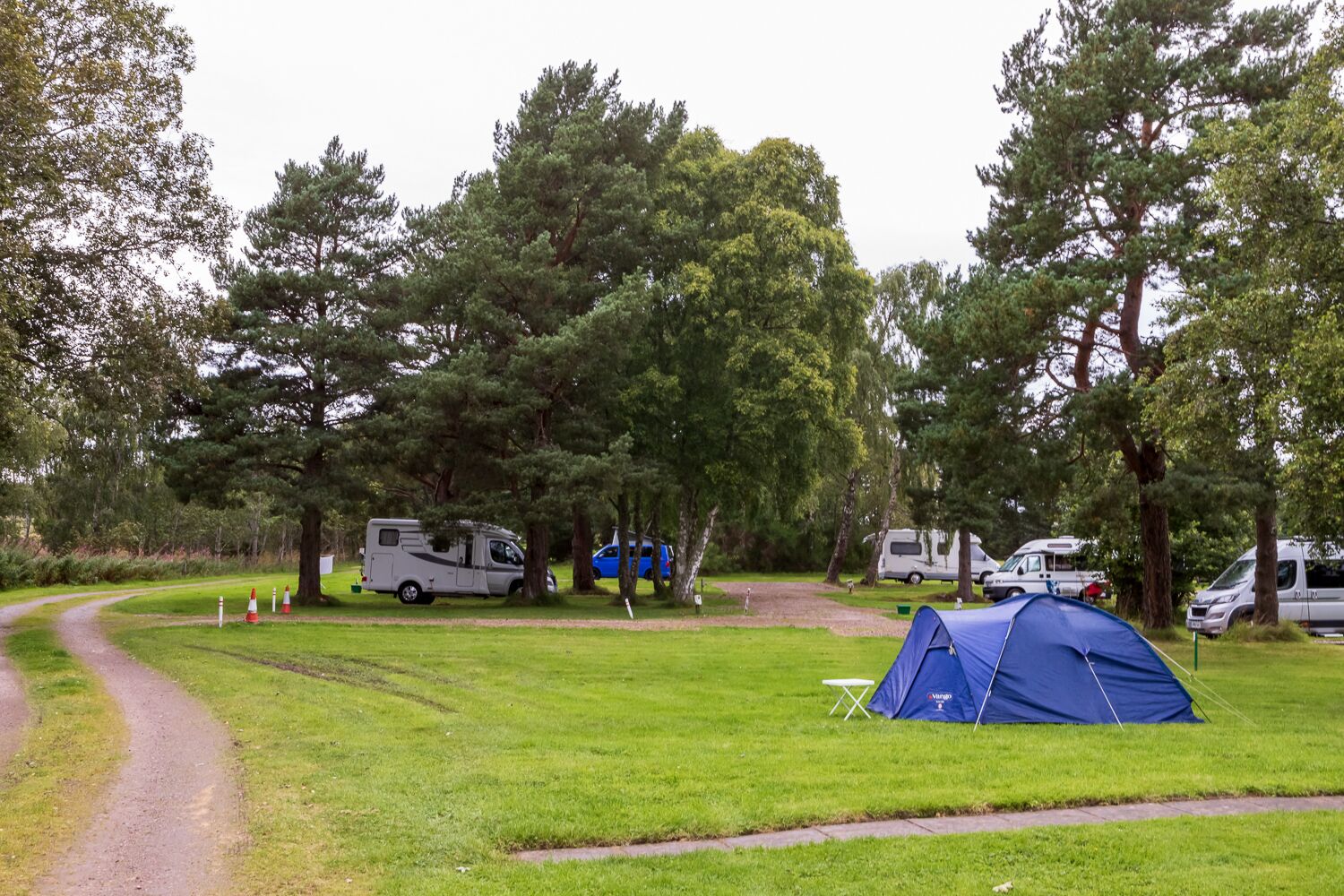
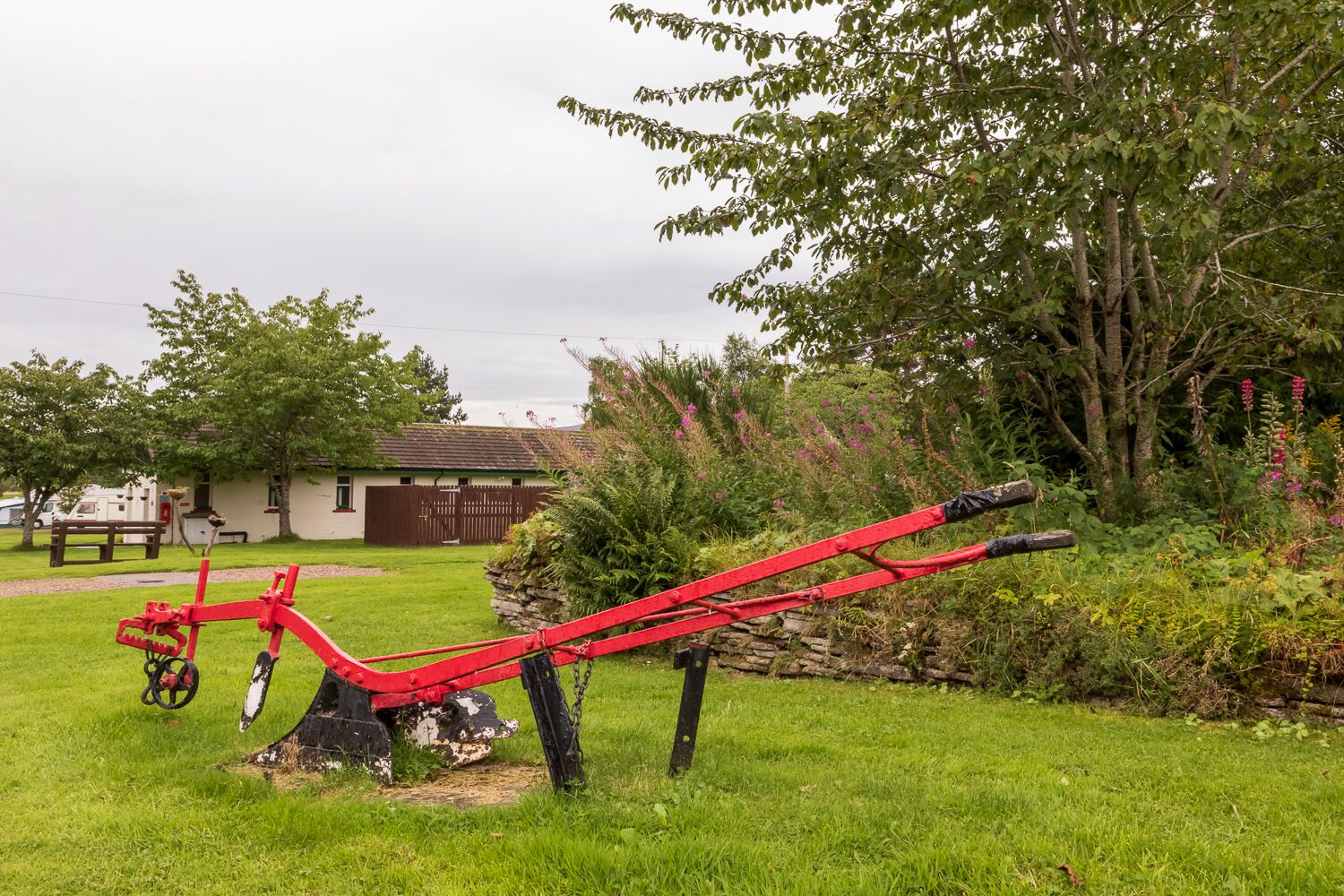
In August 2019 the former camp was photographed as Speyside Camping and Caravanning Club Site at Archiestown. The survey recorded paths, hut bases and an old ablutions block still serving a washing function. Historical material displayed at reception preserved information about the site’s prison-camp years.
The modern photographs show a tree-lined camping ground and a surviving low building. Its leisure use contrasts with the wartime enclosure, while the remains retain parts of the earlier layout.
Sources for this section
Sources
- In which ways is the Ukrainian community in Scotland a diaspora?
Peter David Kormylo, University of Glasgow · 2021
Original appendix xii, printed 323, entry 23, YMCA hostel Sandyhillock. Ukrainian identity directory; no precise hostel dates inferred.
- Grant’s visit to Sandyhillock Camp 67
The National Archives, FO 939/148; scan reproduced by Banged Up Abroad · 30 September–1 October 1945
Original photographed page 34 visually read in full. Italian Labour Battalion statement concerns headquarters. Detailed German accounts concern Cairnfield and Nethybridge and are not transferred to headquarters.
- S. Denham Jacobs, re-education report, Camp 67
The National Archives, FO 939/148; scan reproduced by Banged Up Abroad · Visit 15–18 February 1947; submitted 24 April 1947
Original scan pages 19–21 read; page 19 has been transcribed in full for this site. Main camp 269; total 638 includes Cairnfield 123, Nethybridge 93, billets 133, sundry 20. Header, screening block and staff list taken from the transcription. Contemporary assessments attributed, activities and counts scoped to German POW phase.
- R. D. Miller, English inspector’s report
The National Archives, FO 939/148; scan reproduced by Banged Up Abroad · 24–27 January 1948
Original scans 6–8 visually read. Main camp 322, English pupils 10. Report’s broader 1504 total does not reconcile with visible component rows; omitted. No inference of population trend across differing administrative scopes.
- PoW Camp 67 Sandy Hillock: site survey
Banged Up Abroad photographic research project · August 2019 site visit
Original field account read and two actual site photographs visually inspected. Wooden hut relocation discussed by photographer is not used to assert original position.
- 67 Working Camp, Sandy Hillock Camp, Craigellachie, Banffshire
The National Archives, Discovery catalogue · File FO 939/148, 1945–1948
Catalogue entry read: citable reference, covering dates and held-by statement, together with the series description for FO 939.
- Sandyhillock, Camp 67, German Working Camp
Historic Environment Scotland, National Record of the Historic Environment · Account by RCAHMS, May 2005
Full record read: NRHE 272620, site number NJ24SE 109, NGR NJ 25652 44925, parish of Knockando; description of the 1946 and 1988 air photographs, hut counts and layout.
- Post-war camps and hostels
Ukrainians in the United Kingdom · Accessed 13 September 2026
Page read for the numbers of Ukrainian European Volunteer Workers and dependants, the transfer and release dates of former Galicia Division prisoners, the types of hostel and the bodies that ran them.
- Prisoner of War Camps (1939–1948): Project Report (Twentieth Century Military Recording Project)
Roger JC Thomas, English Heritage / National Monuments Record Centre, Swindon · 2003
Gazetteer entry for Camp 67 read on printed page 25: “Snadyhillock Camp, Criagellachie”, Banffshire, German Working Camp, Scotland. No grid reference, map sheet or survival classification is given in that row.
Last researched 12 September 2026