Seedorf Camp
Displacement in Europe
Seedorf, near Zeven, Germany · 1945–1957
A former naval training camp became a multilingual refugee community and a staging point for journeys to Britain, Australia and New Zealand. Ukrainian church records connect Seedorf with the wider network of displaced Ukrainians.
Introduction
Seedorf occupied a former military camp near Zeven in northern Germany, in the British occupation zone. Its population changed repeatedly after liberation: Soviet former prisoners of war and Polish displaced people were followed by Baltic communities, while Ukrainians also established a substantial presence. The site served both as a place to live and as a departure stage for emigration.
The Ukrainian Orthodox parish is documented in records covering 1947–1950. Its correspondence with church administration at Heidenau places Seedorf within a network that linked communities across the British zone, even as families moved between camps and overseas.
Sources for this section
A history in dates
- 1938About 320 hectares at Godenstedt and Seedorf are requisitioned for a Reich Labour Service barracks camp.
- 1941The navy takes over the site as Lager Godenstedt, with room for about 3,500 men.
- March 1945U-boat training at the camp ends.
- May 1945British authorities take over the former naval camp.
- 1 July 1945UNRRA takes over the administration of the camp.
- 18 July 1945UNRRA Team 295 dates the beginning of its own work at Seedorf.
- March 19462,100 Lithuanians, 1,700 Latvians and 200 Estonians arrive from other camps.
- 1947–1950Surviving Ukrainian parish correspondence and accounts document the congregation.
- December 1947A camp return records 2,155 Ukrainian residents.
- June 1948A Ukrainian elementary school is recorded at the camp.
- 7 October 1948An IRO processing card records a resident arriving from “66 DPACS: Seedorf Camp”, area team 905.
- 1 July 1950The camp passes to German administration.
- Autumn 1957The remaining refugee camp is dissolved and almost all its buildings demolished.
- 18 March 1959The first Bundeswehr soldiers move into the new barracks on the site.
The camp before 1945
A commission inspected some 320 hectares at Godenstedt and Seedorf in 1938 and requisitioned the land for a barracks camp for the Reich Labour Service. From 1939 the site was laid out as a reserve airfield, with about 215 standard barracks and administrative buildings; once the campaigns in Poland and the west were over, the airfield was no longer wanted.
The navy took the site over in 1941 and it became Lager Godenstedt. The units stationed there included the 2nd U-boat training division from April 1941, the 2nd naval artillery replacement battalion from October 1941 to September 1943, and the 10th naval replacement battalion from April 1944. About 3,500 sailors could be accommodated in the wooden barracks. U-boat training ended in March 1945.
Uses of the site before the refugee camp
| Period | Use |
|---|---|
| 1938 | About 320 hectares requisitioned for a Reich Labour Service barracks camp |
| From 1939 | Laid out as a reserve airfield with about 215 standard barracks |
| From April 1941 | 2nd U-boat training division |
| October 1941 – September 1943 | 2nd naval artillery replacement battalion |
| From April 1944 | 10th naval replacement battalion |
| March 1945 | U-boat training ends |
Sources for this section
A military site becomes a refugee camp
British authorities took control in May 1945. About 1,500 former Soviet prisoners of war from the Sandbostel camp were housed at Seedorf until July, and about 10,000 Poles used it as a transit station. UNRRA took over the administration on 1 July 1945; UNRRA Team 295 dated the start of its own work to 18 July 1945 in the anniversary album it published the following year. A 2024 exhibition catalogue of displaced-persons camp publications gives the album’s full imprint: “DP Baltic Camp at Seedorf, 1946–1947”, prepared by S. Narkeliūnaitė, with J. Steponavičius as artist and photographs by V. Augustinas, Br. Gross and S. Narkeliūnaitė, published at Hamburg by UNRRA Team 295 in 1947.
From March 1946 the camp received Baltic residents transferred from elsewhere: 2,100 Lithuanians, 1,700 Latvians and 200 Estonians. The 1946 album describes national committees and a General Welfare Committee helping with administration. Its photographs show food stores, transport, medical services and communal activities: the practical infrastructure needed to keep a large settlement functioning.
Sources for this section
Several communities sharing one camp
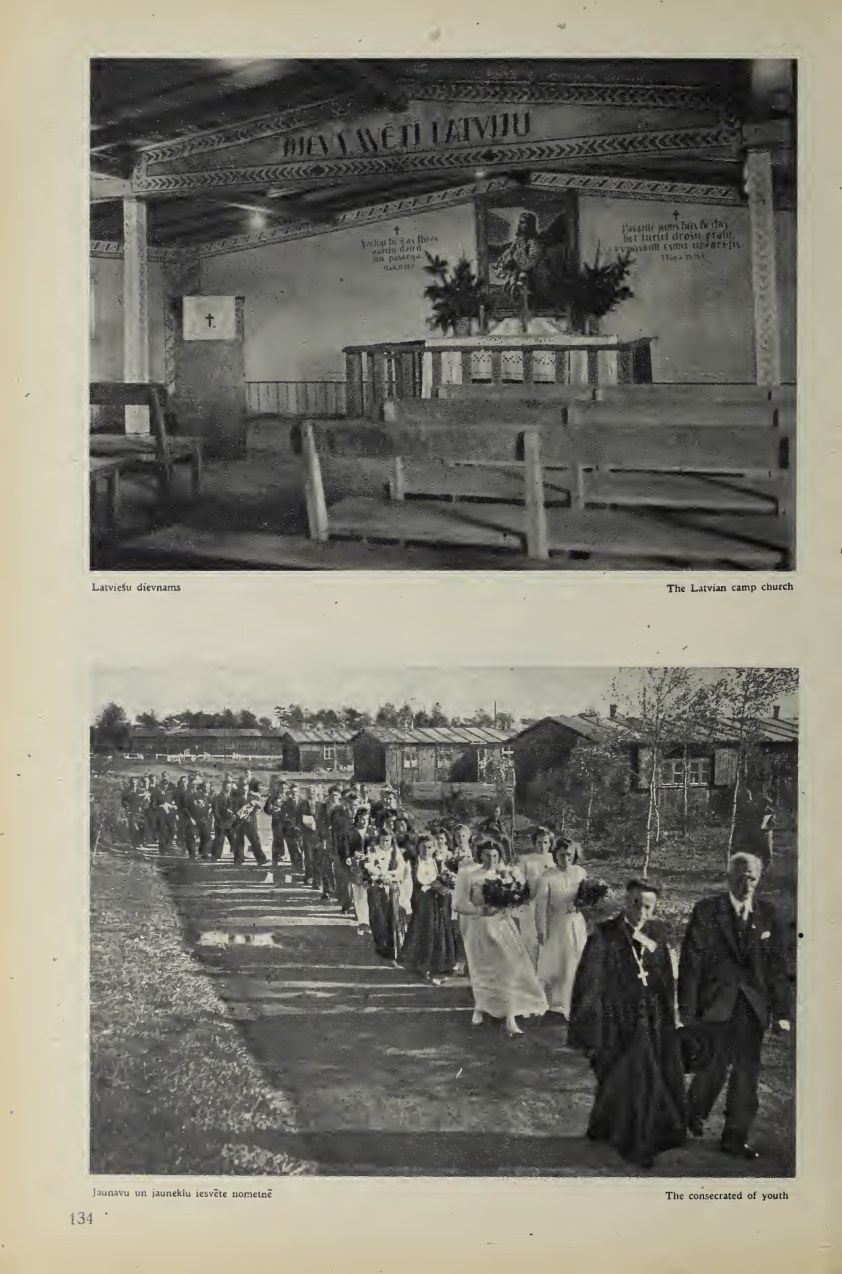
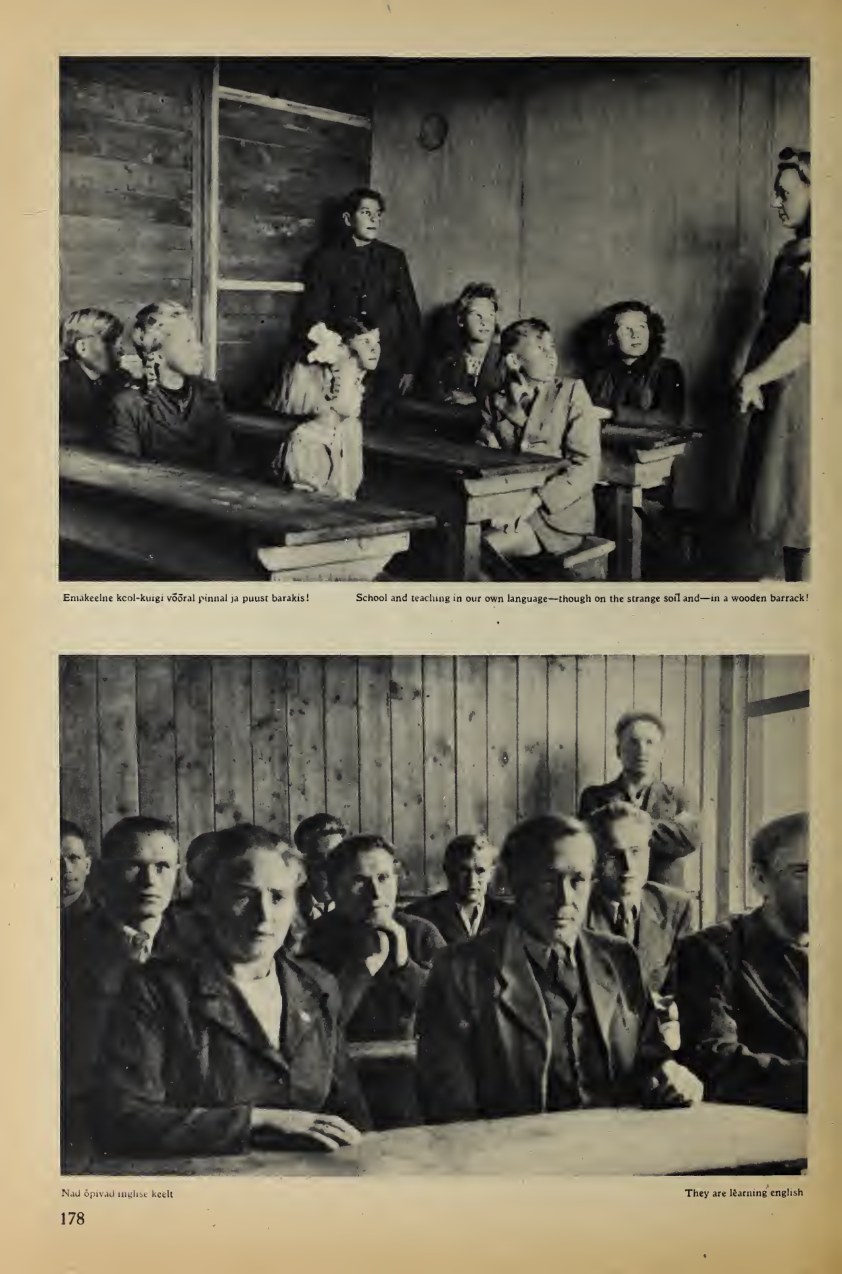
Seedorf’s 1946 commemorative volume concentrates on Lithuanians, Latvians and Estonians. They maintained distinct schools, religious life, arts and youth activities. The photographs reproduced here show the Latvian church and Estonian teaching; they belong to the camp’s wider history rather than depicting Ukrainian institutions.
The camp was mixed throughout. The postal historian’s summary lists Poles, Balts, Yugoslavs, Lithuanians and Ukrainians among its residents, together with Russian scout troops. A Ukrainian elementary school was running at Seedorf in June 1948.
Ukrainian figures appear separately in the later camp surveys. The December 1947 return records 2,155 Ukrainians; subsequent returns give much smaller numbers. The table follows that community, not Seedorf’s total population.
Ukrainian residents in successive returns
| Return | Ukrainians |
|---|---|
| December 1947 | 2,155 |
| July 1949 | 153 |
| December 1950 | 199 |
| August 1951 | 146 |
A Ukrainian parish connected to other camps
The parish belonged to the Ukrainian Autocephalous Orthodox Church and its rector was Fr Vasyl Il’chuk. The single folder of records that survives, catalogued as uaoc-6 and covering 1947 to 1950, holds circulars and correspondence from the church administration at Heidenau, copies of the rector’s reports to Metropolitan Polikarp, and financial records and receipts. Most are in Ukrainian, with some German and a little English.
Church life reached beyond the camp boundary. Research based on residents’ recollections at Burgdorf’s Camp Ohio describes visiting Orthodox clergy from Seedorf and Heidenau, where resident ministry could support congregations without their own priest.
Il’chuk was ordained in Germany in 1947 and moved to England in May 1950, where he became rector of the Midlands parish district of the church in Great Britain and, in November 1950, of its London parish. This pastoral route offers one documented connection between the German camps and the institutional life Ukrainians built in Britain.
Preparing to leave Germany
Seedorf became a staging camp for movement to Britain under the Westward Ho! recruitment programme, which ran until March 1948. Its later transit work included departures towards Australia and New Zealand through Genoa. Departure therefore involved several stages: selection and preparation in Germany, travel to a port, and the eventual overseas journey.
Some 21,000 Ukrainian European Volunteer Workers and 860 dependants were brought to the United Kingdom between 1947 and 1950, almost all of them housed on arrival in hostels run by bodies such as the National Service Hostels Corporation, the Ministry of Agriculture, the National Coal Board, the YMCA, local authorities and private firms. Movement in the other direction continued into 1949: families were still being moved to Seedorf in August of that year before sailing for Australia.
The camp’s administrative labels changed with the organisations processing its residents. It appears as assembly centre 249 at Seedorf bei Zeven, and an International Refugee Organisation processing card of 7 October 1948 records a resident arriving from “66 DPACS: Seedorf Camp” under area team 905. These describe the same Seedorf near Zeven, whose name can otherwise be confused with other German towns.
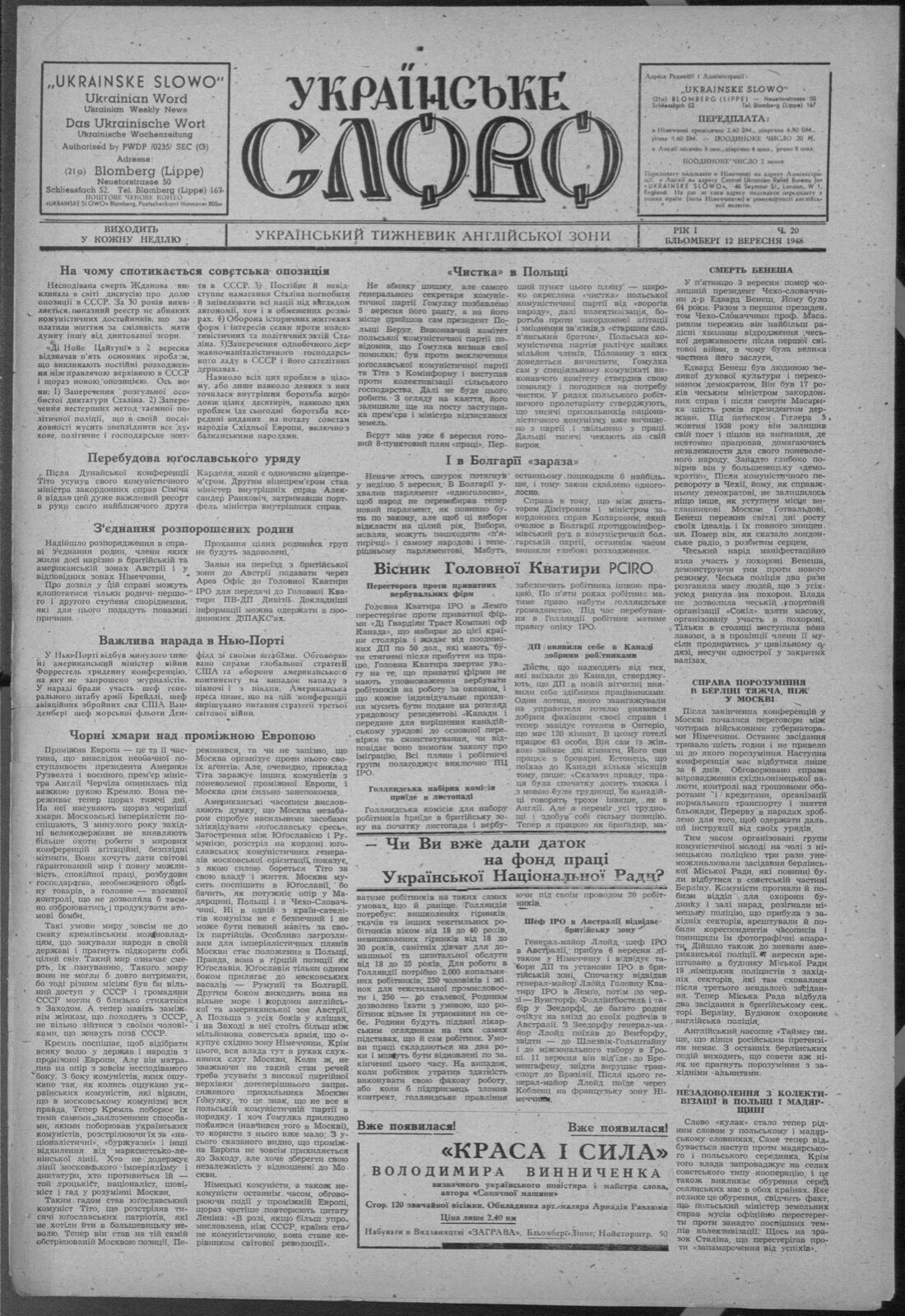
A notice in Ukrainske Slovo of 12 September 1948 shows where Seedorf stood in the Australian scheme. Major-General Lloyd, head of the International Refugee Organisation in Australia, flew to Germany on 6 September to visit DP camps and IRO establishments in the British zone. He went first to IRO headquarters at Lemgo, then in turn to Wunstorf, Fallingbostel and the camp at Seedorf, where many families were waiting to leave for their relatives in Australia; from Seedorf he went on to Wentorf, and from there to Schleswig-Holstein and the interzonal camp at Grohn. On 11 September he was to leave for Bremerhaven, from which a transport was sailing for Brazil, and afterwards to travel by way of Koblenz to the French zone of Germany.
The residents who remained
German administration took over on 1 July 1950. About 650 people remained in the middle of the decade, some finding work in farming and local businesses, others moving to areas with better employment or emigrating. The remaining camp was dissolved in autumn 1957 and almost all of its buildings were demolished.
Six million marks had been voted in 1956 for a new barracks on the site, and the first soldiers of the Bundeswehr moved in on 18 March 1959. The ground the camp stood on is now the Fallschirmjäger-Kaserne.
Sources for this section
Sources
- Seedorf DP camp church records
Ukrainian History and Education Center · 1947–1950
Finding aid uaoc-6; full collection description read, including extent of one folder, languages and the named rector and correspondents.
- Die Geschichte: 1945 bis 1957
Fallschirmjäger-Kaserne Seedorf · Local site history
Full site history read, covering the 1938 requisition, the naval period, the British takeover, the DP years and the 1957 dissolution. It dates the UNRRA takeover to 1 July 1945; the 1946 album’s own date of 18 July is reported separately.
- DP Baltic Camp at Seedorf
UNRRA Team 295, Hamburg · 1946
Original illustrated volume, printed pages 11, 134 and 178; scanned pages 15, 138 and 182.
- Ukrainians in UNRRA or IRO Camps of the British Zone of Germany, Table 6
The Refugee Experience, edited by W. W. Isajiw, Y. Boshyk and R. Senkus · 1992
Ihor Stebelsky chapter, printed pages 44–46; column headings and source notes checked. The Seedorf row reads 2,155 (December 1947), 153 (July 1949), 199 (December 1950) and 146 (August 1951).
- Seedorf DP Camp
DP Camps, contribution by postal historian Wolfgang Strobel · Undated
Full page read: locality and assembly centre 249, the nationalities listed, the note of a Ukrainian elementary school in June 1948, and correspondents’ transcriptions of an IRO card of 7 October 1948 giving “66 DPACS” and area team 905. Personal details of correspondents excluded.
- The Ukrainian Orthodox Church and Its Impact on Camp Ohio
Camp Ohio Research Project · 2017
Resident recollections on visiting clergy; not treated as parish records.
- Wasyl Ilczuk
Ukrainians in the United Kingdom · 2014
Full biography read: ordination in 1947, pastoral care at Seedorf, move to England in May 1950, Midlands parish district and the London parish from November 1950.
- Fallschirmjäger-Kaserne
German Wikipedia · Accessed 13 September 2026
Article read in full for the 1938 requisition, the 215 barracks, the naval units and their dates, the DP population figures, the 1957 dissolution and the 1959 occupation of the new barracks.
- Post-war camps and hostels
Ukrainians in the United Kingdom · Accessed 13 September 2026
Page read for the number of Ukrainian European Volunteer Workers and dependants brought to Britain in 1947–1950 and the bodies that ran the hostels.
- Ukrainske Slovo (Українське Слово), year I, number 20, 12 September 1948, front page
Ukrainian Museum-Archives of Cleveland, DP Camp Periodicals Collection, via the Internet Archive · 12 September 1948
Marked in the collection as public domain or an orphan work and offered under CC BY-NC-ND 4.0. Ukrainske Slovo was published at Blomberg in Lippe by the Ukrainian Central Relief Committee for the British zone. The front page carries the notice “Шеф ІРО в Австралії відвідає бритійську зону”, reporting Major-General Lloyd’s visit to the Seedorf camp.
- The exhibition on the Great Flight in 1944
BaltHerNet · 2024
Exhibition page read for its list of displaced-persons camp publications, which gives the full imprint of the UNRRA Team 295 album about the Baltic camp at Seedorf.
Last researched 12 September 2026