Tannadice Hostel
Arrival and settlement
Tannadice, near Forfar, Angus, Scotland · German POW hostel 1947; Ukrainian YMCA hostel from 1948
A painted trident and the motto Glory to Ukraine, Glory to Heroes survived inside a deserted camp building at Tannadice until it was demolished. Around that photograph sit a German prisoner return of March 1947, a farmer’s memory of an unlisted camp near Broom Farm and a Ukrainian directory entry for a YMCA hostel near Forfar.
Introduction
Tannadice, near Forfar in Angus, appears in Peter Kormylo’s directory as entry 20, “YMCA Hostel Tannadice, Nr. Forfar, Angusshire”. A photograph reproduced twice in his thesis shows a deserted camp building with a Ukrainian trident painted on its end wall. Three separate records touch the site: a wartime local memory, a German prisoner of war return of 1947 and the Ukrainian hostel of the years that followed.
A history in dates
- Earlier in the Second World WarLocal memory places an unlisted prisoner of war camp just outside Tannadice near Broom Farm, holding Italians and then Germans from 1943.
- 17–19 March 1947The Camp 63 return lists Tannadice as the smallest of the Camp 63 hostels, with six German prisoners and Peter Gosch as hostel leader; snow and flooding keep the inspector from visiting any hostel.
- August to October 1948Ukrainian former soldiers are released from prisoner of war status into the European Voluntary Workers scheme and their camps are redesignated as hostels.
- PostwarTannadice is recorded in the Ukrainian directory as a YMCA hostel near Forfar.
- 1991A Scottish Life Archive photograph records the Ukrainian wall painting; the catalogue later describes the building as demolished.
Sources for this section
- The symbolic tapner
- Camp 63 inspection, March 1947: headquarters and hostel return
- Camp 63 inspection, March 1947: full four-page report
- Post-war camps and hostels
- In which ways is the Ukrainian community in Scotland a diaspora?
- Wall-painting at a prisoner-of-war camp for Ukrainians, Tannadice, Angus, 1991
Before the hostel
The official list of prisoner of war camps in Britain records one camp in Angus, Camp 275 at Kinnell near Friockheim. A recollection published by the National Trust for Scotland in 2018 adds an unlisted one. Ian Bruce, a local man with a farming background who advised the Trust on the Angus Folk Museum collections, remembered a prisoner of war camp just outside Tannadice, close to Broom Farm. Italians were based there earlier in the war and Germans followed from 1943. The men stayed in the camp and worked in squads on the land, sometimes with guards in attendance and sometimes not, using tools belonging to the local farmers, and local people would bring them sweets or venison.
This is a spoken memory recorded some seventy years later, without opening or closing dates and without a map reference. The village and the sequence it describes, Italians and then Germans put to agricultural work, fit the documented pattern, but the recollection cannot on its own be treated as describing the same buildings as the hostel in the records below.
Sources for this section
A small hostel in the Balhary network
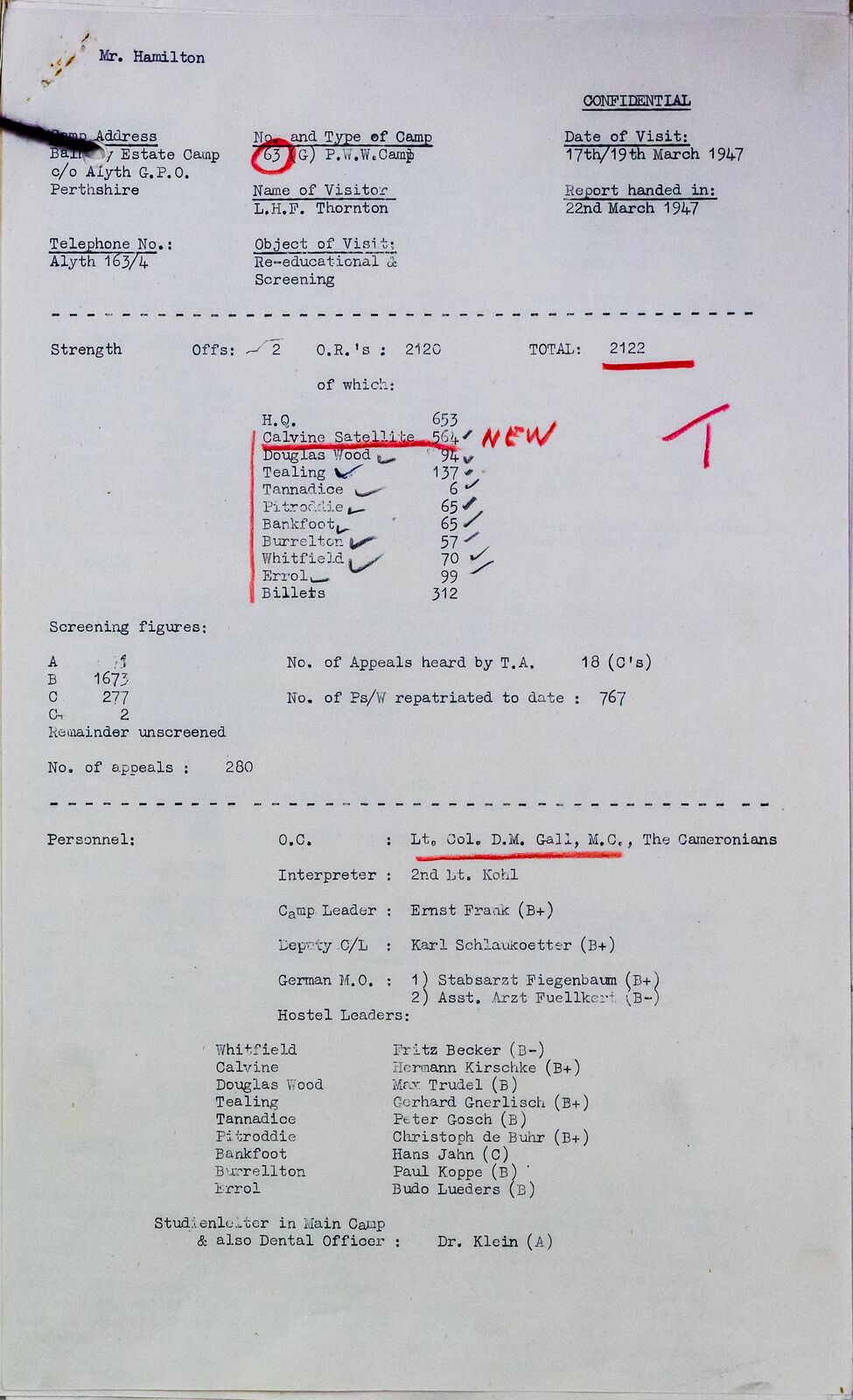
Camp 63 was a German prisoner of war camp with its headquarters at Balhary Estate, near Alyth in Perthshire, commanded by Lieutenant Colonel D.M. Gall of the Cameronians. Its combined strength on 17 to 19 March 1947 was 2,122 men: 653 at headquarters, 564 at the Calvine satellite, 312 in billets and the remainder spread across eight further hostels from Errol and Whitfield in the south to Tannadice in the north. Tannadice, with six men and Peter Gosch as hostel leader, was the smallest of them.
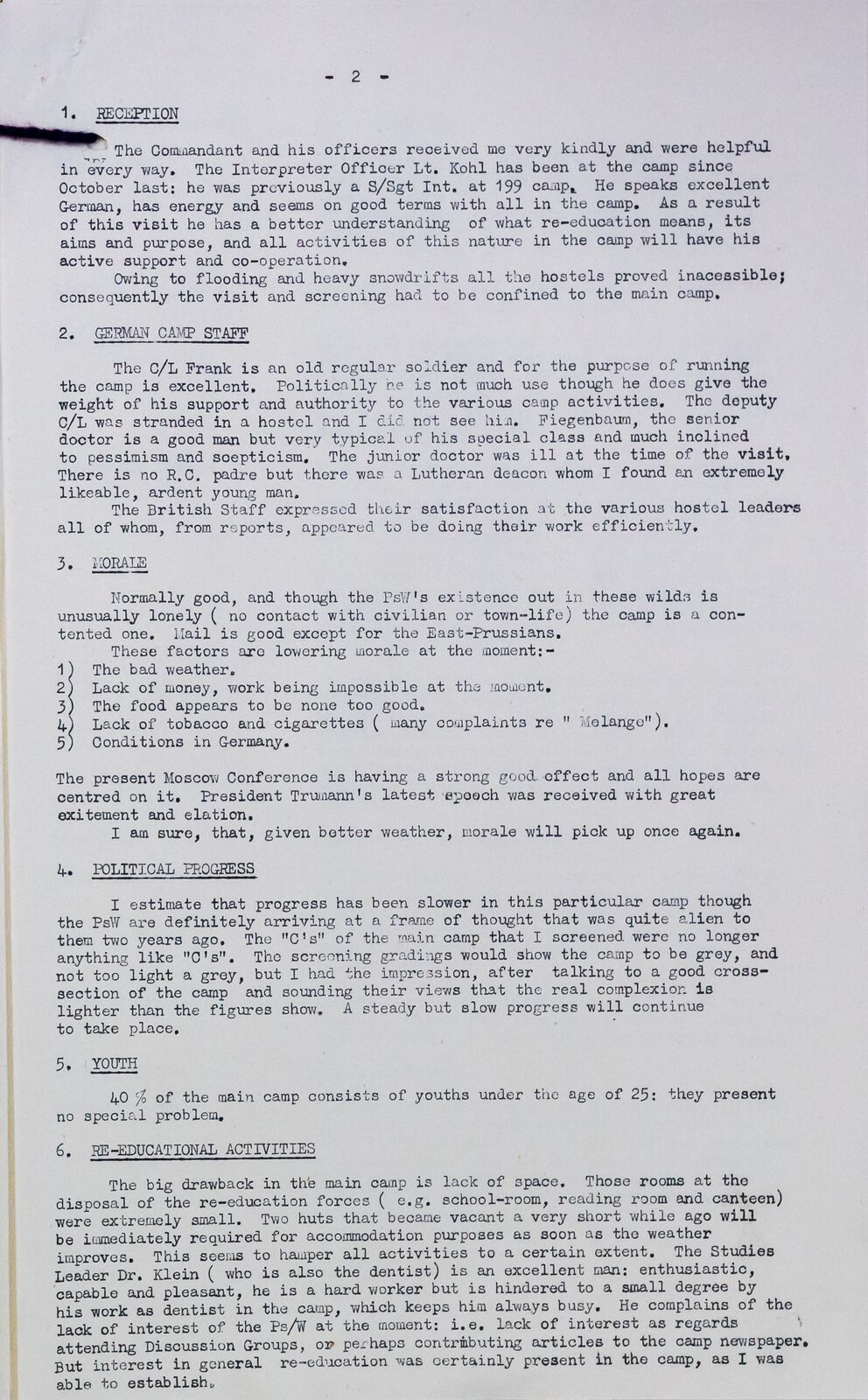
The inspector, L.H.F. Thornton, never reached it. “Owing to flooding and heavy snowdrifts all the hostels proved inacessible”, he wrote, “consequently the visit and screening had to be confined to the main camp.” His accounts of the thousand-volume library, the lectures, the camp newspaper and the theatre group therefore describe Balhary and not the six men at Tannadice. He noted separately that touring entertainment could not be sent out to the hostels at all, because War Office charges for transport were beyond the means of the camp fund, and concluded that many of the hostels would probably close in the near future.
On morale he wrote that the prisoners’ “existence out in these wilds is unusually lonely (no contact with civilian or town-life)”, and listed the bad weather, lack of money with work impossible, poor food, a shortage of tobacco and conditions in Germany as the things pulling morale down that March. That is as close as the surviving record comes to daily life in a six-man hostel in Angus.
Tannadice in the March 1947 return
| Field | Record |
|---|---|
| Parent camp | Camp 63 (G) P.W. Camp, Balhary Estate, c/o Alyth, Perthshire |
| Commanding officer | Lt Col D.M. Gall, M.C., The Cameronians |
| Hostel | Tannadice |
| German POWs at Tannadice | 6 |
| Hostel leader | Peter Gosch |
| Inspection | 17–19 March 1947, by L.H.F. Thornton; report handed in 22 March 1947 |
| Hostel visited? | No. Flooding and snowdrifts made all hostels inaccessible |
Camp 63 strength, 17 to 19 March 1947
| Component | Men |
|---|---|
| Headquarters, Balhary | 653 |
| Calvine satellite | 564 |
| Billets | 312 |
| Tealing | 137 |
| Errol | 99 |
| Douglas Wood | 94 |
| Whitfield | 70 |
| Pitroddie | 65 |
| Bankfoot | 65 |
| Burrelton | 57 |
| Tannadice | 6 |
| Total (2 officers, 2,120 other ranks) | 2,122 |
From prisoners to workers
Ukrainian former soldiers of the Galicia Division reached Britain from Italy in May and June 1947 and were held in prisoner of war camps, mainly in the agricultural areas of eastern England and southern Scotland. When they were released from prisoner of war status between August and October 1948 and taken into the European Voluntary Workers scheme, the camps holding them passed to civilian authorities and were redesignated as hostels, the YMCA being among the bodies that ran them. Kormylo’s directory records the outcome at Tannadice as a YMCA hostel near Forfar.
An Edinburgh local history account states that men of the Ukrainian Liberation Army captured by the Allies in Italy were among those dispersed in east Scotland at Tannadice Camp, that they were a low security category and that they were put to work on the land. That account restates the museum catalogue entry for the 1991 photograph rather than adding an independent record, and its author says plainly that his sources for this passage are thin. No dated document naming Ukrainians at Tannadice has been found, and no Ukrainian total for the hostel is known.
The Ukrainian wall painting
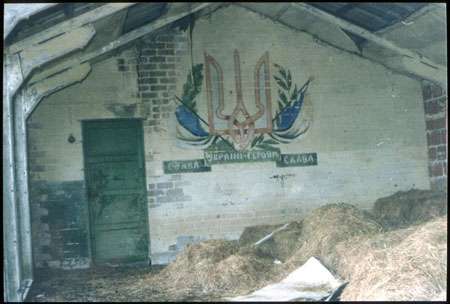
The photograph in Kormylo’s thesis shows a large trident framed by blue and yellow decoration and foliage. The accompanying caption identifies the motto as “Glory to Ukraine—Glory to Heroes”. A door stands beside the painting, beneath exposed roof timbers; loose material covers much of the floor.
The Scottish Life Archive also catalogues a photograph of a Ukrainian wall painting at Tannadice taken in 1991. Its record states that the building has since been demolished. The photographic date establishes when that view was made; it does not establish when the decoration was painted.
Kormylo reproduces the photograph twice, at figure 2-6 captioned “Tryzub painted on the wall of now long deserted barrack in Angus” and at figure 6-4 as “Deserted Prisoner of War / EVW camp, Tannadice”. Neither caption names a photographer or gives a date.
What survives
The directory entry names the hostel, the 1947 return fixes the site in the prisoner of war network, and the photographed decoration preserves the Ukrainian use of camp space. Nothing has been found to date the hostel’s opening or closure, to say how many people lived there, or to record a church, school, choir or sports team at Tannadice.
The surviving image matters because the building does not. Its painted end wall records how an institutional interior was given a recognisably Ukrainian character, and the Scottish Life Archive catalogue that holds the 1991 photograph notes that the building has since been demolished.
Sources
- In which ways is the Ukrainian community in Scotland a diaspora?
Peter David Kormylo, University of Glasgow · 2021
Printed 218 figure 6-4 and printed 323 appendix entry 20; original PDF text and embedded photograph read.
- Camp 63 inspection, March 1947: headquarters and hostel return
The National Archives, FO 939/144; reproduced by Banged Up Abroad · 1947-03-22
Inspection of 17–19 March 1947 by L.H.F. Thornton, report handed in 22 March. Scans 25–28 downloaded and read in full. Tannadice: six men, hostel leader Peter Gosch.
- Wall-painting at a prisoner-of-war camp for Ukrainians, Tannadice, Angus, 1991
Historic Environment Scotland; Scottish Life Archive / SCRAN · 1991 photograph
DP 488298; external references 000-000-466-990-C and -R. Catalogue text checked; its broad wartime dating of the painting is not adopted.
- Camp 63 inspection, March 1947: full four-page report
The National Archives, FO 939/144; reproduced by Banged Up Abroad · 1947-03-22
Pages 2 to 4 of the same report: hostels inaccessible through flooding and snow, morale, the impossibility of sending entertainment to the hostels, and the conclusion that many hostels would soon close.
- The symbolic tapner
Ross MacLennan, Project Reveal, National Trust for Scotland · 6 December 2018
Records Ian Bruce’s memory of an unlisted prisoner of war camp just outside Tannadice near Broom Farm, Italians then Germans from 1943, working in squads on local farms. Also names Camp 275 Kinnell as the official Angus camp.
- Our Lady of Pochaev and St Andrew: the Ukrainian Church in Leith
Threadinburgh · 30 August 2022
Secondary restatement of the SCRAN catalogue entry: Ukrainian Liberation Army men captured in Italy dispersed at Tannadice Camp, a low security category put to work on the land. The author states his sources for this section are thin.
- Post-war camps and hostels
Ukrainians in the United Kingdom, online encyclopaedia · accessed 13 September 2026
Framework source for the arrival of the Galicia Division from Italy, the release from POW status in August to October 1948, the redesignation of camps as hostels and the YMCA among hostel administrators. Context only; no Tannadice figure taken from it.
Last researched 13 September 2026