Hallmuir
Arrival and settlement
Near Lockerbie, Dumfries and Galloway, Scotland · Camp built 1942; Ukrainian community from 1947
Ukrainian former prisoners of war brought from the Rimini camp in Italy made a home near Lockerbie in 1947 and turned a camp hut into a Greek Catholic chapel. The chapel, a memorial cross and several huts still stand, and family photographs connect work, faith and lives rebuilt in Scotland and overseas.
Introduction
Hallmuir became a home for Ukrainian former prisoners of war in 1947. Men who had been held in Italy were brought to Scotland and put to work on farms and in forestry. Some later moved elsewhere in Britain or emigrated overseas. Others married locally and remained in the area. Their chapel continued to bring families together after camp life ended.
Sources for this section
A history in dates
- Early 1940sThe wartime camp is established.
- 1942The surviving chapel hut is built.
- 1942The camp is built to hold 450 German and Italian prisoners.
- 1947Ukrainian former prisoners of war arrive and adapt the chapel for worship.
- 1947The first Hallmuir gala day is held, with entertainment by a Ukrainian mandolin trio, and a Christmas party follows.
- 1 April 1947The British Cabinet decides to bring the former soldiers of the Galicia Division from Italy to the United Kingdom.
- 15 May 1947The troopship India Victory docks at Glasgow.
- 27 May 1947The date carried by the memorial cross at the camp entrance.
- 1948The men mark the Feast of Jordan with a blessing of the waters.
- July 1948Krawec’s distribution records 463 men at or near Lockerbie, one of eight groups in Britain.
- August–October 1948Former Galicia Division prisoners in Britain move into civilian European Voluntary Worker status.
- December 1948A strike of the former internees follows the proposal to remove them; in the end 81 are sent to Germany.
- Early 1951Employment restrictions are lifted for European Voluntary Workers of three years’ residence.
- 18 December 2003The chapel is listed at Category B.
- 2007The memorial plaque is dated to the sixtieth year after the men’s arrival.
- 2009Friends of the Ukrainian Chapel is established.
- 2018A four-phase restoration programme begins.
- March 2022The chapel collects clothes and medicines for Ukraine.
- 23 May 2022South of Scotland Enterprise announces a £52,777 preservation and visitor-development grant.
- September 2026The Doors Open Days programme includes the chapel and a museum barrack with historical photographs.
Sources for this section
- Historic Environment Scotland, Hallmuir Ukrainian Chapel with Memorial, LB49592
- Hallmuir Ukrainian Chapel
- Friends of the Lockerbie Chapel, visitor leaflet, hosted by Scottish Civic Trust
- Giancarlo Rinaldi, Tiny chapel near Lockerbie offers Ukraine a helping hand, BBC, 2 March 2022
- Roman Krawec, Former soldiers of the Galicia Division
- Hallmuir Ukrainian POW Chapel
- Ukrainian war memorial at Hallmuir, photographed 11 January 2014
- Roman Krawec, Post-war camps and hostels
- Sandra Dick, Tiny chapel built by Ukrainian prisoners of war being revived for new generation, The Herald, 2022
- Ukrainian POW Chapel, case study
- South of Scotland Enterprise, Funding boost secures future of Ukrainian Chapel, 23 May 2022
- Scottish Civic Trust, Ukrainian POW Chapel, Hallmuir, Doors Open Days 2026
From wartime camp to Ukrainian chapel
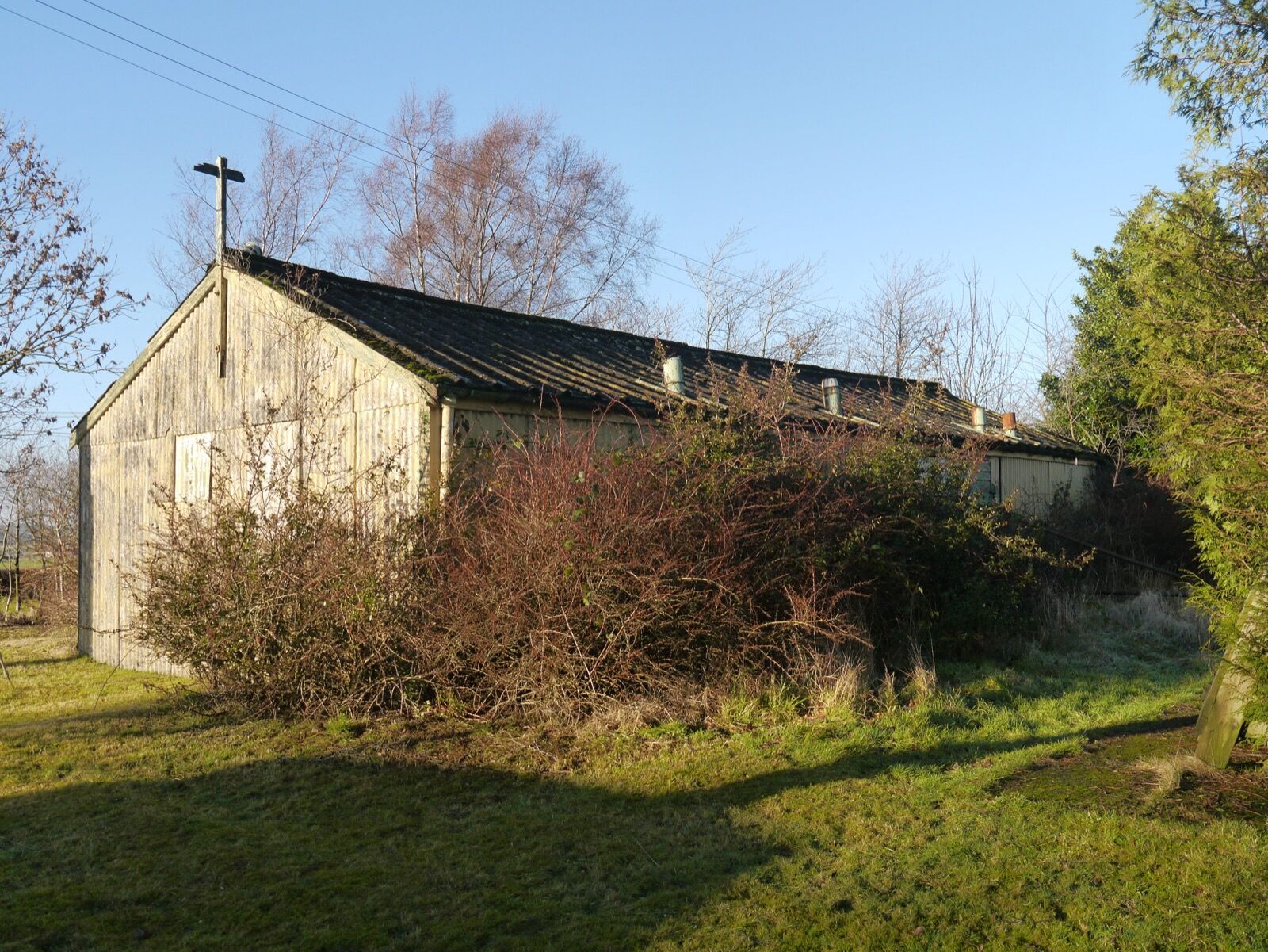
Historic Environment Scotland identifies the site as 68 Working Camp at Halmuir Farm. German and Italian prisoners had occupied it before the Ukrainians arrived. The listing estimates that the early-1940s camp originally contained 40 buildings and dates the surviving chapel hut to 1942. Italian prisoners had already worshipped in the building; its Ukrainian occupants subsequently furnished and decorated it for their own use.
The camp stood about a mile and a half south of Lockerbie and was built in 1942 to hold 450 German and Italian prisoners. Those men were repatriated after the war, and by 1947 the huts stood empty. Later that year the site became home to more than 400 Ukrainian men.
From Rimini to Lockerbie
The men reached Scotland from the Ukrainian camp at Rimini in Italy. The British Cabinet decided on 1 April 1947 to bring the former soldiers of the Galicia Division to the United Kingdom, and about 8,570 of them were shipped from Venice during May and June, together with seventeen nurses and a few civilian relatives. The troopship India Victory docked at Glasgow on 15 May 1947, and a party of the men was sent on to Hallmuir.
Accounts of the size of that party differ. The chapel’s own leaflet and the local heritage accounts speak of more than 400 men, while one published feature puts the number at 450. The memorial cross at the camp entrance carries the date 27 May 1947.
A 2026 local news report gives the number of Ukrainians who arrived at Hallmuir in 1947 as 463, the same figure Krawec recorded at or near Lockerbie in July 1948. The report describes a different sequence of status from the published camp history: it states that the men were classed as surrendered enemy personnel for two years, until 1949, that they were then offered three-year contracts to work in the local forests and farms, and that they were released in 1951. The two accounts cannot be reconciled from the sources read here.
Sources for this section
- Roman Krawec, Former soldiers of the Galicia Division
- Hallmuir Ukrainian Chapel
- Hallmuir Ukrainian POW Chapel
- Friends of the Lockerbie Chapel, visitor leaflet, hosted by Scottish Civic Trust
- Ukrainian war memorial at Hallmuir, photographed 11 January 2014
- Roman Krawec, Post-war camps and hostels
- Zac Hannay, ‘Roots run deep in region’
Making a place of worship
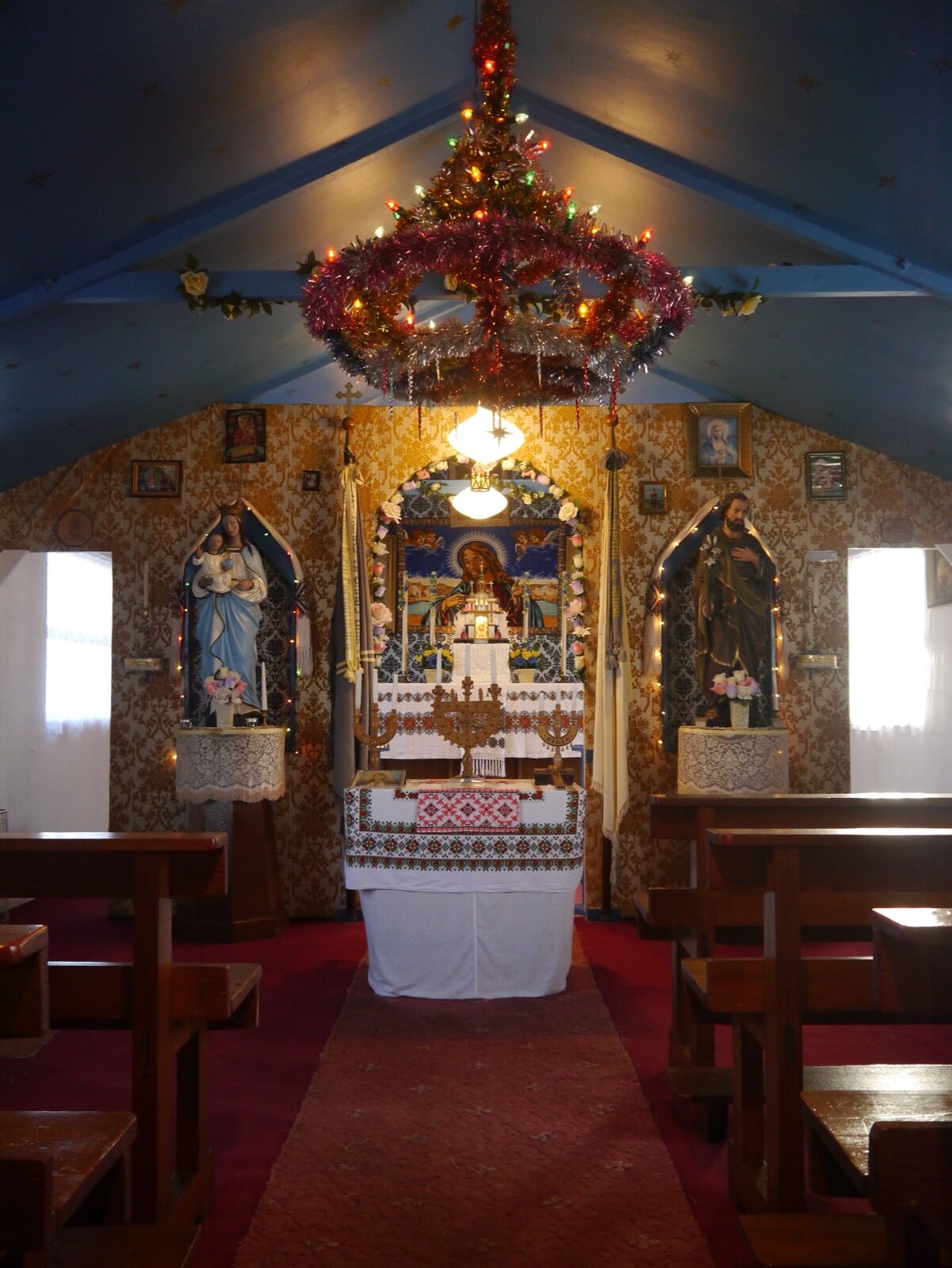
Inside the prefabricated hut, the men worked with the materials available to them. Shell fragments became candlesticks, tent fabric became banners, and a penknife was used to carve a small cathedral for the altar. Historic Environment Scotland records paintings made by prisoners, an altar screen and a blue ceiling patterned with gold stars. These details preserve the work of individuals whose creativity transformed an ordinary camp building. The chapel’s own visitor leaflet identifies worship as Ukrainian Greek Catholic and describes both its original adaptation for that rite and later Greek Catholic services.
The hut had already been used by the Italian prisoners as a place of worship. The Ukrainians rebuilt and decorated it so that they could celebrate in their own Greek Catholic rite, and Greek Catholic services are still held there, drawing worshippers from across Scotland. The chapel is one of only two prisoner-of-war chapels surviving in Scotland from the Second World War, the other being the Italian Chapel on Lamb Holm in Orkney.
Work and life in the camp
The Ministry of Agriculture put the men to work on farms and in forestry around Annandale. Photographs displayed in the chapel record a tractor group, camp drivers and the camp chauffeurs photographed with the commandant, which shows how far the daily routine had moved from guarded confinement.
The same collection records the camp’s own social life: the first Hallmuir gala day in 1947, entertainment at it by a Ukrainian mandolin trio, a Christmas party in 1947, a camp football team, and the blessing of the waters at the Feast of Jordan in 1948. One man carried apple seeds with him from Rimini, and the trees grown from them still stand beside the memorial.
Work and the transition to civilian life
Roman Krawec’s account places Hallmuir within the movement of former Galicia Division personnel from Italy to Britain in May–June 1947. It records 463 men at or near Lockerbie in July 1948. The same account dates release from prisoner-of-war status and admission to the European Voluntary Workers scheme to August–October 1948. Camps housing these men then became civilian hostels. Their subsequent freedom to change employment and find private accommodation developed over several years.
Lockerbie was one of eight places named in that July 1948 distribution, and the smallest of the named camps except for a residual group. The largest were Hempton in Norfolk with 1,682 men and Mildenhall in Suffolk with 1,401; Dalkeith, the other Scottish camp, held 958. In all, some 21,000 Ukrainian European Voluntary Workers and 860 dependants came to Britain between 1947 and 1950.
Restrictions on changing employment were lifted at the beginning of 1951 for men who had been in the country three years, and most of the hostels closed by the middle of that decade. Of the men brought from Italy, only 81 were eventually removed to Germany.
Two different records of the men
Where the men from Italy were held, July 1948
| Camp | Men |
|---|---|
| Hempton, Norfolk | 1,682 |
| Mildenhall, Suffolk | 1,401 |
| Allington, Lincolnshire | 1,319 |
| Moorby, Lincolnshire | 1,264 |
| Botesdale, Suffolk | 1,010 |
| Dalkeith, Scotland | 958 |
| Lockerbie, Scotland | 463 |
| Elsewhere | 300 |
Sources for this section
A chapel after the camp
Peter Kormylo, whose father settled locally, recalled a priest travelling from Edinburgh each month during his childhood. In his account, worship also brought friends together: gatherings continued socially, and religious singing gave way to folk songs. The chapel therefore connected people who no longer shared the same camp address. A 2022 Herald report describes the Friends of the Ukrainian Chapel, established in 2009, working to preserve both the building and the memories of its community.
Scotland and onward journeys
Kormylo told the BBC that some men found mining work in central Scotland. Those who had married locally, including his father, often stayed nearby; others went to England, the United States or Canada. These recollections describe several possible paths from Hallmuir rather than a single destination shared by all residents.
Sources for this section
Faces in family photographs
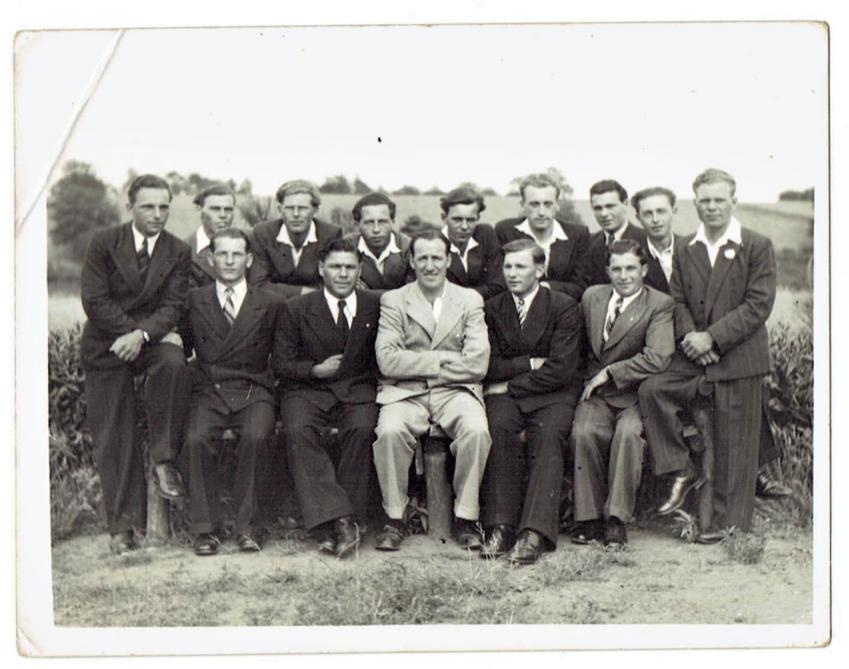
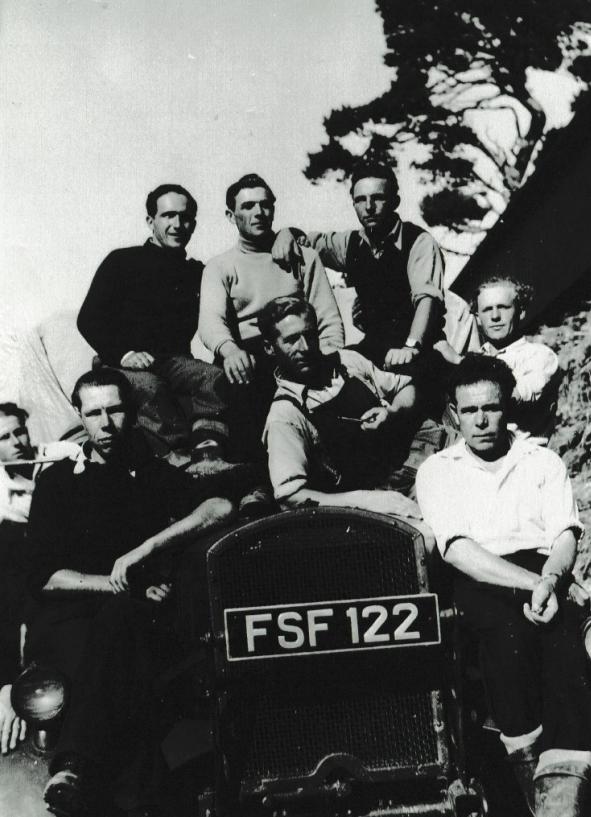
Two photographs reproduced in Michael Drapan’s history of Ukrainians in Huddersfield connect Hallmuir with later lives in Yorkshire. One shows men in suits posing outdoors around 1948–1949; another shows a group taking a break from farm work around 1947–1948. Drapan identifies Wasyl Zubak, Andriy Prychidnyj, and Stefan and Mychajlo Hnatkiwskyj among the men who subsequently settled in Huddersfield. These family photographs preserve both work and friendship during their years at Hallmuir.
Renewal and connections with Ukraine
In March 2022, the chapel became a collection point for clothes and medicines destined for Ukraine. The BBC reported that donations would travel through Edinburgh. Later that year, the Herald described repairs to the roof, windows and interior, alongside plans for a museum in a neighbouring barrack. Preserving the old chapel and supporting people displaced by a new war had become connected parts of the community’s work. South of Scotland Enterprise announced a £52,777 grant in May 2022 for repairs, landscaping and visitor-centre development. By the 2026 Doors Open Days programme, the chapel was advertising a museum barrack containing historical photographs.
The Friends’ programme has run in four phases since 2018, covering the chapel inside and out, a visitor building, services and the grounds; drainage and new windows were completed first. Besides the enterprise grant, money came from the Lockerbie Trust Fund and from Muirhall Windfarm, and the appeal passed its £80,000 target by £10,500.
Sources for this section
- Giancarlo Rinaldi, Tiny chapel near Lockerbie offers Ukraine a helping hand, BBC, 2 March 2022
- Sandra Dick, Tiny chapel built by Ukrainian prisoners of war being revived for new generation, The Herald, 2022
- South of Scotland Enterprise, Funding boost secures future of Ukrainian Chapel, 23 May 2022
- Scottish Civic Trust, Ukrainian POW Chapel, Hallmuir, Doors Open Days 2026
- Ukrainian POW Chapel, case study
The site today
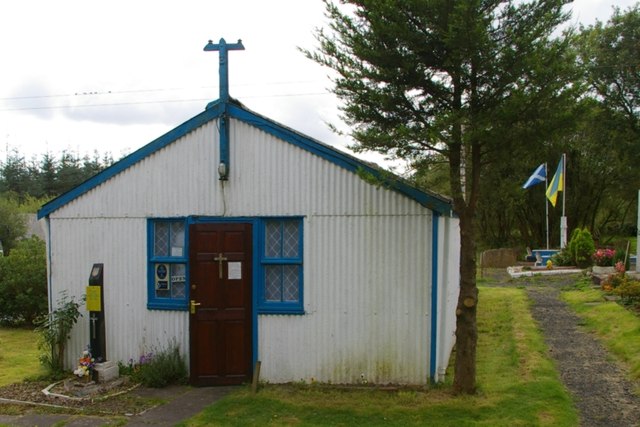
The chapel is a single-storey hut of corrugated sheeting on a timber frame and a concrete base, six bays long, with a three-barred cross on the gable and blue dressings around the door and windows. Inside are timber pews, prisoners’ paintings, an altar screen and a ceiling painted blue and scattered with gold stars.
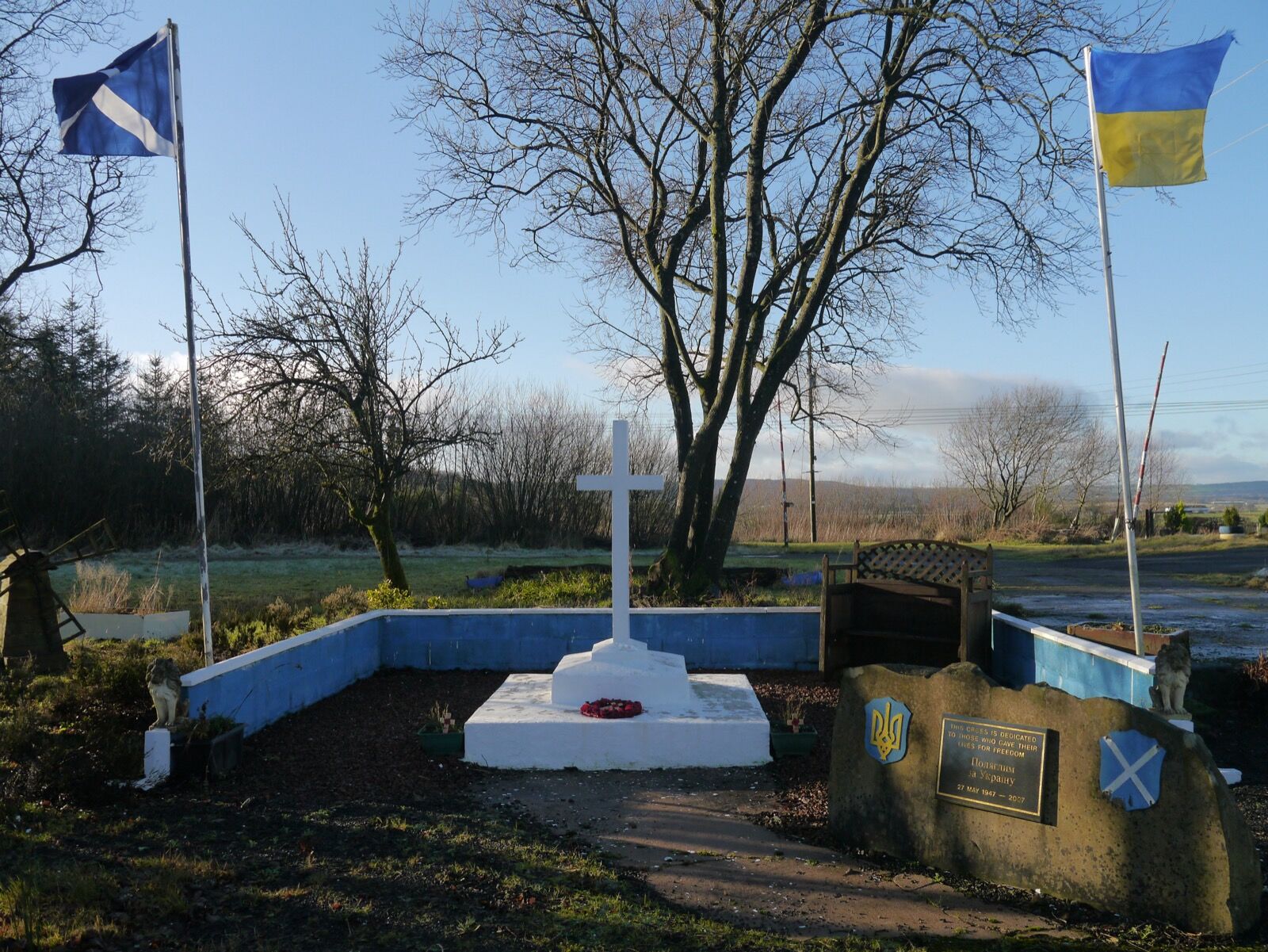
A white cross stands in a low blue-painted enclosure at the entrance, between the Scottish and Ukrainian flags. Its plaque reads “This cross is dedicated to those who gave their lives for freedom” above the Ukrainian words Поляглим за Україну and the dates 27 May 1947 to 2007. Other huts of the camp survive nearby, one of them still carrying a cross on its gable.
The chapel and the ground around it are held on lease from the Buchanan-Jardine family of Castlemilk. Inside, a full list of the 416 original internees is displayed, together with copies of photographs given by Ukrainian veterans and their families, and the site is looked after by their relatives and by the wider Ukrainian community.
A timber post on a concrete base by the entrance carries a plaque in Ukrainian and English reading “This chapel was created by Ukrainian POWs during their internment here after World War 2”. A visitor writing in 2014 found the chapel still cared for and in use, with regular services and the occasional wedding, and next door a small museum and library whose walls were covered with photographs and information and whose tables carried binders of further documents. The 2026 local report describes two prefabricated huts remaining at the camp, the Greek Catholic chapel and the cultural hub, with people still involved in the Hallmuir Trust.
Sources for this section
- Historic Environment Scotland, Hallmuir Ukrainian Chapel with Memorial, LB49592
- Hallmuir Ukrainian Chapel, photographed 3 September 2012
- Ukrainian war memorial at Hallmuir, photographed 11 January 2014
- A former camp building at Hallmuir, photographed 11 January 2014
- Friends of the Lockerbie Chapel, visitor leaflet, hosted by Scottish Civic Trust
- Zac Hannay, ‘Roots run deep in region’
- Hallmuir Ukrainian Prisoner of War Chapel, War Memorials Online, WMO/279111
- Ukrainian POW Chapel, Scotland
Sources
- Historic Environment Scotland, Hallmuir Ukrainian Chapel with Memorial, LB49592
Historic Environment Scotland · Listed 2003
Live full designation text read; listing description is not a current site survey.
- Roman Krawec, Post-war camps and hostels
Ukrainians in the United Kingdom · 2013
Full published text read; 2013 overview, with original bibliography not yet inspected.
- Giancarlo Rinaldi, Tiny chapel near Lockerbie offers Ukraine a helping hand, BBC, 2 March 2022
BBC News · 2 March 2022
Full retrieved article text independently read from archived pipeline retrieval; live web extractor blocked.
- Sandra Dick, Tiny chapel built by Ukrainian prisoners of war being revived for new generation, The Herald, 2022
The Herald · 2022
Full retrieved article text independently read; historical reminiscences attributed, museum plan not treated as completed.
- Friends of the Lockerbie Chapel, visitor leaflet, hosted by Scottish Civic Trust
Friends of the Lockerbie Chapel / Scottish Civic Trust · Undated
Two-page extracted PDF text read. Undated leaflet; host crawl/publication dates are not document dates. First-person custodial account.
- Scottish Civic Trust, Ukrainian POW Chapel, Hallmuir, Doors Open Days 2026
Scottish Civic Trust · 2026
Full live event entry read; advertises 5–6 September 2026 museum barrack and historic-photo collection. Does not prove attendance or complete renovation.
- South of Scotland Enterprise, Funding boost secures future of Ukrainian Chapel, 23 May 2022
South of Scotland Enterprise · 23 May 2022
Primary funder announcement read; £52,777 grant for repairs, landscaping and visitor-centre development. Historical first-conversion sentence not adopted.
- Michael Drapan, Home from Home: The history of an émigré Ukrainian community based in the heart of Yorkshire – Huddersfield, 1948–2018, University of Huddersfield, 2019
University of Huddersfield · 2019
Appendix 3 images 27 and 31, printed 163 and 165, visually inspected with captions. Third-party image permissions do not establish open reuse.
- Hallmuir Ukrainian Chapel
Undiscovered Scotland · Accessed September 2026
Full published feature read: camp built 1942 for up to 450 German and Italian prisoners, empty by 1947, the India Victory docking at Glasgow on 15 May 1947, and 450 of the men sent on to Hallmuir. The page’s description of the chapel’s rite differs from the chapel’s own leaflet and is not followed here.
- Hallmuir Ukrainian POW Chapel
Heritage and History · September 2010
Full published article read: the camp of 1942, the arrival of the India Victory at Glasgow on 15 May 1947, employment by the Ministry of Agriculture in farming and forestry, the apple trees grown from seed carried from Rimini, and a wedding in the chapel in 2002. Its date for the raising of the division is not followed here.
- Roman Krawec, Former soldiers of the Galicia Division
Ukrainians in the United Kingdom · 2009
Full published text read: the British Cabinet decision of 1 April 1947, the movement of about 8,570 men from Venice to Britain in May and June 1947 together with 17 nurses and civilian relatives, release to European Voluntary Worker status between August and October 1948, and the small number eventually removed to Germany. The page reproduces a photograph captioned Hallmuir POW camp near Lockerbie, 1948.
- Ukrainian POW Chapel, case study
Scottish Civic Trust · Accessed September 2026
Full published case study read: the site 1.5 miles south of Lockerbie, the Friends’ formation in 2009, the four-phase programme begun in 2018, completed drainage and windows, and grants from the Lockerbie Trust Fund, Muirhall Windfarm and South of Scotland Enterprise.
- Ukrainian war memorial at Hallmuir, photographed 11 January 2014
James T M Towill, via Geograph and Wikimedia Commons · 11 January 2014
Photograph read at full resolution and the plaque transcribed from it: “THIS CROSS IS DEDICATED TO THOSE WHO GAVE THEIR LIVES FOR FREEDOM / Поляглим за Україну / 27 MAY 1947 — 2007”. Licensed CC BY-SA 2.0.
- A former camp building at Hallmuir, photographed 11 January 2014
James T M Towill, via Geograph and Wikimedia Commons · 11 January 2014
Photograph inspected: a timber-clad hut of the former camp, still standing and carrying a cross on its gable. Licensed CC BY-SA 2.0.
- Hallmuir Ukrainian Chapel, photographed 3 September 2012
Tiger, via Geograph and Wikimedia Commons · 3 September 2012
Photograph inspected: the chapel hut from the west, corrugated sheeting painted white with blue dressings and a three-barred cross on the gable. Licensed CC BY-SA 2.0.
- The interior of Hallmuir Ukrainian Chapel, photographed 11 January 2014
James T M Towill, via Geograph and Wikimedia Commons · 11 January 2014
Photograph inspected: the interior of the chapel hut looking towards the altar screen. Licensed CC BY-SA 2.0.
- Zac Hannay, ‘Roots run deep in region’
DNG24 · 7 March 2026
Single-page news article read in full: the arrival of 463 Ukrainian men at Hallmuir in 1947, their classification as surrendered enemy personnel until 1949 and the three-year work contracts that followed, release given as 1951, and the two prefabricated huts standing at the site in 2026.
- Hallmuir Ukrainian Prisoner of War Chapel, War Memorials Online, WMO/279111
War Memorials Online · Record with images dated 2023
Memorial record read in full, including the description of the entrance plaque and a quoted Historic Environment Scotland description of the chapel.
- Ukrainian POW Chapel, Scotland
maraid.co.uk, a personal blog · 2 November 2014
Blog post read in full: an account of a visit in 2014 describing regular services and occasional weddings at the chapel and an adjoining small museum and library of photographs and documents.
Last researched 12 September 2026