Barony Hostel
Arrival and settlement
Parkgate, Dumfriesshire, Scotland · German working camp No 298, files covering 1945 to 1948; Ukrainian accommodation in the late 1940s
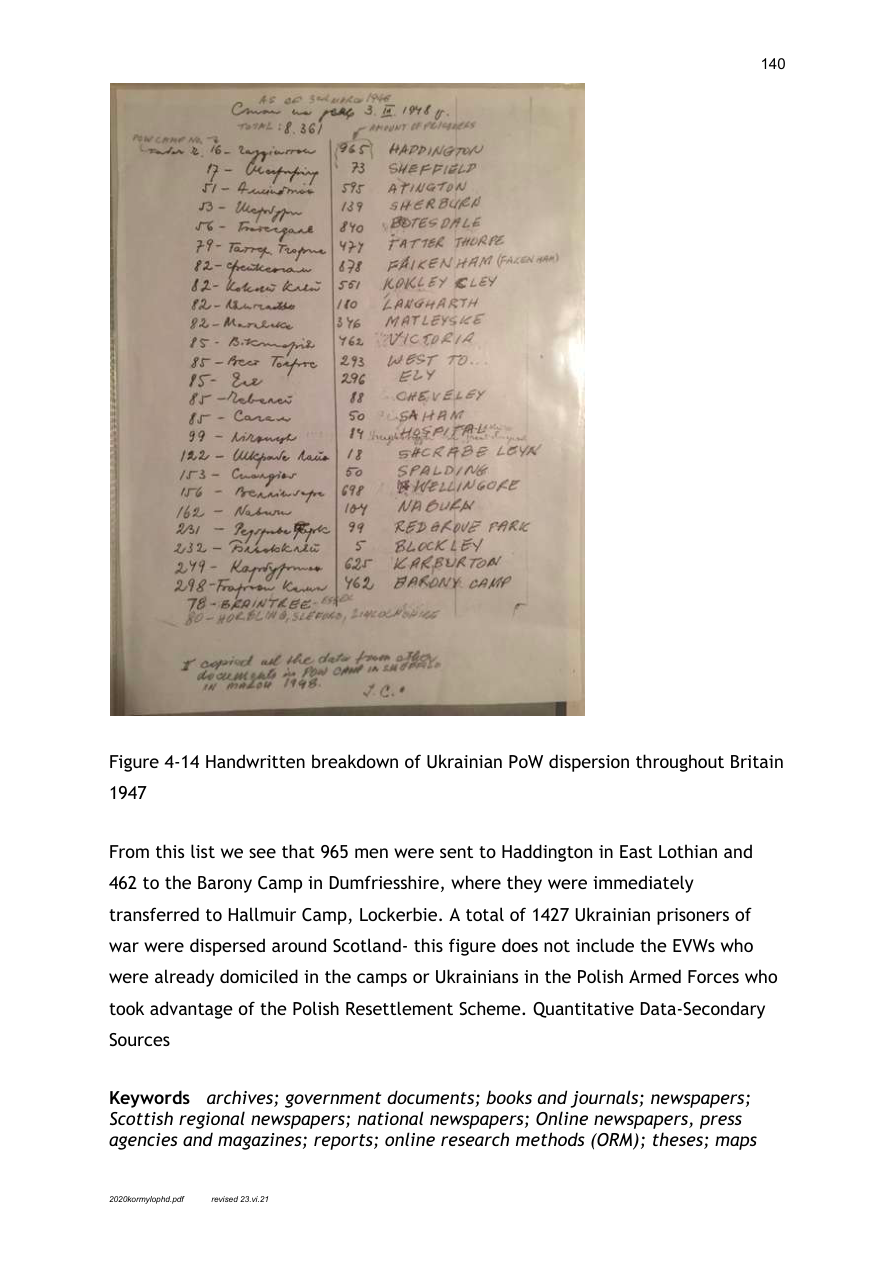
Barony Camp at Parkgate was German Working Camp No 298 before it appeared in the Ukrainian community’s own list of Scottish accommodation. A handwritten dispersal list reproduced by Peter Kormylo records 462 men against Barony, and his account sends them straight on to Hallmuir near Lockerbie.
Introduction
Barony Hostel at Parkgate belongs to the early history of Ukrainians in Dumfriesshire. It appears in the community’s Scottish camp directory, while a reproduced handwritten list records 462 men against Barony Camp. Historian Peter Kormylo connects this group with an onward transfer to Hallmuir near Lockerbie. The wider Barony site had already passed through military and prisoner-of-war uses before its place in postwar Ukrainian migration.
The camp number is confirmed outside the Ukrainian record. The National Archives holds a file titled 298 Working Camp, Barony Camp, Dumfriesshire, covering 1945 to 1948, among the prisoner-of-war camp files of the Control Office for Germany and Austria. The file has not been read, but its title matches the number 298 on the handwritten list and shows that the camp was still an administrative concern in 1948.
A history in dates
- 1834Kirkmichael House is built to William Burn’s design on the estate that would later hold the camp.
- Second World WarMilitary huts and later prisoner accommodation occupied the Barony estate.
- 1945–1948Covering dates of the government file on 298 Working Camp, Barony Camp, Dumfriesshire.
- German phase, year uncertainA Christmas issue of the camp newspaper Litfassaeule is produced at Barony Camp No 298.
- 27 May and 6 June 1947Dates given in a compiled account for the Ukrainian arrival at Glasgow and the march into Hallmuir, by a route that does not name Barony.
- 1947–1948 recordsA handwritten dispersal list and Kormylo’s later interpretation connect 462 Ukrainian men with Barony and Hallmuir.
- 20 May 1948Aerial photographs later interpreted by RCAHMS record the large hutted compound.
- After closureThe main huts were removed and housing appeared at Beech Avenue.
- 1974The Barony Agricultural College is founded on the estate.
- 2021A site photography project recorded housing and surrounding land.
Sources for this section
- Kirkmichael House, Parkgate: Category B listed building
- Far From Home, POWs on the Solway Coast
- 298 Working Camp, Barony Camp, Dumfriesshire
- Litfassaeule: Lagerzeitung des Barony-Camps Nr. 298
- Displaced Persons: Researching Scotland
- Peter Kormylo, Ukrainians in Scotland, PhD thesis
- The Barony Camp, German Working Camp No 298, NRHE273037
- SRUC Barony Campus
- PoW Camp 182 Barony Camp, site photography
A military camp on an estate
The Devil’s Porridge Museum traces Barony’s wartime beginnings to the Galbraith family estate near Dumfries. Its account describes the British Army and a Jewish Pioneer Corps building huts, first for training and subsequently for prisoners from Germany, Austria and other countries. This history helps explain why accommodation existed at Parkgate when wartime detention gave way to postwar movements of people.
The estate at the centre of all this was Kirkmichael House, a large asymmetrical Jacobean mansion built in 1834 to designs by William Burn, with a service range and courtyard to the west and a quadrangular walled garden of about the same date. It stands at NY 022870, just south of Parkgate and about eight miles north of Dumfries. The huts went up in its grounds rather than in the house.
Something survives of what the German prisoners made of the place. The Wiener Holocaust Library holds a 44 page Christmas issue of Litfassaeule, described as the camp newspaper of Barony Camp No 298, printed in German and lavishly illustrated with colour block prints. Its editor was Erich Voss and its illustrators Otto Rohse, Heinz Kowald and Karl Buehler, and the catalogue lists re-education, poetry, religion and Christianity among its subjects. The library records the dates only as uncertain, so the issue cannot be pinned to a year.
The hutted landscape
Historic Environment Scotland’s record identifies a large camp within the Kirkmichael House estate. An archaeological reading of aerial photographs taken on 20 May 1948 found at least 90 huts, mainly Nissen huts, in the main section. The compound lay chiefly northwest of the house, with a perimeter fence, an extension enclosure and further huts nearby. Possible staff quarters were identified to the northeast. These are observations of the camp’s physical layout, rather than a count of its Ukrainian occupants.
Sources for this section
The Ukrainian route through Barony
Kormylo’s map and appendix name Barony Hostel, Parkgate, among Scottish accommodation used by Ukrainians. His account of the men transferred from Rimini to Britain reports 462 sent to Barony and immediately transferred to Hallmuir. He reproduces a handwritten list showing the same number beside Barony Camp and camp number 298. The page captions the dispersal as 1947, while the reproduced sheet carries 1948 dating and a note about copying the information in March 1948. The safest reading is a documented Barony entry and an attributed onward movement, without assigning an exact transfer day.
The figure sits inside a larger count. Reading the same handwritten sheet, Kormylo reports 965 men sent to Haddington in East Lothian and 462 to Barony, and puts the total Ukrainian prisoners of war dispersed around Scotland at 1,427. He is explicit that this total excludes European Voluntary Workers already living in the camps and Ukrainians who came through the Polish Resettlement Scheme. These are men counted as they moved, not beds at Barony.
Published accounts of the journey do not agree. A compilation of Scottish displaced persons material states that between 420 and 450 Ukrainian prisoners reached Glasgow docks from Rimini on the morning of 27 May 1947, stayed briefly at Happendon Lodge and Carstairs, and were taken by train to Lockerbie on 6 June 1947 to march to Hallmuir. That account does not mention Barony at all. Kormylo’s route does. Both cannot be complete, and neither rests on a movement order that has been produced, so the Barony entry is best treated as a documented staging point whose place in the sequence is still open.
Reading the Barony evidence
| Record | What it records | Meaning |
|---|---|---|
| Handwritten list reproduced by Kormylo | 298 / 462 / Barony Camp | Camp number 298 and 462 men; not hostel capacity |
| Kormylo’s narrative | Barony→Hallmuir | Reported immediate onward transfer |
| 20 May 1948 aerial, interpreted by RCAHMS | At least 90 mainly Nissen huts | Physical main compound, not resident count |
| Scottish Ukrainian directory | Barony Hostel, Parkgate | Independent named hostel inclusion |
| Government file FO 939/184, 1945–1948 | 298 Working Camp, Barony Camp, Dumfriesshire | Camp number confirmed outside the Ukrainian record |
| Wiener Library P02871 | Camp newspaper of Barony Camp No 298, in German | German phase only; catalogue dates uncertain |
| Compiled Scottish displaced persons account | Glasgow 27 May 1947, Hallmuir 6 June 1947 by way of Happendon Lodge and Carstairs | Route that does not name Barony |
The 1947 dispersal as Kormylo reads it
| Destination | Men |
|---|---|
| Haddington, East Lothian | 965 |
| Barony Camp, Dumfriesshire | 462 |
| Total dispersed around Scotland | 1,427 |
Sources for this section
The camp after the huts
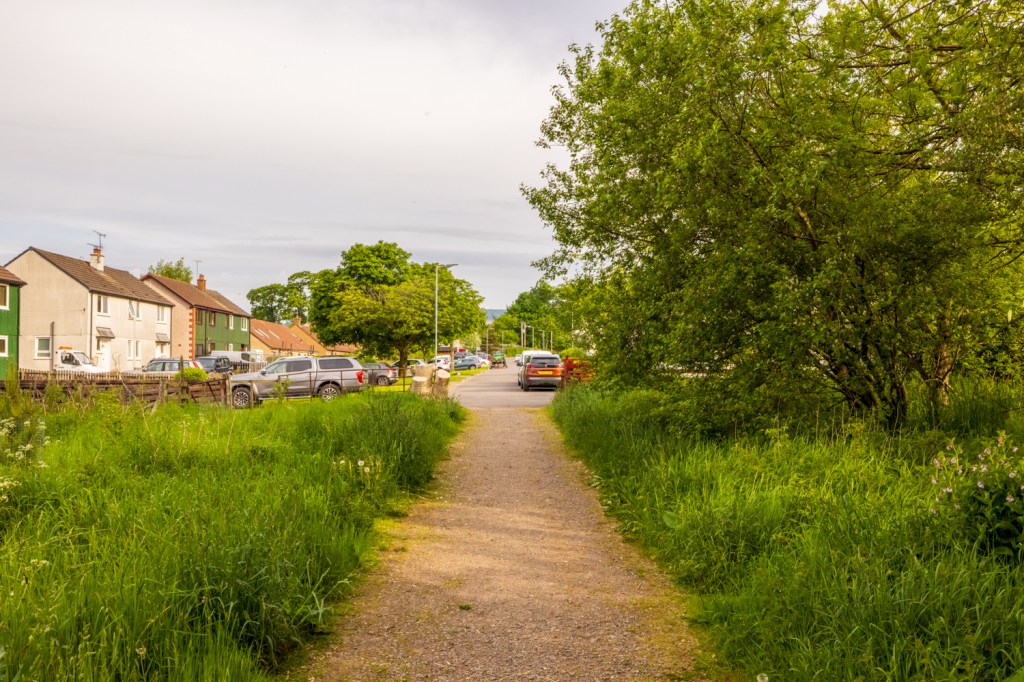
The historic-environment record describes the removal of the main huts after closure and a small housing estate on the northern part, named Beech Avenue on Ordnance Survey mapping. A 2021 site visit photographed houses, a path and wooded margins in this area, with other parts returned to farmland. The modern streetscape is part of the camp’s afterlife; it does not reproduce the arrangement of accommodation known to the postwar residents.
The wider estate found a new purpose. The Barony Agricultural College was founded here in 1974 and Kirkmichael House was extended and converted for college use between 1984 and 1991. Since 2012 the 260 hectare farming and woodland estate has been the Barony Campus of Scotland’s Rural College. Visitors should note that a second, more modern Kirkmichael House stands on the other side of Parkgate.
The estate before and after the huts
| Date | What the record says |
|---|---|
| 1834 | Kirkmichael House built to William Burn’s design, listed Category B in 1971 |
| About 1834 | Quadrangular walled garden, listed separately |
| 1974 | Barony Agricultural College founded on the estate |
| 1984–1991 | Kirkmichael House extended and converted for college use |
| 2012 | The college becomes the Barony Campus of Scotland’s Rural College |
Sources
- Peter Kormylo, Ukrainians in Scotland, PhD thesis
Original printed 100,139–140,322. Figure 4-14 visually inspected: 462 Barony Camp, 298 number; manuscript header/copied note 1948 versus author 1947 caption explicitly distinguished.
- Far From Home, POWs on the Solway Coast
The Devil’s Porridge Museum
Original PDF 22/printed 21 read. Barony paragraph used alone; Hallmuir regional population/chapel statements not transferred.
- The Barony Camp, German Working Camp No 298, NRHE273037
Historic Environment Scotland
Complete institutional archaeology note read via indexed original. RCAHMS July 2005 interpretation of 20 May 1948 aerial 541[A]3973157–3158; no direct aerial inspection.
- PoW Camp 182 Barony Camp, site photography
Repatriated Landscape · Site visit 2021
Original page and actual photograph viewed. Beech Avenue housing; page writes Beach Avenue and dates visit July 2021; image filename June 2021 so caption year only.
- 298 Working Camp, Barony Camp, Dumfriesshire
The National Archives, Kew · File covers 1945–1948
FO 939/184, Control Office for Germany and Austria and Foreign Office German Section, prisoners of war files, former reference CO Files 152/246. Catalogue entry read on 13 September 2026; the file itself is unread. Confirms the camp number and official name from a government series. German prisoner series, so it does not document Ukrainian residents.
- Litfassaeule: Lagerzeitung des Barony-Camps Nr. 298
The Wiener Holocaust Library · Catalogue gives the date range as uncertain
Catalogue record P02871 read in full. German-language camp newspaper, 44 page Christmas issue, editor Erich Voss, illustrators Otto Rohse, Heinz Kowald and Karl Buehler. The publication itself has not been examined. Documents the German phase only.
- Kirkmichael House, Parkgate: Category B listed building
Historic Environment Scotland list text, read through the British Listed Buildings mirror · Listed 3 August 1971
Source ID 342873, grid NY022870. William Burn, built 1834, minor alterations 1912 by Barbour and Bowie. Companion record 342874 covers the walled garden of about the same date. Architectural designation only; silent on the camp.
- SRUC Barony Campus
The Gazetteer for Scotland · Read 13 September 2026
260 hectare estate on the Water of Ae south of Parkgate; Barony Agricultural College founded 1974, Kirkmichael House converted for the college 1984–91, part of Scotland’s Rural College since 2012. Warns that a second, modern Kirkmichael House stands across Parkgate. Its build date of 1832–34 differs slightly from the listed building record.
- Displaced Persons: Researching Scotland
dpcamps.org, compiled and submitted contributions · Read 13 September 2026
Gives 27 May 1947 for the Glasgow arrival and 6 June 1947 for the march into Hallmuir, by way of Happendon Lodge and Carstairs, and does not mention Barony. Compiled material, not an archival record; used only to show that the published routes disagree. No resident name is carried over from it.
Last researched 13 September 2026