Broadmeadows
Arrival and settlement
Melbourne · Victoria · Australia · In operation by December 1949; closed 21 August 1971
A hostel on the army ground at Camp Road took displaced-person workers and their families, and one Ukrainian woman raising a son alone cooked in its kitchen for the better part of fifteen years. It ran for more than twenty years, and the Ukrainian community its residents built grew up outside it, in Glenroy, Essendon and Ardeer.
Introduction
Broadmeadows migrant hostel occupied former military accommodation on Camp Road. Ukrainian families lived there while working and finding homes in Melbourne’s expanding northern suburbs. The hostel belonged to Australia’s settlement system: residents had already made the journey from Europe and were building new lives around employment, schooling and community connections.
Sources for this section
A history in dates
- Between 1 July 1945 and 19 December 1949The hostel commenced operation, according to the parliamentary returns.
- April 1950Broadmeadows temporarily receives people evacuated from flooded Williamstown accommodation.
- 24 May 1950Olga reached Port Melbourne on the Castel Bianco after the Fairsea broke down in the Suez Canal.
- About 1951Broadmeadows is listed for displaced-person workers and families, accommodation fully available, with some construction still proceeding.
- 1953A Ukrainian kitchen worker arrives with her son after earlier Victorian camp stays.
- 1954Migrant pupils make up more than 40 per cent of nearby Westbreen Primary School.
- 8 December 1958Olga was naturalised.
- 1959Olga left the hostel for a rented bungalow in Broadmeadows.
- April 1968A documented Greek family arrival shows the hostel continuing to receive newcomers.
- July 1970–September 1974A surviving hostel duty book records weekend and night administration.
- 21 August 1971The hostel closed down.
An army camp becomes a temporary home
A Commonwealth programme reproduced by the Migration Heritage Project lists Broadmeadows for displaced-person workers and families. Accommodation was already available while further construction continued. The entry shows a family function alongside the supply of housing for workers.
The hostel also offered emergency shelter. When flooding forced nearly a thousand residents from the Williamstown racecourse accommodation in April 1950, they were evacuated to Broadmeadows for four days. Migration accommodation could therefore operate as a connected network when an individual site became uninhabitable.
Sources for this section
Opening and closing
The Migration Heritage Project’s compilation of parliamentary returns dates the hostel more precisely than the local accounts do. Its table of Commonwealth hostels in Victoria records Broadmeadows as having commenced operation at some point between 1 July 1945 and 19 December 1949, and as having closed down on 21 August 1971. A workers’ hostel table of about 1951 lists Broadmeadows under displaced-person workers and families, with accommodation fully available and some construction still proceeding, and an estimated date of completion of March 1951.
That places Broadmeadows among the hostels built in the industrial or less developed outer suburbs of Melbourne, which Heritage Victoria lists as Altona, Broadmeadows, Holmesglen, Maribyrnong, Nunawading and Preston. These were distinct from the country holding centres such as Benalla and Rushworth: the hostels housed workers and, where there was room, their families, while the holding centres took dependants whose breadwinner was working elsewhere.
The hostel in the parliamentary returns
| Field | Entry |
|---|---|
| Commenced operation | Between 1 July 1945 and 19 December 1949 |
| Type of resident, about 1951 | Displaced-person workers and families |
| Progress in construction, about 1951 | Accommodation fully available, but some construction proceeding |
| Estimated date of completion | March 1951 |
| Closed down | 21 August 1971 |
Olga’s years in the kitchen
The fullest Ukrainian account of the hostel is a memoir published by Kalyna Care in 2012. Olga had been in displaced-person camps around Bielefeld and Munster, and sailed for Australia in October 1949 with a two-year-old son. Her ship, the Fairsea, broke down in the Suez Canal and had to put back to Naples, where the passengers transferred to the Castel Bianco; they reached Port Melbourne on 24 May 1950. She was sent first to Mildura and then to Bonegilla, where she worked in the kitchen for Commonwealth Hostels Limited. Her wages were two pounds a week after food and board were deducted, and she gave most of her food ration tickets to her son.
Because she was alone she was kept on by the hostels after she had worked off her passage, and in 1953 she was transferred to what she calls the Broadmeadows army barracks in Camp Road, where a new migrant centre had been opened. She worked in its kitchen for nearly fifteen years. She was naturalised on 8 December 1958, and in 1959 she rented a bungalow in Broadmeadows. Her memoir says the hostel was then closing and transferring to Maribyrnong, which cannot be reconciled either with her own fifteen years of work there or with the closing date of 1971 in the parliamentary returns; her move out is the part of it that the article relies on.
Her later working life was at LM Ericsson, in the catering section of the factory, for fifteen years until she was told to retire at nearly sixty-nine, after which she still worked special functions for the company once or twice a year. Of the ten women who had worked with her at the hostel, she wrote in 2012, only one was still alive.
Sources for this section
Ukrainian family and community life
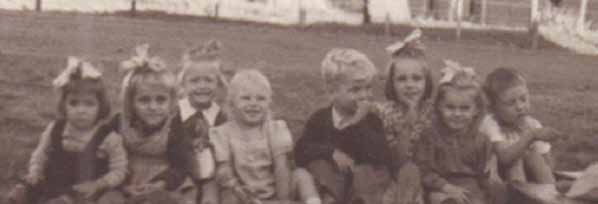
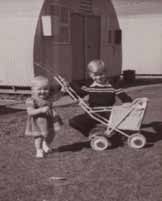
One Ukrainian mother arrived at Broadmeadows in 1953 after earlier stays in Mildura and Bonegilla. She worked in hostel kitchens while raising her son. Her photographs show children outside Nissen huts and a group of young friends at the hostel.
Her account describes a growing Ukrainian community around Glenroy and Broadmeadows. Families travelled to Ukrainian services in central Melbourne and to gatherings in South Melbourne. Children first attended Ukrainian lessons in a local garage before activities moved to Essendon; boys also took part in scouting and football.
For this family, leaving the hostel meant renting a bungalow in 1959. School costs influenced the move from Catholic to state education. Later employment in a factory’s catering section formed part of the transition to independent housing and working life.
Sources for this section
A community built outside the hostel
Olga’s account is precise about where Ukrainian life actually happened, and it was not at the hostel. Families travelled into the city to St Augustine’s for Sunday mass in Ukrainian, and to South Melbourne for community events, until a community centre was bought at Essendon near the railway station. The children’s Ukrainian school began in a garage at one of the houses in Broadmeadows and then moved to Essendon. The boys had their own scout group and formed a soccer team.
She also travelled on her days off to friends from Bielefeld who had settled at Ardeer, going by train to Sunshine and then by bus, and walking the nine kilometres when the buses did not run. Ardeer, she writes, became known in the 1960s as little Ukraine because so many Ukrainian families had moved into the new suburb. Broadmeadows itself was filling with housing commission estates of pre-fabricated concrete houses and with factories, and she describes homes going up at what felt like one every four weeks.
Sources for this section
Children enter local schools
Westbreen Primary School absorbed many children from the nearby military-camp hostel. By 1954 more than 40 per cent of its pupils were migrants, speaking more than a dozen languages between them. The old public hall was brought back into educational use and classrooms were added repeatedly as the surrounding population grew.
These figures describe the school, not the hostel’s population. They reveal how migrant accommodation affected established neighbourhood institutions: temporary housing generated an immediate need for school places, even before families moved into permanent homes.
Growth at nearby Westbreen Primary School
| Year | Pupils enrolled |
|---|---|
| 1952 | 216 |
| 1966 | 807 |
| 1981 | 325 |
Sources for this section
A changing hostel population
Broadmeadows continued to receive newcomers beyond the first postwar refugee arrivals. An official Federal Court account records a Greek family reaching the hostel in April 1968, before moving through shared houses. Museums Victoria identifies the hostel as an early home for Turkish immigrants who subsequently settled in Broadmeadows and Coburg.
A surviving management notebook covers weekend and night duties from July 1970 to September 1974. Its catalogue describes reports of the problems encountered by staff. This administrative record carries the hostel’s story into the 1970s, well beyond the departure dates recalled by individual earlier residents.
Sources
- Destination DownUnder: Your Story 2012
Kalyna Care · Undated
Original Ukrainian memoir, printed pages 22 to 24, read in full from the project copy on 13 September 2026. Supplies the Bielefeld and Munster camps, the October 1949 departure, the breakdown of the Fairsea and transfer to the Castel Bianco, the arrival at Port Melbourne on 24 May 1950, Mildura and Bonegilla, kitchen work for Commonwealth Hostels Limited at two pounds a week after board, the 1953 transfer to Broadmeadows army barracks in Camp Road, nearly fifteen years in its kitchen, naturalisation on 8 December 1958, the bungalow of 1959, St Augustine’s and South Melbourne and the Essendon community centre, the Ukrainian school in a garage, the scout group and soccer team, Ardeer as little Ukraine, and LM Ericsson. The memoir’s statement that the hostel was closing in 1959 conflicts with its own account of fifteen years of work and with the parliamentary returns, and is not adopted.
- Commonwealth Government Hostels
Migration Heritage Project · Undated
2022 archival compilation of parliamentary returns and programme tables, read from the project copy on 13 September 2026. Programme entry describes Broadmeadows as for displaced-person workers and families with accommodation available while construction continued.
- Migrants
Altona Laverton Historical Society · Undated
Williamstown flood evacuation to Broadmeadows April 1950; not a permanent transfer of the entire hostel.
- Moreland North of Bell Heritage Study, volume 2
Merri-bek City Council · Undated
Westbreen school citation, 2013. Institutional source passages on hostel children and 1954 pupil demographics reviewed via indexed full text.
- Ceremonial sitting, 28 June 2023
Federal Court of Australia · Undated
Official account of a family arriving 5 April 1968 and staying at Broadmeadows; residents’ names omitted.
- Origins: Turkey
Museums Victoria · Undated
Institutional migration history connects Turkish settlement in Broadmeadows/Coburg with the hostel.
- Report Book: Weekend and Night Duties, Broadmeadows Hostel
Museums Victoria · Undated
Item HT24148, July 1970–September 1974. Catalogue read; notebook entries not inspected. Place field anomalously includes Springvale, but title, inscription and user locality identify Broadmeadows.
- Commonwealth Government Hostels, tables 5 and 8
Migration Heritage Project · Compiled as at 12 April 2022
Table 8, Commonwealth Hostels in Victoria 1949 to 1971, printed page 28: Broadmeadows commenced operation between 1 July 1945 and 19 December 1949 and closed down on 21 August 1971. Table 5, Migrant Workers Hostels Victoria, printed page 25: Broadmeadows, displaced-person workers and families, accommodation fully available but some construction proceeding, estimated completion March 1951. The compiler gives House of Representatives Hansard of 12 November 1957, pages 2086 to 2087, and of 27 September 1967, page 1440, as the sources for table 8.
- Former Benalla Migrant Camp, Victorian Heritage Register H2358, history section
Heritage Victoria, Victorian Heritage Database place 196487 · Registered 19 May 2016; read 13 September 2026
Cited here only for its account of the accommodation system: that holding centres took residents for four to six months while their breadwinner worked nearby, and that hostels were established in the industrial or less developed outer suburbs of Melbourne at Altona, Broadmeadows, Holmesglen, Maribyrnong, Nunawading and Preston.
Last researched 12 September 2026