Castel Bianco
IRO fleet·Displaced-person service: 1948–1952
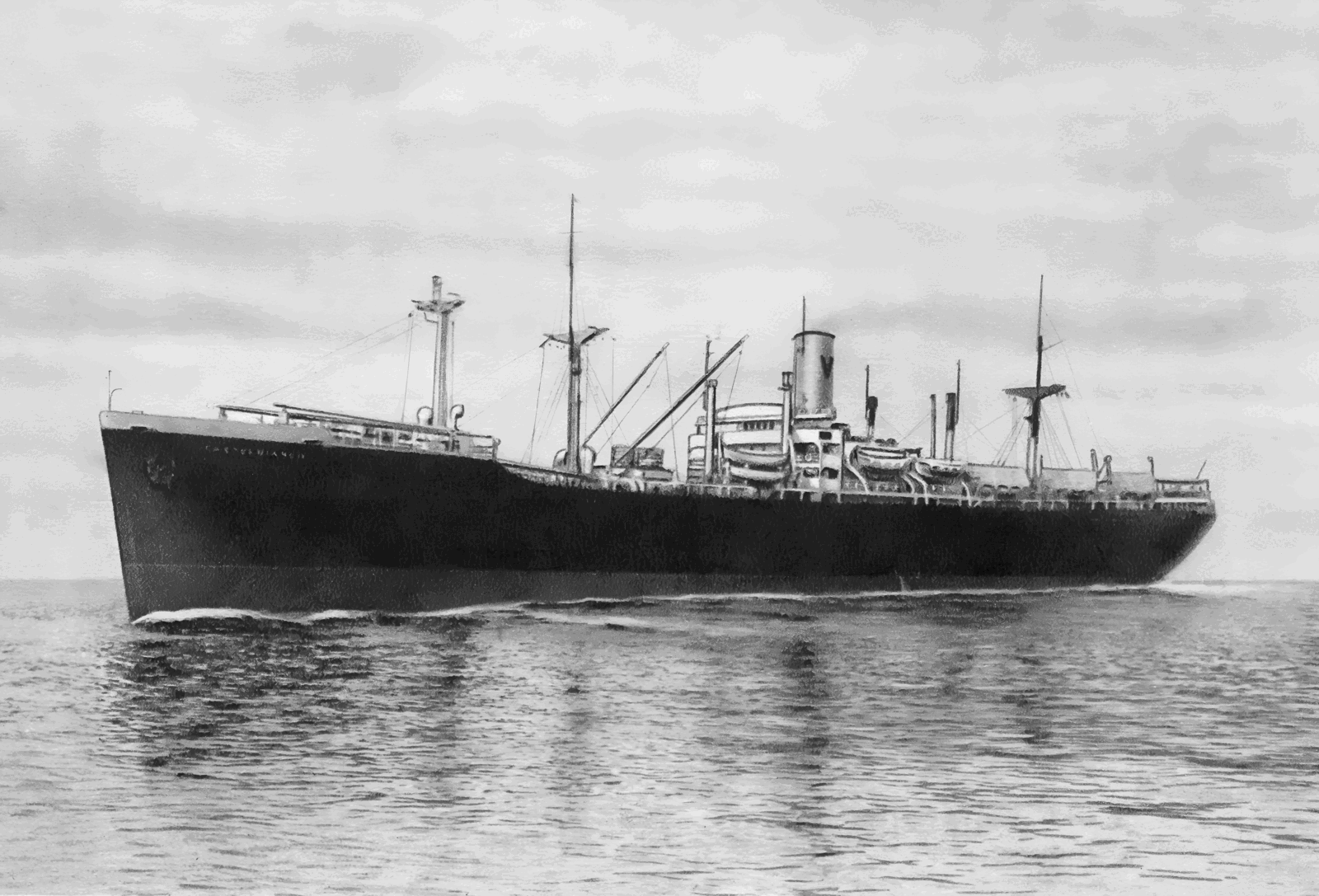
Castel Bianco was an American Victory ship bought by the Sitmar Line in 1947, converted at Genoa into a passenger carrier for about 900 people in segregated quarters, and among the first vessels contracted to the International Refugee Organisation for resettlement out of the former Reich. She carried displaced persons from Naples, Genoa and Bremerhaven to Sydney, Melbourne and Fremantle between April 1948 and March 1952, Ukrainian families among them.
Introduction
Castel Bianco was a cargo ship pressed into carrying people. She was smaller and slower than the American General class transports and the rebuilt liners, and her accommodation was fitted into former cargo spaces, but she began work earlier than most of the fleet and she made the run for four years. The first voyage to Australia by any of the ships that Sitmar had earmarked for the International Refugee Organisation contract was hers.1
Her name appears in Ukrainian family records in New South Wales and Victoria. Families who embarked at Genoa or Naples came ashore at Sydney and Port Melbourne and went inland to Bonegilla, Parkes and Benalla. She is also the ship that took over passengers when the Fairsea broke down.456
A history in dates
- 1945
- July 1947Mass resettlement from the former Reich begins with an IRO contract for a group of ships; Castelbianco is among the first earmarked.1
- Late 1947
- 23 April 1948Arrives at Sydney from Europe by way of Madras, the first Australian voyage by any of the earmarked ships.1
- 20 March 1949Arrives at Melbourne from Naples, the first of five recorded 1949 voyages.3
- 3 August 1949
- 22 April 1950
- 29 March 1952Recorded arrival at Fremantle at the end of the IRO period.3
- 1952
- 1957
- 24 December 1974Reaches Castellon for demolition after breaking down and drifting in October.2
A Victory ship converted
The hull was built in 1945 by the Bethlehem-Fairfield yards at Baltimore for the United States Maritime Commission as Vassar Victory, one of the mass-produced Victory type built alongside the better known Liberty ships. As a freighter she registered 7,604 tons, measured 455 by 62 feet and made fifteen knots.12
The Sitmar Line of Genoa acquired her from the Maritime Commission in 1947 and renamed her Castelbianco, the form used on most of the wartime-era passenger rolls; Castel Bianco is the later spelling. She was refitted at the end of 1947 to carry some 900 passengers in segregated quarters, with a single deck of superstructure added. In July 1947 the mass resettlement of refugees from the former Reich began with the signing of a contract with the IRO for a group of ships, and Castelbianco was among the first earmarked for the work.12
The ship
| Measure | Detail |
|---|---|
| Built | 1945, Bethlehem-Fairfield, Baltimore, as the Victory ship Vassar Victory |
| Original owner | United States Maritime Commission |
| Tonnage as a freighter | 7,604 tons gross |
| Dimensions | 455 by 62 feet (138.7 by 18.9 metres) |
| Service speed | 15 knots |
| Acquired by Sitmar | 1947; refitted late 1947 for some 900 passengers in segregated quarters |
| Rebuilt | Trieste, 1952; 10,139 tons and 1,200 passengers |
| Sold | 1957, to the Compania Trasatlantica Espanola; renamed Begona, capacity 830 |
| Broken up | Castellon, Spain, from 24 December 1974 |
Sources for this section
How the charter worked
The selection chain was the same as for the other chartered ships. Applicants were interviewed in the camps, screened medically and for security, and signed a two-year contract to work where the Commonwealth directed. What varied was the route to the ship. Her Italian sailings loaded at Naples and Genoa, drawing on parties moved south by rail from the German and Austrian camps. Her one documented German sailing loaded at Bremerhaven on 22 April 1950 from the emigrant camp at Delmenhorst.35
Two Ukrainian couples who trained under the IRO at Ludwigsburg and Pforzheim, one as a dressmaker and one as a motor mechanic, recorded that the choice put to them was repatriation, Canada or Australia. They embarked at Genoa in 1950 with the wife's parents, three generations in one party. Passing through the Suez Canal the grandfather traded a thick featherdown quilt for a Pfaff pedal sewing machine, which suggests trading with boats or quayside sellers at the canal transit rather than a controlled shipboard economy.5
Reception followed the standard pattern. Arrivals at Melbourne went by train to Bonegilla for processing and on to holding centres such as Benalla; arrivals at Sydney went to the New South Wales centres at Parkes, Cowra, Bathurst and their neighbours.54
Dated voyages
The first Australian voyage arrived at Sydney on 23 April 1948, from Europe by way of Madras, and a second sailed from Genoa later the same year. Recorded 1949 voyages run: Naples on 18 February to Melbourne on 20 March; Genoa on 27 April to Sydney on 27 May; Naples on 5 July to Sydney on 3 August; Naples on 26 September to Sydney on 24 October; Naples on 29 November to Melbourne on 29 December.13
In 1950 she loaded in Germany at least once, leaving Bremerhaven on 22 April with a party drawn from Delmenhorst and reaching Fremantle on 17 May before continuing to Port Melbourne, where passengers landed on 24 May. A further Fremantle arrival is recorded on 29 March 1952, at the very end of the IRO's work. The Istrian shipping record dates her IRO group voyages from February 1949 to March 1952 and gives Naples, Genoa and Bremerhaven as the loading ports and Melbourne, Sydney and Fremantle as the arrival ports.362
Displaced-person voyages to Australia recorded in the sources read
| Departed | Arrived | Note |
|---|---|---|
| Europe, via Madras, early 1948 | Sydney, 23 April 1948 | Recorded as the first Australian voyage by any of the ships earmarked under the July 1947 IRO contract |
| Genoa, later in 1948 | Australia, 1948 | Recorded only as a second trip that year, without dates |
| Naples, 18 February 1949 | Melbourne, 20 March 1949 | |
| Genoa, 27 April 1949 | Sydney, 27 May 1949 | |
| Naples, 5 July 1949 | Sydney, 3 August 1949 | The Ukrainian Schillich family arrives and goes to Parkes |
| Naples, 26 September 1949 | Sydney, 24 October 1949 | |
| Naples, 29 November 1949 | Melbourne, 29 December 1949 | |
| Bremerhaven, 22 April 1950 | Fremantle, 17 May 1950; Port Melbourne, 24 May 1950 | Party drawn from the Delmenhorst camp |
| Genoa, 1950, date not recorded | Melbourne, 1950 | A Ukrainian family of three generations aboard, on to Bonegilla and Benalla |
| Not recorded | Fremantle, 29 March 1952 | The last recorded arrival of the IRO period |
Ukrainians on board
Named Ukrainian passengers are documented on three of her voyages. The Schillich family, Ivan and Sonia with their small daughter, reached Sydney from Naples on the Castel Bianco on 3 August 1949, six days before the Parkes Migrant Centre opened, and went to Parkes. Aleksandr Pandik, born at Konstantinovka and taken to Germany as a forced labourer at fifteen, and Luba Wysocka, born in 1927 at Zynkowszcyna, embarked at Genoa in 1950 with Luba's parents Mykola and Aleksandra Wysocki and came through Bonegilla to Benalla, where they lived in hut 36/7. A Ukrainian woman travelling alone with a two-year-old son transferred to the Castel Bianco at Naples after her original ship failed, and landed at Port Melbourne on 24 May 1950.456
No Ukrainian count can be taken from her passenger rolls. The 1949 lists carry names only. The one substantial 1950 list records country of birth rather than nationality, and of 889 transcribed entries 475 give Poland and 249 Germany, with a single entry each for Ukraine and for Dniepropetrovsk. That is a limitation of the record and not a measure of who was aboard: Ukrainians from interwar eastern Poland were registered as born in Poland, those from the Soviet republic as born in Russia, and children born in the camps as born in Germany. The 1952 Fremantle list, taken after the displaced-person programme had given way to Italian assisted migration, is overwhelmingly Italian.3
Country of birth recorded on the Bremerhaven to Fremantle roll, 17 May 1950
| Country of birth | Entries |
|---|---|
| Poland | 475 |
| Germany | 249 |
| Latvia | 61 |
| Russia | 24 |
| Yugoslavia | 23 |
| Czechoslovakia | 18 |
| Roumania | 16 |
| Estonia | 7 |
| Lithuania | 5 |
| Hungary | 3 |
| Ukraine | 1 |
| Dniepropetrowsk | 1 |
| Total entries counted | 889 |
Sources for this section
Afterwards
In 1952 she was reconstructed at Trieste. Her tonnage rose to 10,139 and her passenger capacity to 1,200, and it was at this point that the name settled as Castel Bianco. From 1953 she ran between Genoa and Australia, later switching her European terminal to Bremerhaven.12
Sitmar sold her in 1957 to the Compania Trasatlantica Espanola, which renamed her Begona, cut her capacity to 830 and put her on the Southampton to Spain and Central America run. She suffered machinery failure and began drifting on 4 October 1974, was towed to Barbados by the German tug Oceanic, and reached Castellon in Spain on 24 December 1974 for demolition.21
Sources for this section
Sources
- Polish and other migrants in Wyalkatchem 1950-1970
Joseph Poprzeczny / Polish Museum and Archives in Australia, Rocznik tom V · 2012
Chapter section on Castelbianco read in full: Vassar Victory built 1945 at Bethlehem Fairfield, 7,604 tons, 15 knots, 455 by 62 feet, the Sitmar purchase and late 1947 refit for some 900 passengers in segregated quarters with an added deck of superstructure, the July 1947 IRO contract for a group of ships, the 23 April 1948 Sydney arrival via Madras as the first such voyage, the 1952 Trieste reconstruction to 10,139 tons and the renaming, the 1953 Genoa and later Bremerhaven services, and the 1957 sale to the Spanish Line. Cites Peter Plowman.
- Castel Bianco
Istria on the Internet, Navigation, Ships · Accessed 13 September 2026
Read for the build at Bethlehem-Fairfield, the 1947 Sitmar acquisition and conversion, the 1952 Trieste rebuilding to 1,200 passengers, the statement that she carried IRO groups from Naples, Genoa and Bremerhaven to Melbourne, Sydney and Fremantle between February 1949 and March 1952, the 1957 sale to Cia Trasatlantica with capacity cut to 830, and the October 1974 breakdown and December 1974 demolition at Castellon as Begona.
- International Refugee Organisation group resettlement to Australia: Castel Bianco passenger lists
Immigrant Ships Transcribers Guild · Accessed 13 September 2026
Voyage headers read for the arrivals of 20 March 1949, 27 May 1949, 3 August 1949, 24 October 1949, 29 December 1949, 17 May 1950 and 29 March 1952, giving departure port and date against arrival port and date. The 17 May 1950 roll names Bremerhaven and Delmenhorst and carries a country of birth column, tallied at 889 entries. The 1949 rolls carry names only.
- August 9 marks the 70th anniversary when Parkes Migrant Centre opened
Christine Little, The Senior · 9 August 2019, updated 28 August 2023
Read for the Schillich family's arrival at Sydney from Naples aboard the Castel Bianco six days before the Parkes Migrant Centre opened on 9 August 1949, and for the general figure of more than 180,000 migrants accepted by Australia between 1948 and 1952.
- Mikola and Aleksandra Wysocki, and Aleksandr and Luba Pandik
Benalla Migrant Camp 1949-1967, accounts by Ludmila Walsh nee Pandik · Emailed 10 April 2020, accessed 13 September 2026
Both family accounts read in full: birthplaces in Ukraine, IRO vocational training at Ludwigsburg and Pforzheim, the choice between repatriation, Canada and Australia, the embarkation of four family members at Genoa on the Castelbianco in 1950, the trade of a featherdown quilt for a Pfaff sewing machine at the Suez Canal, the train from Melbourne to Bonegilla and the move to Benalla and hut 36/7.
- Destination DownUnder: Your Story 2012, Olga's memoir
Kalyna Care · 2012
Printed pages 22 to 24 read: a Ukrainian passenger's transfer from the disabled Fairsea to the Castel Bianco at Naples and her arrival at Port Melbourne on 24 May 1950, followed by Mildura, Bonegilla and Broadmeadows.
Last researched 13 September 2026