Deer Park Hostel
Arrival and settlement
Dalkeith, Midlothian, Scotland · Postwar EVW accommodation
A Dalkeith hostel in the Ukrainian settlement network, laid out in the policies of Dalkeith Palace on a site also documented as a German prisoner-of-war working camp.
Introduction
Deer Park at Dalkeith appears in the network of hostels where Ukrainians lived after reaching Scotland. The place also has a documented German prisoner-of-war history. Reports from 1948 capture a camp approaching the end of that phase: numbers were falling, men were preparing to return to Germany, and contact with nearby Edinburgh had become part of everyday life.
The two histories are consecutive rather than parallel. Deer Park was a German prisoner-of-war working camp, numbered 16 and also carrying the working-camp numbers 1013 and 1024. It enters the Ukrainian record separately, as an EVW hostel at Dalkeith in a directory compiled from the archives of the Association of Ukrainians in Great Britain and of the Ukrainian Catholic Church in Scotland. The surviving evidence does not fix the day on which one use gave way to the other.
A history in dates
- 1637The park at Dalkeith is enclosed when Charles I seeks the estate for its hunting.
- 22 June 1946RAF photographs record three hut areas around Cat Haugh and The Kennels.
- May–June 1947About 8,500 Ukrainian former soldiers of the Galicia Division are transferred to the United Kingdom from Italy and held in prisoner-of-war camps.
- 10 February 1948K. Bloch lectured to forty prisoners at Deer Park.
- 27–29 April 1948Milner inspected the camp as its German prisoner population declined.
- July 1948A locality return records 958 former soldiers of the Galicia Division at or near Dalkeith.
- August–October 1948The Ukrainian former prisoners are released from prisoner-of-war status and admitted to the European Voluntary Workers scheme; their camps pass to civilian authorities and are redesignated as hostels.
- 1951Employment restrictions begin to be lifted from those who have lived in the United Kingdom for three years, and men start to leave the hostels.
- 14 August 1960A vellum presented to Archbishop Gordon Gray records the organised Ukrainian township groups in Scotland; Dalkeith is among the Ukrainian communities Kormylo maps.
- 2003R J C Thomas’s project report on prisoner-of-war camps notes two German working camps at Deer Park.
- August 2019A site survey photographed the former camp field in agricultural use.
Sources for this section
- Our Story: Dalkeith Country Park
- Dalkeith, Deer Park, Camps 1013 and 1024
- Post-war camps and hostels
- K. Bloch, lecture report
- J. C. Milner, report on No.16 German prisoner-of-war working camp
- Peter Kormylo, Ukrainians in Scotland: a study of a post-war migrant community
- POW Camp 16 Deer Park: site visit and archive gallery
The park before the huts
The huts stood in the policies of Dalkeith Palace. The estate has been in Buccleuch hands for more than three centuries; the palace was completed in 1711 for Anna, 1st Duchess of Buccleuch, and the park had been enclosed as early as 1637, when Charles I wanted the estate for its hunting. Veteran oaks survive in what used to be the deer park that gave the ground its name.
The camp was set down on the northern side of that designed landscape, on the haugh by the South Esk, and the national monuments record still files it under the older field names of the ground it took: Cat Haugh and The Kennels.
Sources for this section
A camp beside Dalkeith
Kormylo’s map of Ukrainians in displaced persons camps in Scotland names Deer Park Camp, Dalkeith, Midlothian, among the Lothian sites, and his appendix lists “EVW Hostel Deer Park, Dalkeith, Midlothian” fifth among the Scottish and northern English hostels that held significant numbers of ethnic Ukrainians. The list was drawn from Ukrainian community and church archives, and its compiler records that it may not be complete and that other camps may have existed outside it.
Deer Park is not the only Dalkeith entry on that list. Newbattle Miners’ Hostel, also at Dalkeith, stands separately at number 40, and Mortonhall in Edinburgh — one of the two outstations of the prisoner-of-war camp in April 1948 — appears at number 4. Amisfield Park at Haddington, the Ukrainian hostel named in the inspection report itself, heads the same list. The Ukrainian accommodation of the Lothians was a scatter of separate places, not one compound.
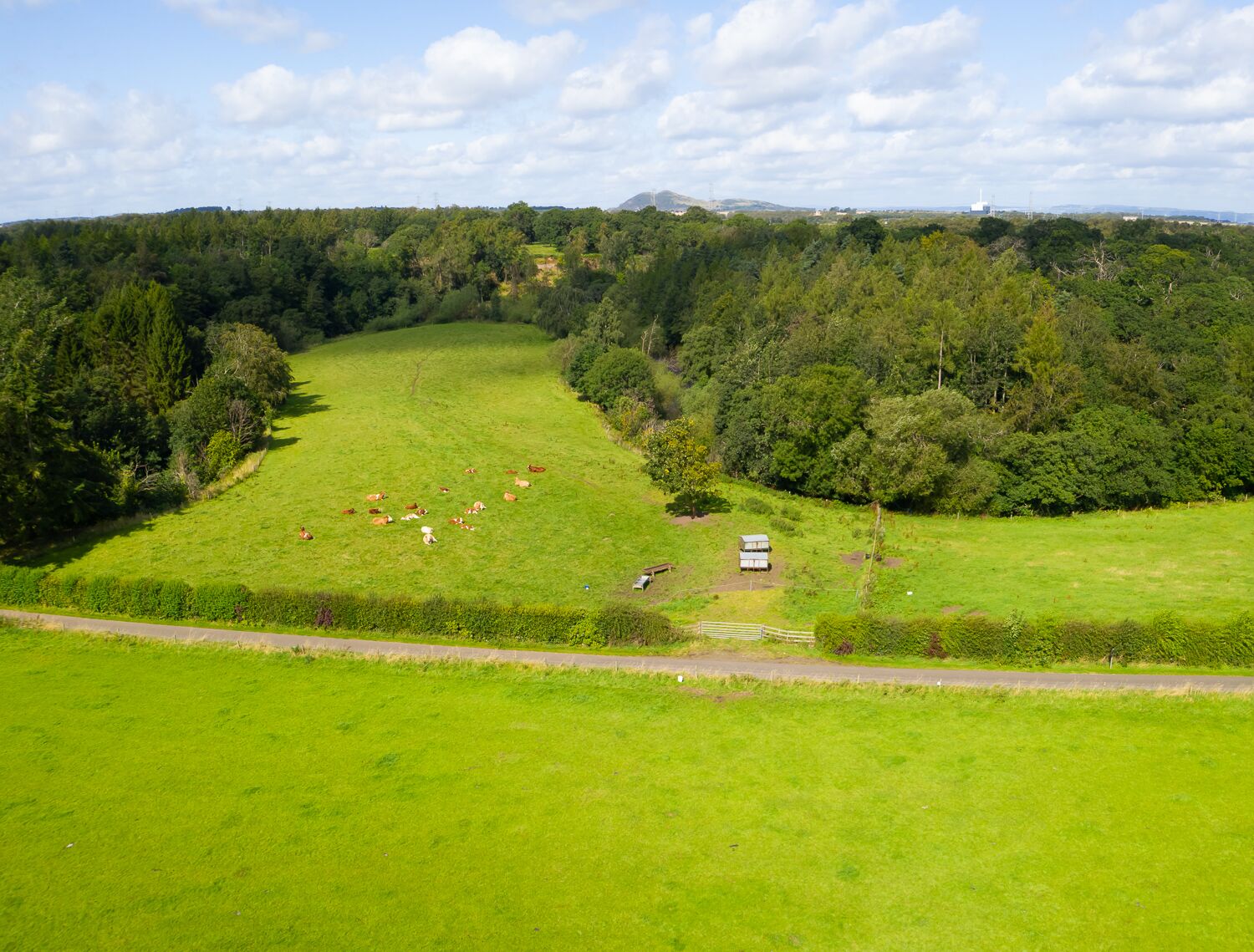
A later field survey identifies the former prisoner-of-war site at the northern side of Dalkeith Country Park, where pasture and trees now occupy the landscape. The Ukrainian hostel name and the wartime camp share the Deer Park location; the surviving evidence does not fix the precise extent of each accommodation area.
Three groups of huts
RAF photographs taken on 22 June 1946 show three hut areas between Cat Haugh and The Kennels, east of the South Esk. The largest group contained about forty huts, mainly Nissen huts. Two smaller groups lay north and south of The Kennels; the northern group retained three standing huts with further bases nearby.
The record is precise about how that identification was made. The site is entered as NT36NW 547, centred on NT 3400 6840 with two further centres at NT 3435 6814 and NT 3430 6790, in the parish of Dalkeith. Two German working camps, numbered 1013 and 1024, were noted in R J C Thomas’s 2003 project report on prisoner-of-war camps and then located on the vertical air photographs of sortie 106G/Scot/UK 123, frames 6011 to 6013. Writing in May 2005, the compiler added that it was not known whether any remains of the camps survived.
Accommodation in the 1946 aerial record
| Area | Recorded structures |
|---|---|
| East and southeast of Cat Haugh | About 40 huts, mainly Nissen type |
| North of The Kennels | Three standing huts and further bases |
| South of The Kennels | A separate smaller hut group |
Sources for this section
Lectures during the final prisoner-of-war months
On 10 February 1948, lecturer K. Bloch visited Deer Park. His report records a camp strength of 300 and an audience of 40. Transport difficulties made him about fifteen minutes late, so he began without his usual preliminary conversation with prisoners. He found the response very good and recorded a spokesman’s interest in the United States and American humour. These were German prisoners in an educational programme, before their return home.
The February 1948 lecture visit
| Measure | Number |
|---|---|
| Camp strength at Deer Park, 10 February 1948 | 300 |
| Attendance at the lecture | 40 |
Sources for this section
A shrinking camp and local friendships
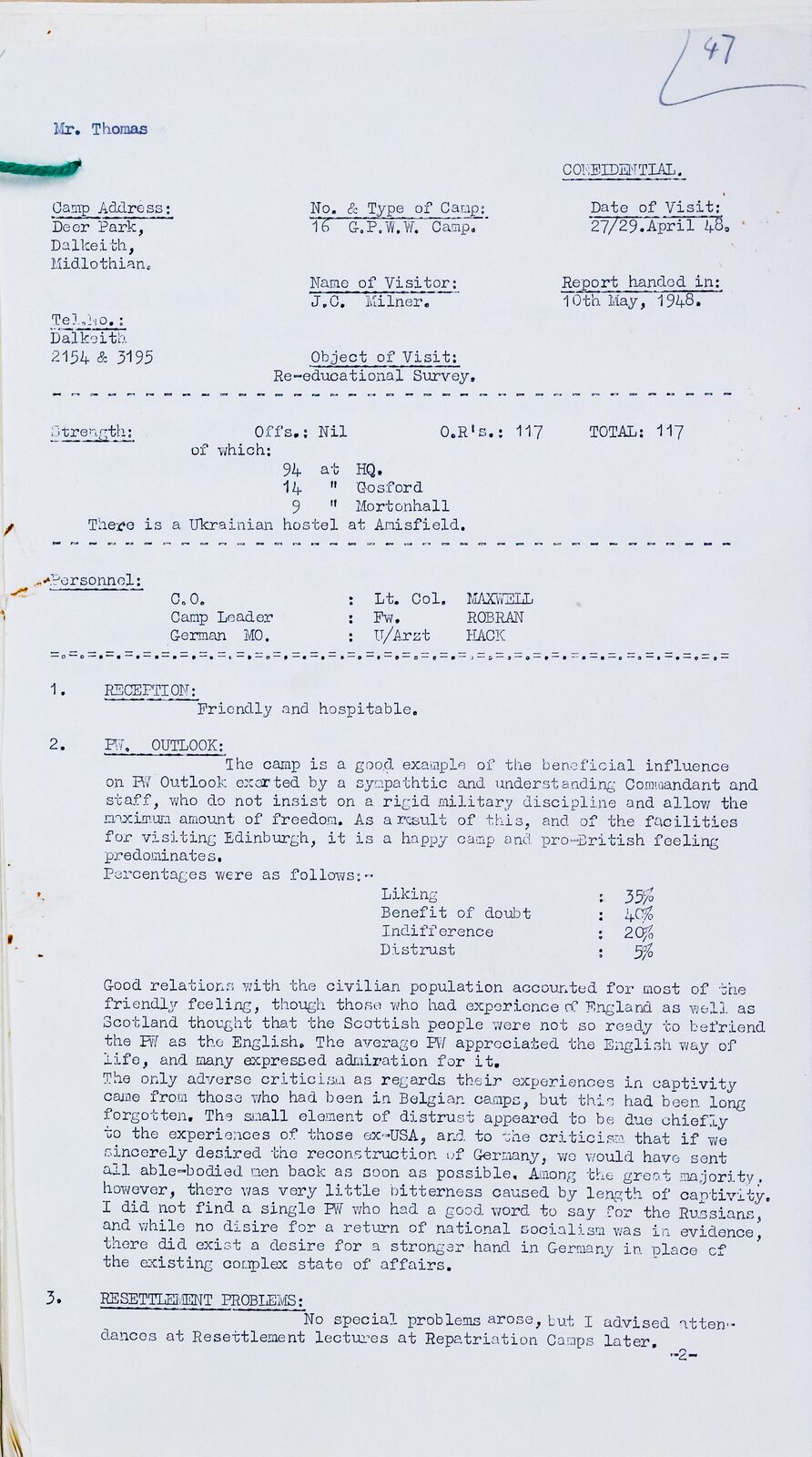
When J. C. Milner inspected the camp on 27–29 April, the headquarters held 94 German prisoners. His administrative total of 117 included another 14 at Gosford and nine at Mortonhall. He described a hospitable atmosphere and a sympathetic commandant, Lieutenant-Colonel Maxwell. The men had considerable freedom, visited Edinburgh, and had developed friendly relations locally. Milner believed their experiences of British people would matter after repatriation.
German prisoner numbers in the April 1948 inspection
| Place | Number |
|---|---|
| Headquarters at Deer Park | 94 |
| Gosford outstation | 14 |
| Mortonhall outstation | 9 |
| Administrative total across the three locations | 117 |
Sources for this section
Newspapers and everyday contact
The shrinking population changed camp life. Milner reported that organised outside activities had declined as numbers fell, while personal friendships continued. The camp magazine, Der Aufbau, was no longer being printed. He considered the remaining facilities satisfactory. These small details describe a community winding down rather than a camp at its busiest: activities disappeared as people left, while individual relationships outlasted the organised programme.
Sources for this section
From prisoner-of-war camp to hostel
The change from camp to hostel was a national process rather than a local decision. About 8,500 Ukrainian former soldiers of the Galicia Division were transferred to the United Kingdom from Italy in May and June 1947 and held in prisoner-of-war camps, mainly in the agricultural districts of eastern England and southern Scotland. A return for July 1948 counts 958 of them in camps at or near Dalkeith — after Hempton, Mildenhall, Allington, Moorby and Botesdale, the sixth largest locality total in the country, and much the larger of the two Scottish entries, the other being Lockerbie with 463.
Between August and October 1948 the men were released from prisoner-of-war status and admitted to the European Voluntary Workers scheme. The camps holding them were taken over by civilian authorities and redesignated as hostels, administered by bodies such as the National Service Hostels Corporation, the Ministry of Agriculture, the National Coal Board, the YMCA, local authorities and private industrial firms. Most were able to leave the hostels only after the beginning of 1951, when employment restrictions began to be lifted from those who had lived in the country for at least three years.
The Dalkeith figure is a locality total and cannot be assigned to one compound. Deer Park and Newbattle are separate entries in the Ukrainian directory, and Newbattle was a miners’ hostel in a coalfield that wanted labour, so the men counted at or near Dalkeith in July 1948 were distributed across more than one set of huts.
Former soldiers of the Galicia Division by locality, July 1948
| Locality | Men |
|---|---|
| Hempton, Norfolk | 1,682 |
| Mildenhall, Suffolk | 1,401 |
| Allington, Lincolnshire | 1,319 |
| Moorby, Lincolnshire | 1,264 |
| Botesdale, Suffolk | 1,010 |
| Dalkeith, Scotland | 958 |
| Lockerbie, Scotland | 463 |
| Other locations | 300 |
The Ukrainian hostel and the later landscape
Deer Park’s place in Ukrainian settlement survives through its identification as an EVW hostel in the Scottish Ukrainian directory. This was a different migration experience from that of German prisoners awaiting repatriation, and the names and figures in the 1948 prisoner reports describe that earlier population.
By 1960 Dalkeith appears among the organised Ukrainian communities of Scotland. Kormylo’s map of Ukrainian settlement places it alongside Edinburgh, Easthouses, Haddington, Tranent, Dunbar, Galashiels, Annan, Dumfries, Lockerbie, Perth, Dundee, Grangemouth, Glasgow and Carlisle. His account of a framed vellum presented to Archbishop Gordon Gray on 14 August 1960, now in the Scottish Catholic Archives, records how many formal township groups of Ukrainians existed in Scotland that year, each signed for by its own leaders.
The hostels themselves did not last. The early 1950s saw the Scottish camps and hostels close, with chain migration carrying Ukrainians to the textile towns of England and onward to North America, while those who stayed gathered in the Scottish towns rather than the countryside. By the time of the August 2019 site visit, the photographed field was grazed by cattle, with woodland around its margins: a quiet landscape where the accommodation itself was no longer visible.
Sources
- Peter Kormylo, Ukrainians in Scotland: a study of a post-war migrant community
University of Glasgow (PhD thesis) · 2021
Printed page 100, map “Ukrainians in Displaced Persons camps 1946-51 in Scotland”: “Deer Park Camp, Dalkeith, Midlothian” under THE LOTHIANS, the map’s data sources given as the archives of the Association of Ukrainians in Great Britain and the Ukrainian Catholic Church in Scotland. Printed pages 322–323, appendix xii, “Scottish & Northern English Hostels which held significant numbers of ethnic Ukrainians”: 1 Amisfield Park, 4 Mortonhall Edinburgh, 5 “EVW Hostel Deer Park, Dalkeith, Midlothian”, 40 Newbattle Miners’ Hostel, Dalkeith, with the compiler’s note that the list may not be complete. Printed page 207: the closure of the Scottish camps and hostels in the early 1950s, chain migration to the English textile towns, and the framed vellum presented to Archbishop Gordon Gray on 14 August 1960, now in the Scottish Catholic Archives. Printed page 208, figure 5.33: Dalkeith among the urban Ukrainian communities of Scotland.
- J. C. Milner, report on No.16 German prisoner-of-war working camp
Visit 27–29 April 1948; submitted 10 May 1948
Original FO939/100 scan read visually. 117 administrative total comprises 94 headquarters, 14 Gosford, 9 Mortonhall. Ukrainian hostel mentioned separately is Amisfield.
- Milner report, continuation
May 1948
Original scan read: contacts, newspaper Der Aufbau ceased, facilities satisfactory.
- K. Bloch, lecture report
11 February 1948
Original scan read. Deer Park 10 February strength 300, attendance 40. Gosford 9 February 360/120 separate; late-night discussion applies main camp.
- POW Camp 16 Deer Park: site visit and archive gallery
Banged Up Abroad · Site visit August 2019
Complete gallery text and field photographs inspected. The page gives the camp as “PoW Camp 16 Deer Park”, also numbered Camps 1013 and 1024, at Dalkeith Country Park, and cites FO 939/100 (Camp 16 Gosford and Deer Park inspection reports) and FO 1120/183 (prisoner-of-war camp list dated 20 February 1947). Modern field identified by the gallery as the former site; the exact EVW hostel parcel is not independently established.
- Dalkeith, Deer Park, Camps 1013 and 1024
Historic Environment Scotland · 2005
National Record of the Historic Environment 272630, site number NT36NW 547, “Dalkeith, Deer Park, Camps 1013 And 1024, German Working Camps”, also known as Cat Haugh and The Kennels; parish of Dalkeith, Midlothian; centred NT 3400 6840, with further centres at NT 3435 6814 and NT 3430 6790. Archaeology note read in full: two German working prisoner-of-war camps noted in R J C Thomas, Project Report (Twentieth Century Military Recording Project, Prisoner-of-War Camps 1939–1948), National Monuments Records Centre, English Heritage, July 2003, identified on vertical air photographs 106G/Scot/UK 123, Part I, frames 6011-6013, flown 22 June 1946; three separate areas of huts, the main group about 40 huts mainly of Nissen type; “It is not known whether any remains are extant of these camps.” Information from RCAHMS (DE), May 2005.
- Post-war camps and hostels
Ukrainians in the United Kingdom Online Encyclopedia · 2013
Page read in full: about 8,500 Ukrainian former soldiers of the Galicia Division transferred to the UK from Italy in May–June 1947 and held in prisoner-of-war camps; July 1948 locality figures — Hempton 1,682, Mildenhall 1,401, Allington 1,319, Moorby 1,264, Botesdale 1,010, Dalkeith 958, Lockerbie 463, other locations 300; release from prisoner-of-war status August–October 1948 and admission to the European Voluntary Workers scheme, the camps then taken over by civilian authorities and redesignated as hostels administered by the National Service Hostels Corporation, the Ministry of Agriculture, the National Coal Board, the YMCA, local authorities and private industrial firms; employment restrictions lifted from the beginning of 1951. The Dalkeith figure is a locality total, not a verified Deer Park occupancy count.
- Our Story: Dalkeith Country Park
Dalkeith Country Park, Buccleuch · Accessed 14 September 2026
Estate history page read: the park has been in the Buccleuch family for more than three hundred years; Dalkeith Palace completed in 1711 for Anna, 1st Duchess of Buccleuch, to James Smith’s design; the park first enclosed in 1637, when Charles I wanted to buy the estate for its hunting; veteran oaks surviving in what used to be the deer park.
Last researched 13 September 2026