The IRO Resettlement Programme
Germany, Austria and Italy to the world·PCIRO operations from 1 July 1947; IRO closed 31 January 1952
The International Refugee Organisation took over the displaced persons of the western occupation zones on 1 July 1947 and spent fifty-five months deciding who was eligible for its help and finding countries that would take them. It resettled 1,045,750 people and repatriated 73,873 before it closed on 31 January 1952, and the Ukrainians who would not go home were moved inside that machinery.
Introduction
The International Refugee Organisation was the body that emptied the displaced persons camps. Every scheme in this section, the labour recruitment to Britain and Belgium, the assisted passages to Australia and Canada, the agreements with Brazil, Argentina and Venezuela, ran through its registers, its selection procedures and usually its ships. Its Constitution was approved by the General Assembly on 15 December 1946 and its Preparatory Commission took over operations on 1 July 1947, the day UNRRA and the Intergovernmental Committee on Refugees ended their work for refugees. The IRO itself was formally established on 20 August 1948.1
What it inherited was large: direct care of more than 719,000 people and responsibility for the interests of some 900,000 more, which meant about 700 camps holding an average of a thousand people each, mostly in Germany, Austria and Italy but reaching every continent except the Americas.13
A history in dates
- 15 December 1946The General Assembly approves the Constitution of the International Refugee Organisation.1
- 31 December 1946The Preparatory Commission comes into being when eight governments have signed.1
- 1 July 1947
- Summer 1947The CM/1 application for IRO assistance comes into use as the basis of eligibility decisions.4
- 20 August 1948The IRO is formally established as fifteen states become parties to the Constitution.1
- July 1949The General Council sets the closing datelines: no new applications after 31 August 1949 and care and maintenance to end on 30 June 1950.1
- 1949
- June 1950The amended United States Displaced Persons Act raises the total admissible under the Act to 313,000.2
- 1 July 1950Care and maintenance for eligible refugees passes to local authorities; 15,319 institutional hard core cases remain.2
- 31 January 1952The IRO closes, having resettled 1,045,750 people and repatriated 73,873 in fifty-five months.3
Mandate and eligibility
The Constitution gave the organisation five purposes: repatriation or resettlement, the identification, registration and classification of refugees, care and assistance, legal and political protection, and transport. Annex I set out who counted, among them victims of the Nazi and Fascist regimes, Spanish Republicans, prewar refugees, and displaced persons, defined as those deported from or obliged to leave their country of nationality or former habitual residence, including people compelled to undertake forced labour. Most categories had to show valid objections to returning. Part II listed those who would not be the organisation's concern: quislings, war criminals, people who had voluntarily assisted the enemy, and the Volksdeutsche.13
Eligibility was decided on a four-page form. From the summer of 1947 the IRO issued the CM/1, headed Application for IRO Assistance, and about 350,000 were completed in the German zones, Austria, Italy, Switzerland, England and as far away as Egypt and Syria. Applicants had to account for where they had been and where they had worked over the previous ten or twelve years, say why they would not go home, and set out their qualifications, languages and resources. An eligibility officer interviewed them on those answers and wrote the decision on the form, classifying the case as within or not within the mandate. A Review Board in Geneva heard appeals: of 14,815 decided by the end of 1949 it reversed 4,601 into the mandate and confirmed 8,622 as outside it.41
The door was then closed by timetable. In July 1949 the General Council set 31 August 1949 as the last day for new applications and ruled that care and maintenance would stop on 30 June 1950 for everyone not already moving or needing permanent institutional care.1
The machinery of resettlement
Resettlement was not something the IRO could do alone. Receiving governments set their own criteria and sent selection missions to the camps, and the organisation repeatedly urged them to take a fair share of the non-repatriable and to lower their entry requirements. Where no mass scheme existed people moved on individual work contracts or on nomination by relatives and sponsors.12
The route out ran through a chain of installations. Interviews, medical examinations and trade tests were done at resettlement centres, among them Funk-Kaserne Transit Centre in Munich and Wentorf Resettlement Centre near Hamburg. Shortly before sailing people moved to an emigrant staging area for about a fortnight of formalities, customs and security checks and a final medical inspection. Bremen held one of the largest, made up of Camp Tirpitz, Camp Grohn and Camp Lesum. Bremen and Genoa were the main departure ports.56
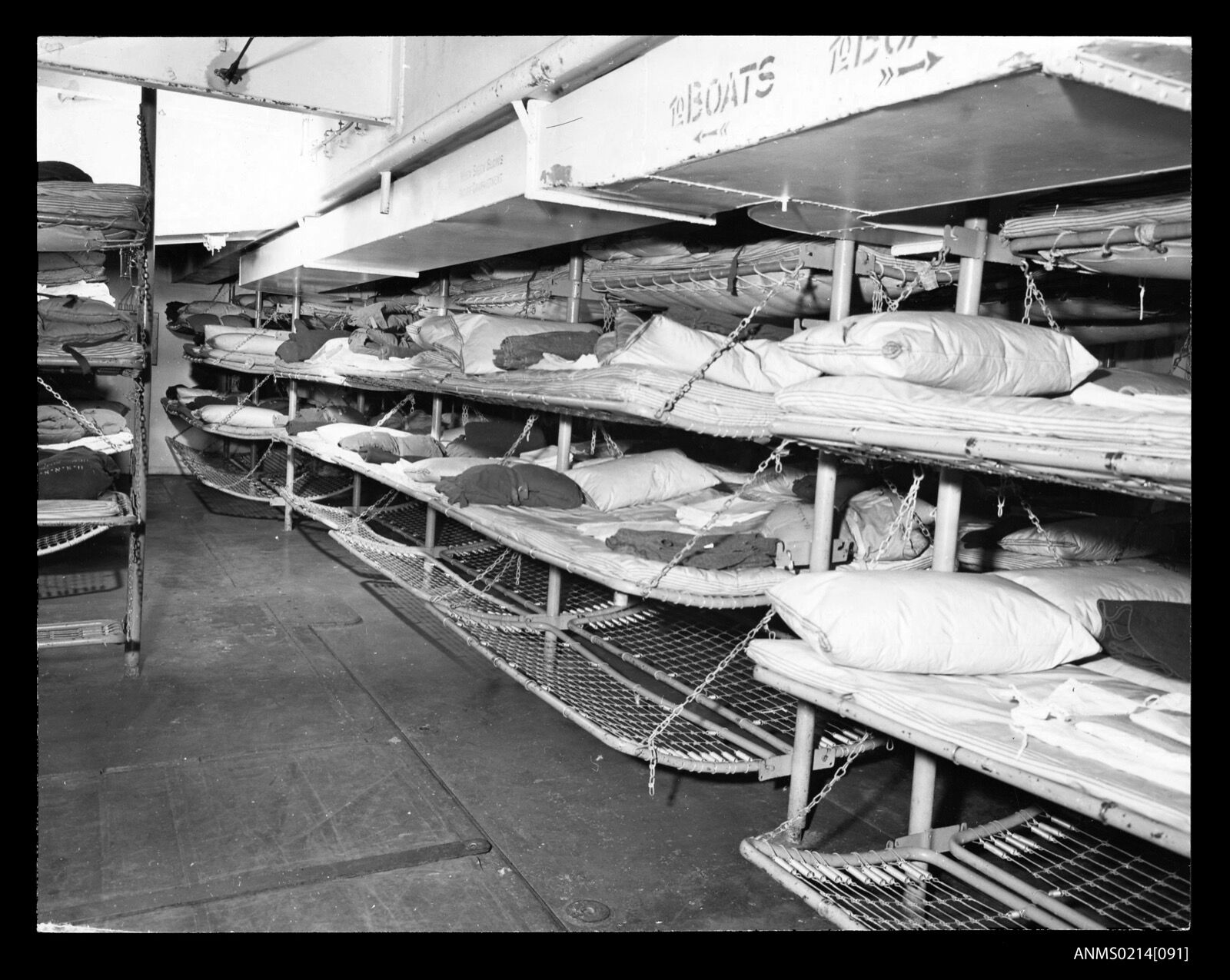
The organisation ran its own transport network, chartering ships, booking space on commercial vessels and aircraft and running a monthly average of 35 trains inland over its first thirty months. Thirty-nine chartered vessels, nineteen of them United States Army transports, were in constant operation until late 1949, when falling numbers forced the release of ten. The fleet stood at about 36 vessels in the peak months of 1949 and 15 by the end of 1950. At the far end of the voyage the receiving countries had their own reception centres, among them Pier 21 at Halifax and, in Australia, Bonegilla Migrant Reception and Training Centre and Bathurst Migrant Reception and Training Centre.123
Transport capacity
| Date or period | Measure | Figure |
|---|---|---|
| 1 July 1947 to 31 August 1948 | Inland trains, monthly average | 27 |
| 1 July 1947 to 31 December 1949 | Inland trains, monthly average | 35 |
| To late 1949 | Chartered vessels in constant operation | 39, including 19 United States Army transports |
| Peak months of 1949 | Vessels in the chartered fleet | about 36 |
| Beginning of 1950 | Vessels in the chartered fleet | 29 |
| End of 1950 | Vessels in the chartered fleet | 15 |
| 1950 | Refugees moved by air | 5,336 |
Sources for this section
- Yearbook of the United Nations 1948-49, Chapter X: The International Refugee Organization
- Yearbook of the United Nations 1950, Chapter X: The International Refugee Organization
- Bremen Emigrant Staging Area card
- The emigration of displaced persons
- Yearbook of the United Nations 1951: The International Refugee Organization
What the movement amounted to
By 31 December 1949, thirty months in, the organisation had repatriated 68,778 people and resettled about 690,000. The United States, Israel, Australia, the United Kingdom and Canada took the five largest shares, and Argentina, Brazil and Venezuela together accounted for about 65,000. The two published versions of that table differ slightly, giving 690,145 and 688,284 for the same period.12
Nineteen fifty was slower, at 191,119 resettled and 2,917 repatriated, held back by the difficulty of working the amended United States Displaced Persons Act, which in June 1950 raised the total admissible under the Act to 313,000, and by the near completion of the Australian programme, which had absorbed 170,543 refugees since IRO operations began. More than 150,000 people were resettled during 1951 and a further 7,000 in January 1952, bringing the totals for fifty-five months to 1,045,750 resettled and 73,873 repatriated.23
Refugees resettled by the IRO, 1 July 1947 to 31 December 1949, by country of reception
| Country | Yearbook 1950 figure | Yearbook 1948-49 figure |
|---|---|---|
| United States | 149,971 | 150,843 |
| Israel | 116,580 | 116,368 |
| Australia | 105,352 | 105,485 |
| United Kingdom | 82,474 | 83,016 |
| Canada | 77,500 | 77,703 |
| France | 36,871 | 36,886 |
| Argentina | 28,045 | 28,065 |
| Brazil | 23,305 | 23,354 |
| Belgium | 22,183 | 22,183 |
| Venezuela | 13,276 | 13,287 |
| Other countries | 32,727 | 32,955 |
| Total | 688,284 | 690,145 |
Main countries of reception during 1950
| Country | Resettled in 1950 |
|---|---|
| United States | 88,035 |
| Australia | 65,191 |
| Canada | 16,615 |
| Israel | 4,186 |
| Argentina | 2,926 |
| United Kingdom | 2,889 |
| Venezuela | 2,719 |
| Brazil | 1,340 |
| France | 1,236 |
| New Zealand | 1,066 |
| Other countries | 4,916 |
| Total | 191,119 |
The programme as a whole
| Measure | Figure | Scope |
|---|---|---|
| People taken into direct care on 1 July 1947 | over 719,000 | PCIRO caseload, all nationalities |
| Others whose interests were protected | about 900,000 | PCIRO caseload, all nationalities |
| Camps at the outset | about 700 | Averaging 1,000 people each |
| Installations remaining at end of 1950 | 88 | Camps, hospitals and sanatoria |
| People still on care and maintenance at end of 1950 | 80,905 | All nationalities |
| Resettled | 1,045,750 | 55 months to 31 January 1952 |
| Repatriated | 73,873 | 55 months to 31 January 1952 |
| Further movement funded at closure | 12,205 | Handed to PICMME with visas already issued |
Ukrainians inside the programme
The IRO counted people by country of origin, so Ukrainians appear inside the Polish and Soviet columns of its returns rather than as a separate line, and no official IRO breakdown of Ukrainian resettlement by destination has been found. In early 1946 there were about 220,000 Ukrainian displaced persons in western Europe, 178,000 in Germany, 29,000 in Austria and 12,000 in Italy, and after the 1946 repatriation drive over 200,000 Ukrainians remained in Germany and Austria.78
For the outcome, the Internet Encyclopedia of Ukraine gives an estimate covering 1947 to 1957, a longer span than the IRO's own life: 80,000 to the United States, 30,000 to Canada, 20,000 to Australia and New Zealand, 20,000 to Great Britain, 10,000 each to Belgium and France, 7,000 to Brazil, 6,000 to Argentina, 2,000 to Venezuela and 2,000 elsewhere. By 1 August 1948 about 33,000 had already gone, 14,000 of them to Britain and 9,000 to Belgium.7
The camp registers show the same movement from the other side. Ihor Stebelsky's tables put the Ukrainian population of the camps of the British Zone of Germany at 28,460 in December 1947 and 4,580 by 1950, and the Ukrainians in the camps of Austria at 6,214 on 31 August 1948 and 2,572 on 30 June 1950. What was left at the end was a residue of about 10,800 elderly people, invalids, widows and unmarried mothers with children whom no country would take.9
Estimated Ukrainian resettlement by destination, 1947 to 1957
| Destination | Estimate |
|---|---|
| United States | 80,000 |
| Canada | 30,000 |
| Australia and New Zealand | 20,000 |
| Great Britain | 20,000 |
| Belgium | 10,000 |
| France | 10,000 |
| Brazil | 7,000 |
| Argentina | 6,000 |
| Venezuela | 2,000 |
| Other countries | 2,000 |
Ukrainians remaining in the UNRRA and IRO camps
| Zone | Earlier count | Later count |
|---|---|---|
| British Zone of Germany | 28,460 (December 1947) | 4,580 (1950) |
| United States Zone of Germany | 60,492 (May 1947) | 53,885 (December 1947) |
| Austria, SHAEF zones | 6,214 (31 August 1948) | 2,572 (30 June 1950) |
The end of the organisation
The people the schemes would not take were the last problem. When responsibility for care and maintenance passed to local authorities on 1 July 1950 there were 15,319 known institutional hard core cases needing permanent care, with 7,509 family members, and a fund of 22 million dollars was set aside for them. About 40,000 refugees were expected to remain where they were because no emigration could be found.23
The IRO ended on 31 January 1952. Its protective functions passed to the United Nations High Commissioner for Refugees, and the movement of migrants to the Provisional Intergovernmental Committee for the Movement of Migrants from Europe, which received a grant to carry a further 12,205 people who already held visas and which became the Intergovernmental Committee for European Migration. The International Tracing Service at Arolsen kept the records, and it is those files, the CM/1 applications and the shipping lists, that make an individual journey traceable today.324
Sources
- Yearbook of the United Nations 1948-49, Chapter X: The International Refugee Organization
United Nations Department of Public Information · 1950
Chapter read in full from the page PDFs 1096 to 1110. Supplies the constitutional dates, the caseload taken over on 1 July 1947, the freeze order, the Annex I categories and Part II exclusions, the 1949 datelines, the Review Board appeal figures, the resettlement table to 31 December 1949 and the transport paragraph on thirty-nine chartered vessels.
- Yearbook of the United Nations 1950, Chapter X: The International Refugee Organization
United Nations Department of Public Information · 1951
Chapter read in full from the page PDFs 994 to 1010. Supplies the second version of the resettlement table to 31 December 1949, the 1950 receiving countries and totals, the Australian cumulative figure of 170,543, the fleet reduction from 36 to 15 vessels, the air movement of 5,336 people, the amended Displaced Persons Act, the hard core figures and the Review Board and Tracing Service descriptions.
- Yearbook of the United Nations 1951: The International Refugee Organization
United Nations Department of Public Information · 1952
Section read in full from the page PDFs 949 to 951. Supplies the five constitutional purposes, the 700 camps at the outset and their reduction to 88 installations and 80,905 people by the end of 1950, the peak fleet of 36 ships, the London Agreement travel document, the 1951 and January 1952 movements and the closing totals of 1,045,750 resettled and 73,873 repatriated, and the Shanghai and PICMME arrangements.
- CM/1 application
Arolsen Archives e-Guide · Accessed 13 September 2026
Describes the four-page Application for IRO Assistance, its use from the summer of 1947, the roughly 350,000 applications, the information demanded of applicants, the eligibility officer interview and the within or not within the mandate decision recorded on the form.
- Bremen Emigrant Staging Area card
Arolsen Archives e-Guide · Accessed 13 September 2026
Describes the Bremen staging area and its camps Tirpitz, Grohn and Lesum with their capacities and dates, the sequence of interview, medical examination and trade test at a resettlement centre before transfer to the staging area, the fortnight of formalities, and Bremen and Genoa as the main departure ports.
- The emigration of displaced persons
Arolsen Archives · Accessed 13 September 2026
Institutional account of the emigration procedure, medical screening and documentation, the more than 500,000 emigration index cards created in Bremen between 1946 and 1952, the principal destinations, and the closure of IRO operations on 31 January 1952.
- Emigration
Internet Encyclopedia of Ukraine, Canadian Institute of Ukrainian Studies · Accessed 13 September 2026
Section on the third wave read for the 1946 distribution of Ukrainian displaced persons in Germany, Austria and Italy, the destination estimates for 1947 to 1957, the position at 1 August 1948, and the note on later secondary emigration from Britain, France and Belgium.
- Displaced persons
Internet Encyclopedia of Ukraine, Canadian Institute of Ukrainian Studies · Accessed 13 September 2026
Read for the residual population after the 1946 repatriation drive, over 200,000 Ukrainians within about 1.2 million displaced persons in Germany and Austria, and for the statement that the IRO resettled over 600,000 refugees to the New World by 1952.
- Ukrainians in the Displaced Persons Camps of Austria and Germany after World War II
Ihor Stebelsky, Ukrainskyi Istoryk / The Ukrainian Historian 3 · 1986
Appendix Tables 6 to 8, printed pages 49–56, and the closing passage on printed page 49. Zone totals for Ukrainians in the camps of Austria (Table 6, p. 49), the British zone of Germany (Table 7, pp. 50–52) and the United States zone of Germany (Table 8, pp. 53–56), the residual population of about 10,800 by 1951 and the some 25,000 Ukrainians absorbed into the Austrian and West German economies. This earlier printing is cited here because the zone totals used on this page – 6,214 for Austria on 31 August 1948 and 60,492 for the United States zone in May 1947 – are the 1986 figures; the 1992 book gives 6,402 on 30 September 1948 and 63,492 respectively.
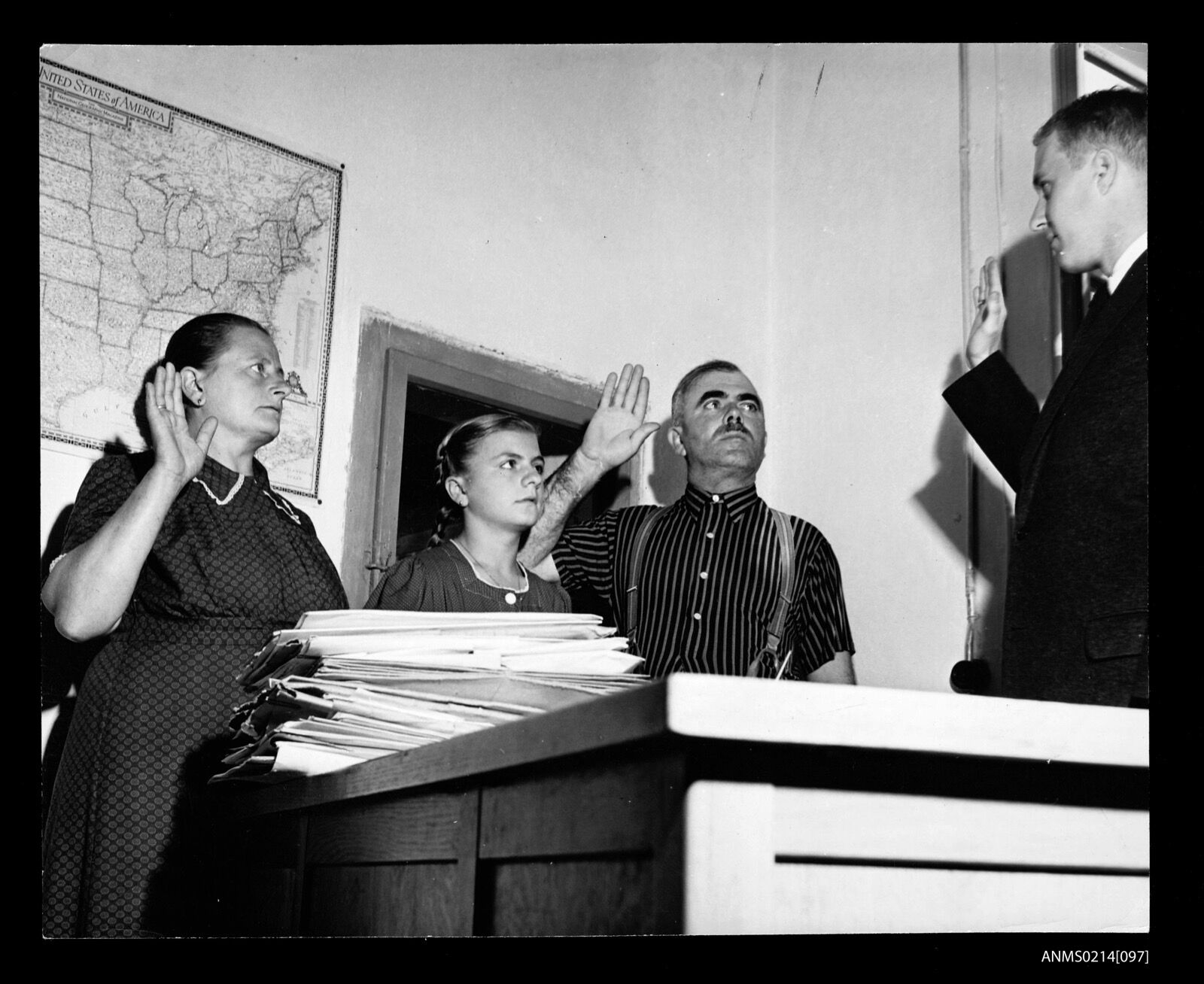
- The Schimpf family take the oath for a United States visa, Salzburg
Australian National Maritime Museum on The Commons; photograph by Davis Pratt for the International Refugee Organization · 1951
International Refugee Organization photograph, stamped on the reverse International Refugee Organization United Nations Specialized Agency HQ US zone Germany, showing a family taking the oath for a United States visa in the IRO refugee centre at Salzburg. Published by the Australian National Maritime Museum through Flickr Commons with the rights statement no known copyright restrictions.
- Sleeping accommodation on a United States naval vessel under International Refugee Organization charter, ANMS0214[091]
Australian National Maritime Museum on The Commons; photograph by Davis Pratt for the International Refugee Organization · 1950
International Refugee Organization photograph numbered 51630 and stamped International Refugee Organization United Nations Specialized Agency HQ US zone Germany, showing tiered berths made up for a sailing aboard a United States naval vessel under IRO charter. The vessel is not identified in the record. Published by the Australian National Maritime Museum through Flickr Commons with the rights statement no known copyright restrictions.
Last researched 13 September 2026