Marine Falcon
IRO fleet·Displaced-persons voyages: 1948
The Marine Falcon was one of the wartime C4-S-A3 transports that United States Lines operated on the North Atlantic emigrant run in 1948, loading displaced persons at Bremerhaven and the other northern ports for Halifax and New York. Three of her Halifax arrivals are recorded, and one of them brought a Ukrainian family out of a camp near Salzburg to a sugar-beet contract in Alberta.
Introduction
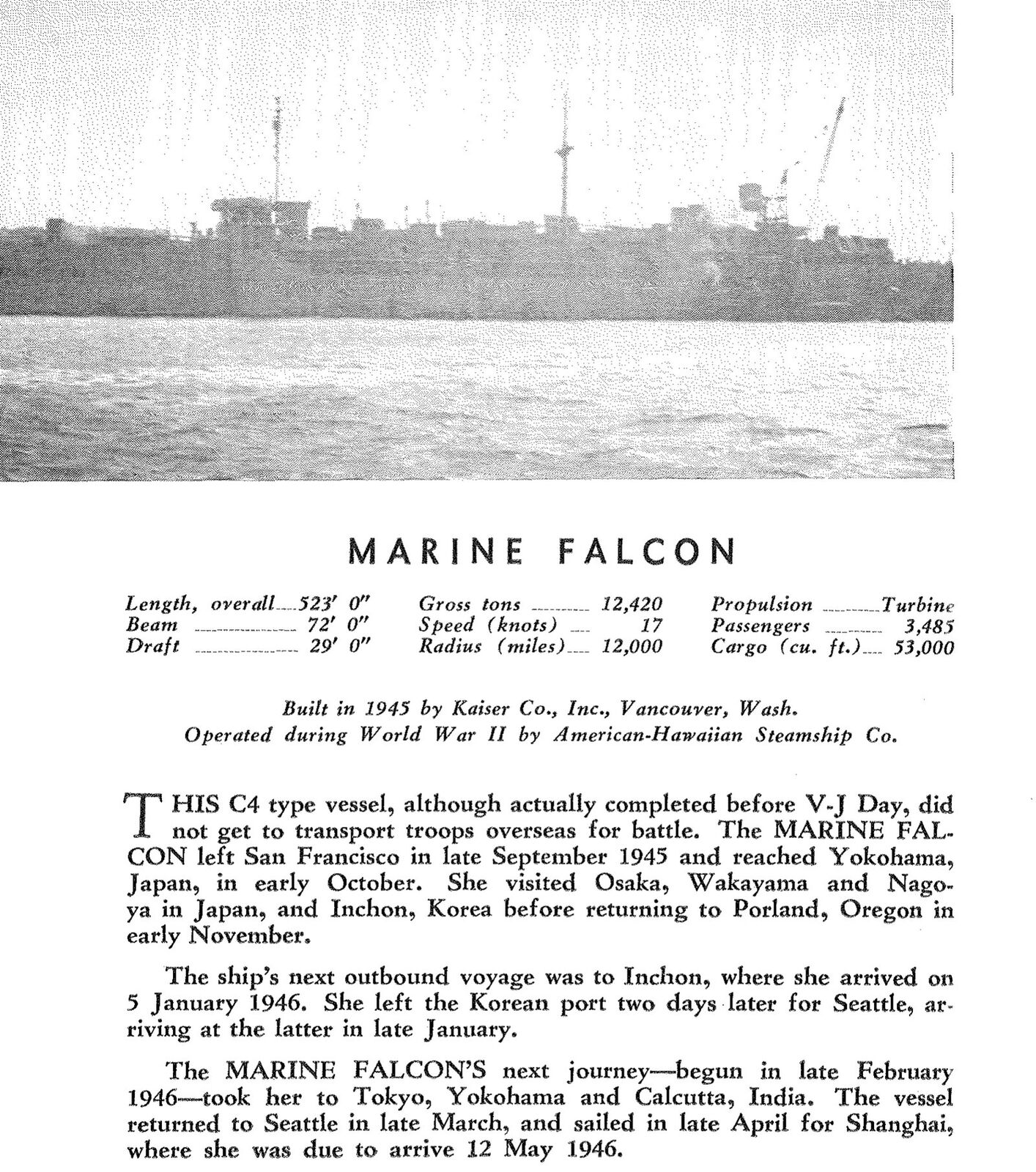
Marine Falcon was a plain wartime hull rather than a liner. She was built by the Kaiser company as a type C4-S-A3 transport, one of the standard Maritime Commission designs turned out in numbers in 1944 and 1945 for moving soldiers, and she was registered at 12,420 gross tons under official number 248239. After the war she went to United States Lines to run under commercial management on government account, and in 1948 she appears in the Canadian arrival records as an emigrant ship.12
Her displaced-persons work was brief. Three crossings are recorded at Halifax, all in the spring and early summer of 1948, and it is the third of them that carries the Ukrainian evidence for this page.23
A history in dates
- 1944Built by the Kaiser company as a C4-S-A3 transport, 12,420 gross tons, official number 248239.1
- September to November 1945First recorded voyage: San Francisco to Yokohama, with calls at Osaka, Wakayama, Nagoya and Inchon, returning to Portland, Oregon.8
- 1945–1947
- 28 March 1948Arrives at Halifax with 431 passengers from Hamburg, Bremerhaven, Bremen and the Channel ports.2
- 24 May 1948Second recorded Halifax arrival, 600 passengers.2
- 23 June 1948
- 14 October 1948Enters the government reserve fleet; withdrawn again on 9 December 1948 and re-entered on 15 April 1949.1
- 20 November 1964Sold to Waterman Steam Ship Company; struck from the fleet on 27 August 1965.1
The ship
The C4 was the largest standard cargo hull of the American wartime programme, and the C4-S-A3 variant was completed as a troop transport. Ships of this design were built to carry several thousand soldiers, and a contemporary account of the refugee sailings notes that although the C4s could hold 3,485 troops they usually took fewer than 700 displaced persons, the space going to family accommodation, hospitals and stores for a long passage.61
After trooping and repatriation work in Asia and Europe in 1945 and 1946, Marine Falcon appears in United Nations archive listings as an UNRRA repatriation ship in the China theatre, and in 1948 on the northern European emigrant service. The government fleet record shows her laid up and reactivated repeatedly in the following years, entering the reserve fleet on 14 October 1948, leaving it on 9 December 1948 and re-entering on 15 April 1949. She was sold out of government hands to Waterman Steam Ship Company in November 1964 and finally struck off in August 1965.14
A handbook of the troopships published in April 1947 records her first voyage. She left San Francisco in late September 1945 and reached Yokohama in early October, called at Osaka, Wakayama and Nagoya in Japan and at Inchon in Korea, and returned to Portland, Oregon, in early November.8
The ship as recorded by the Maritime Administration
| Measure | Figure |
|---|---|
| Builder | Kaiser Company |
| Year built | 1944 |
| Official number | 248239 |
| Gross tons | 12,420 |
| Net tons | 8,556 |
| MARAD type | C4-S-A3 |
| Sold out of government service | 20 November 1964 |
The 1948 voyages
The museum at Pier 21 records three arrivals, all with the same long list of ports: Hamburg, Bremerhaven, Bremen, Antwerp, Le Havre, Southampton, Plymouth and Cobh, then Halifax and New York. She reached Halifax on 28 March 1948 with 431 passengers, on 24 May 1948 with 600 and on 23 June 1948 with 600. The operator on all three records is United States Lines.2
That itinerary is worth reading closely. A ship that called at Hamburg, Bremerhaven and Bremen was loading from the British and American zones of Germany, where the great majority of Ukrainian displaced persons were held; the Channel and Irish calls added ordinary emigrants and returning passengers; and the double destination of Halifax and New York meant that Canadian and American admissions could be carried on the same hull.2
No inspection report on conditions aboard was found. The general pattern on the American transports out of Bremerhaven in 1948 is documented: families were not quartered together, men berthed aft and women forward, meals were taken standing at high tables, and passengers provided their own cleaning, galley and engine-room work details. Nothing in the sources read shows that the Marine Falcon differed from this.6
Recorded arrivals at Halifax
| Arrival | Passengers | Ports | Operator |
|---|---|---|---|
| 28 March 1948 | 431 | Hamburg, Bremerhaven, Bremen, Antwerp, Le Havre, Southampton, Plymouth, Cobh, Halifax, New York | United States Lines |
| 24 May 1948 | 600 | As above | United States Lines |
| 23 June 1948 | 600 | As above | United States Lines |
Sources for this section
A Ukrainian family aboard
The best-documented Ukrainian passage on the ship is a family testimony held by the museum at Pier 21. The family's history before the voyage runs through both dictatorships: Soviet exile and forced labour between 1929 and 1935, then German forced labour in Austria from 1942 to 1945. Liberated in May 1945, they crossed the Alps on foot to reach an American military post and spent three years at Camp Lexenfeld near Salzburg.3
In June 1948 they sailed from Bremerhaven on the Marine Falcon. The entry records that Pier 21 in Halifax welcomed them on 23 June 1948, the date of the third recorded arrival. Their account describes a quick passage through customs and then a Canadian Pacific train across the country to Taber in southern Alberta, where a sponsoring sugar-beet farmer met them at the station and took them to a converted grain bin that became their first home. The father worked out a two-year agricultural sponsorship agreement, and the family built their own house between 1951 and 1953.32
That contract was the ordinary condition of entry. Canada admitted nearly 200,000 displaced persons between 1947 and 1952, many of them under bulk labour schemes that assigned them to farms, mines and mills for a fixed term. About 34,000 Ukrainians came in between 1947 and 1954, chiefly out of the camps in Austria and Germany. Neither figure is specific to this ship, and no Ukrainian count survives for any Marine Falcon sailing.7
A contributor to a merchant-marine message board recalled a Ukrainian scouting presence on the June 1948 crossing: a Plast sea camp named Atliantyk, at one of whose meetings, on 19 June 1948, the boy and girl scouts assembled and sang songs. The recollection was posted long afterwards and has not been checked against any record.9
Scope of the Canadian movement
| Measure | Figure | Scope |
|---|---|---|
| Displaced persons admitted to Canada | Nearly 200,000 | 1947 to 1952, all nationalities |
| Share of postwar Pier 21 arrivals who were displaced persons or political refugees | Over 20 per cent | 1945 to 1971 |
| Ukrainians admitted to Canada | About 34,000 | 1947 to 1954, all ships and routes |
Reception at Halifax
Arrivals landed at Pier 21, the immigration shed on the Halifax waterfront, where medical and civil examination took place under one roof and voluntary agencies met the trains. A customs officer of the period remembered that arrivals brought almost nothing of value, their belongings in sacks and a few battered cardboard suitcases. More than a fifth of all postwar arrivals through the pier were displaced persons or political refugees, and for most of them the shed was a few hours in a journey that continued for several days by rail.7
Sources for this section
Sources
- MARINE FALCON, vessel history record
United States Maritime Administration · Accessed 13 September 2026
Builder, year, official number 248239, 12,420 gross and 8,556 net tons, MARAD type C4-S-A3, reserve fleet dates 1948 to 1949 and the 1964 sale.
- Ship Arrival Database: Marine Falcon
Canadian Museum of Immigration at Pier 21 · Accessed 13 September 2026
Three arrival records read individually: 28 March 1948 with 431 passengers, 24 May 1948 with 600 and 23 June 1948 with 600, all operated by United States Lines with the same port list.
- Sobey Wall of Honour: a Ukrainian family's journey from Lexenfeld to Alberta
Family testimony preserved by the Canadian Museum of Immigration at Pier 21 · Undated
Soviet exile 1929 to 1935, German forced labour in Austria 1942 to 1945, three years at Camp Lexenfeld near Salzburg, the Marine Falcon sailing from Bremerhaven, arrival at Pier 21 on 23 June 1948, the rail journey to Taber and the two-year agricultural sponsorship.
- CNRRA / 336 UNRRA repatriation ship SS Marine Falcon
United Nations Archives · Accessed 13 September 2026
Catalogue listing for an UNRRA file on the ship's repatriation work. The record page requires JavaScript and its contents could not be read; the listing is cited only for the existence of the file.
- Pier 21 in 1948, photographs by E. A. Bollinger
Nova Scotia Archives, accession 1975-305 · 1948
Two public domain photographs of the immigration shed in the year of the ship's three recorded arrivals; they show the reception hall and not the ship.
- Displaced Person Transports: Cargo of Hope
American Merchant Marine at War, compiling The Mast Magazine, 1948 · Accessed 13 September 2026
Loading at Bremerhaven, the usual C4 refugee complement, the separation of men and women in the dormitories and the passenger work details. Used for the general pattern, not for this ship.
- Postwar Immigration through Pier 21; Canada
Jan Raska, Canadian Museum of Immigration at Pier 21; and the Internet Encyclopedia of Ukraine · Accessed 13 September 2026
Nearly 200,000 displaced persons admitted 1947 to 1952 and the bulk labour schemes; the customs officer's description of arrivals; and about 34,000 Ukrainians admitted to Canada 1947 to 1954.
- Troopships of World War II
Roland W. Charles, The Army Transportation Association, Washington, D.C.; PDF scan via 80thdivision.com · First edition, April 1947
Vessel entry at page 206 read for the ship's first voyage: San Francisco in late September 1945, Yokohama in early October, calls at Osaka, Wakayama, Nagoya and Inchon, and return to Portland, Oregon, in early November.
- marine falcon - liberty ship (discussion thread)
AG and MM Board (armed-guard.com message board) · Posts of 2011 to 2024; accessed 13 September 2026
Thread read. A message board carrying unverifiable personal recollections; used only for the attributed detail of a Plast sea camp aboard the June 1948 crossing and its meeting of 19 June 1948. Claims in the thread about the June 1948 sailing being the ship's last were not used, conflicting with the fleet record at source 1.
Last researched 13 September 2026