Samaria
IRO fleet·Displaced-persons service: 1948–1951
Cunard's Samaria, a 1922 intermediate liner released from twenty-seven years of liner and troopship work, was fitted out in 1948 as an austerity carrier for the Canadian displaced-persons movement. Between September 1948 and October 1950 she made monthly crossings from Cuxhaven and Le Havre to Halifax and Quebec, usually with more than 1,500 people aboard.
Introduction
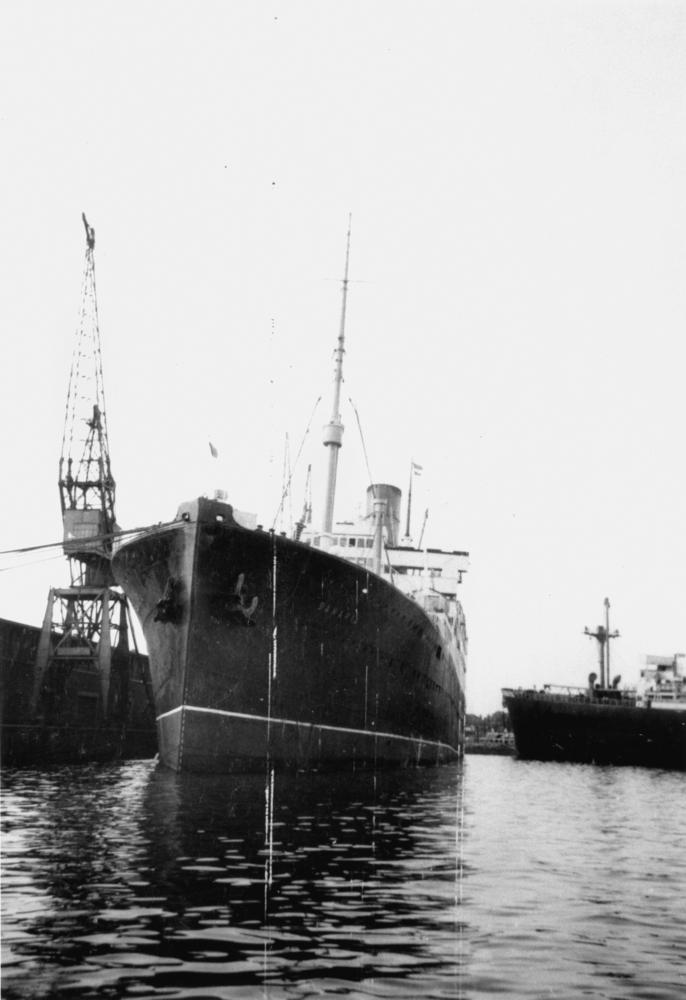
Samaria was the workhorse of the Canadian displaced-persons movement rather than one of its famous ships. She had none of the makeshift look of the converted troopships: she was a proper Cunard liner, launched at Cammell Laird in Birkenhead in 1920 and in service on the Liverpool to Boston run from April 1922. What made her useful in 1948 was capacity. Fitted for 1,500 in third class before the war, she could take more than 1,600 emigrants at a time across the North Atlantic on a schedule of roughly one round trip a month.123
Her passengers came out of the camps in the western zones of Germany and Austria, boarding at Cuxhaven and at Le Havre. They landed at Pier 21 in Halifax in the winter months and at Quebec in the summer, and were put on trains the same day.35
A history in dates
- 27 November 1920Launched by Cammell Laird at Birkenhead for Cunard.1
- April 1922Enters service on the Liverpool to Boston route.1
- 1941–1948
- 18 September 1948
- 3 December 1948
- 27–28 March 1949
- 15 August 1949The largest recorded arrival of the charter, 1,674 passengers at Halifax.3
- 8 October 1950Last recorded Cuxhaven sailing arrives at Halifax with 1,431 passengers.3
- 1951Cuxhaven disappears from the itinerary and passenger numbers halve; the displaced-persons charter has ended.3
- 1956
The ship
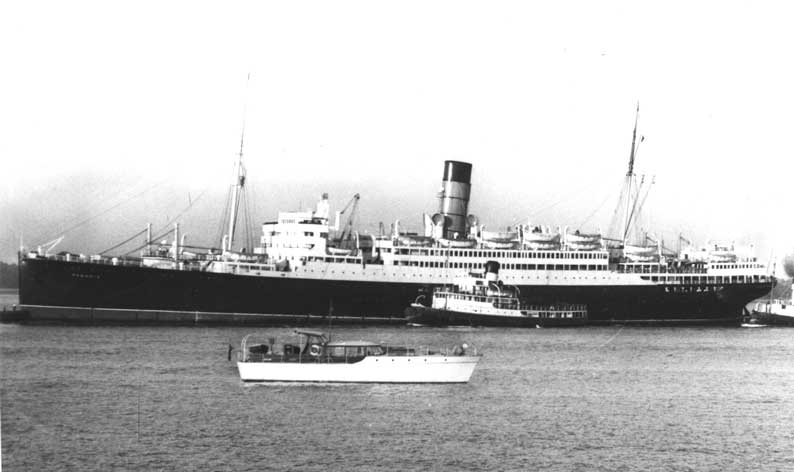
Samaria was one of a group of intermediate liners Cunard ordered after the First World War, sisters to Scythia, Laconia, Franconia and Carinthia, built for economy rather than speed. The published figures give about 19,600 to 19,700 gross tons, 600 feet by 74 feet, twin screws driven by double-reduction geared turbines and a service speed of 16 knots. Original accommodation was 350 first class, 350 second class and 1,500 third class.12
The Royal Navy requisitioned her in 1941 and she served as a troopship until 1948, carrying more than 20,000 servicemen and steaming 250,000 miles, and she was still bringing Canadian troops and their families home in 1948. She was returned to Cunard and refitted that year. The refit was austere: the ship was not restored to prewar class divisions until 1950, when accommodation was set at 250 first class and 650 tourist.12
The ship as built
| Measure | Figure | Source |
|---|---|---|
| Builder | Cammell Laird, Birkenhead | Both sources |
| Launched | 27 November 1920 | Wikipedia |
| Launched | 23 March 1920 | Bonsor, via Richblog |
| Entered service | April 1922 | Wikipedia |
| Gross tonnage | 19,602 | Wikipedia |
| Gross tonnage | 19,730 | Bonsor, via Richblog |
| Dimensions | 600 x 74 ft | Bonsor, via Richblog |
| Service speed | 16 knots | Both sources |
| Accommodation as built | 350 first, 350 second, 1,500 third | Bonsor, via Richblog |
| Accommodation from 1950 | 250 first, 650 tourist | Richblog |
Sources for this section
The Canadian charter
From September 1948 Samaria worked a service arranged between the International Refugee Organisation and the Canadian government, loading at Cuxhaven and Le Havre for Quebec in summer and Halifax in winter. The museum's arrival records show the pattern clearly. In 1948 she reached Halifax on 28 September with 1,614 passengers, on 31 October with 1,581 and on 3 December with 1,609. Through 1949 the monthly arrivals ran between 1,448 and 1,674 people.3
The movement tailed off in 1950. Arrivals fell from 1,556 in February to 939 in May, and the last Cuxhaven sailing recorded in the database reached Halifax on 8 October 1950. When Samaria reappears in 1951 the German port has gone from her itinerary, which now reads Southampton, Le Havre and Cobh to Halifax and Quebec, and the passenger lists have halved. The displaced-persons work was over and ordinary emigration had taken its place.3
Canada admitted nearly 200,000 displaced persons between 1947 and 1952, and more than a fifth of all postwar arrivals at Pier 21 were displaced persons or political refugees. Many were admitted as farm or industrial labour under bulk labour schemes that tied them to an employer for a fixed term. A customs officer at the pier remembered arrivals carrying almost nothing of value, their belongings in sacks and battered cardboard suitcases.5
Samaria arrivals at Halifax during the displaced-persons charter
| Arrival at Halifax | Passengers |
|---|---|
| 28 September 1948 | 1,614 |
| 31 October 1948 | 1,581 |
| 3 December 1948 | 1,609 |
| 23 February 1949 | 1,635 |
| 28 March 1949 | 1,627 |
| 6 May 1949 | 1,569 |
| 7 June 1949 | 1,633 |
| 11 July 1949 | 1,448 |
| 15 August 1949 | 1,674 |
| 18 September 1949 | 1,592 |
| 25 October 1949 | 1,626 |
| 30 November 1949 | 1,604 |
| 8 February 1950 | 1,556 |
| 14 March 1950 | 1,545 |
| 18 April 1950 | 1,371 |
| 19 May 1950 | 939 |
| 17 June 1950 | 964 |
| 15 July 1950 | 1,062 |
| 12 August 1950 | 1,291 |
| 9 September 1950 | 1,349 |
| 8 October 1950 | 1,431 |
Sources for this section
The crossing
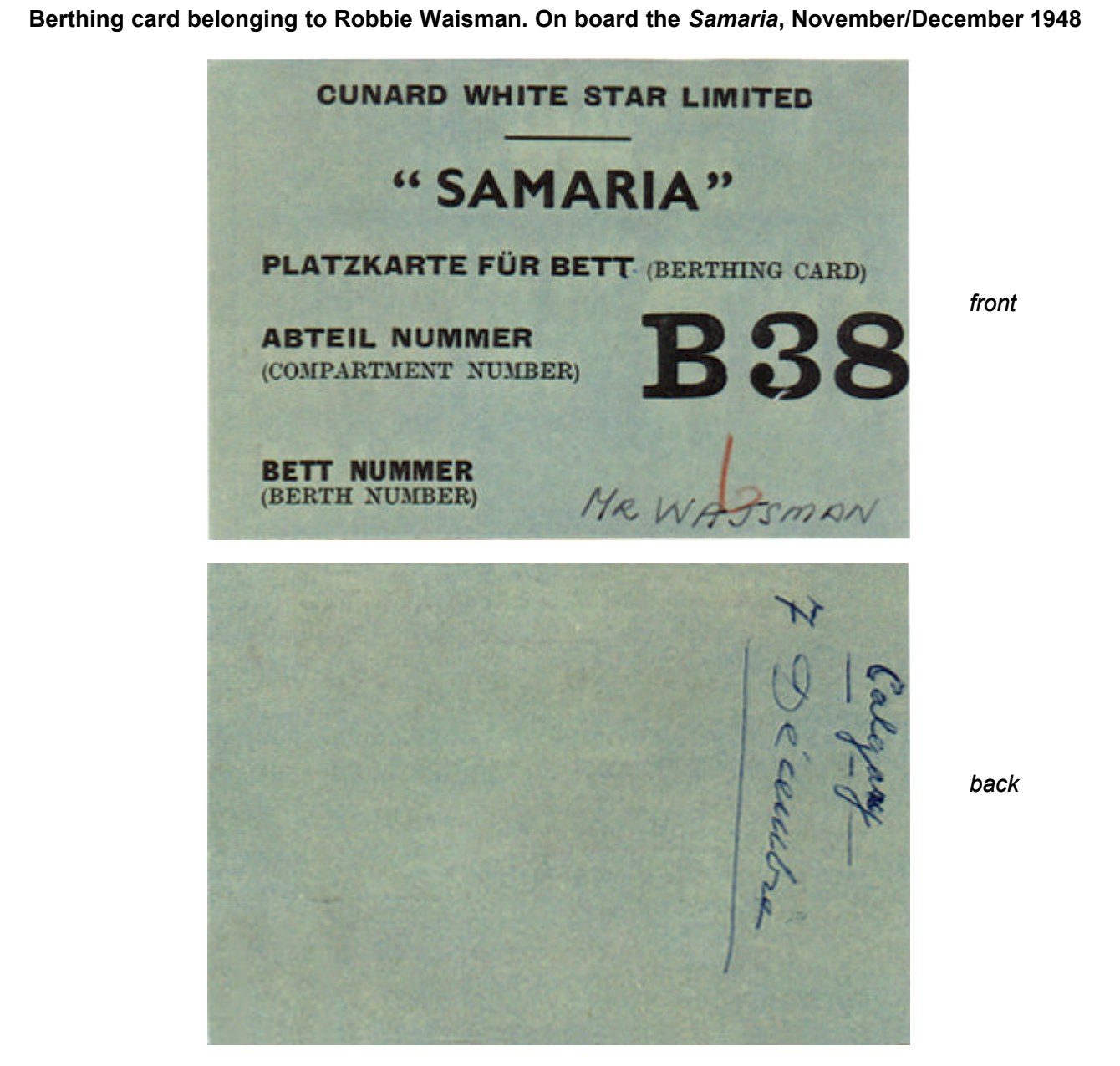
No official inspection of conditions aboard Samaria was found for this page, and the surviving evidence is what passengers remember. What they remember is weather and seasickness rather than the disorder recorded on some of the chartered ships. One passenger who was six years old on the crossing that left Le Havre on 25 November 1948 and reached Halifax on 3 December recalled a really stormy passage on which everyone except he and his older brother was sick. Another family remembered April 1949 as a stormy North Atlantic crossing from Le Havre to Halifax.2
The numbers themselves describe the conditions. A ship rated before the war for 1,500 in third class was carrying more than 1,600 people on a nine or ten day passage, in an interior that had been stripped for trooping and not yet restored. Families were separated by sex in the dormitories, as on the American transports, and the ports of call along the English Channel and the Irish coast lengthened the voyage.13
Sources for this section
Ukrainians aboard
About 34,000 Ukrainians reached Canada between 1947 and 1954, chiefly out of the camps in Austria and Germany, and Samaria was one of the ships that carried them. The passenger manifests give nationality by state rather than by nation, so Ukrainians from interwar Poland appear as Polish and those from Soviet territory as Soviet or stateless. No Ukrainian count for any Samaria sailing survives in the sources read.63
One family's testimony held by the museum at Pier 21 shows how a place on the ship was obtained. A Ukrainian family from occupied Poland, four women after the deaths of the father in 1945 and the grandfather in 1947, had been living in a displaced persons camp at Heidenau. The mother wrote to the Ukrainian-American film actor John Hodiak asking for help in tracing a distant relative in Canada. Hodiak placed notices in Ukrainian Canadian newspapers, an uncle answered and sponsored the family, and they landed at Halifax from the Samaria, by their own account on 27 March 1949; the museum's arrival record for that voyage is dated 28 March. They were put straight on a train for Regina.43
Scope of the Canadian movement
| Measure | Figure | Scope |
|---|---|---|
| Displaced persons admitted to Canada | Nearly 200,000 | 1947 to 1952, all nationalities |
| Share of postwar Pier 21 arrivals who were displaced persons or political refugees | Over 20 per cent | 1945 to 1971 |
| Ukrainians admitted to Canada | About 34,000 | 1947 to 1954, all ships and routes |
Afterwards
Samaria stayed on the Canadian route until 1955, by then carrying British and European fare-paying emigrants rather than refugees. She represented Cunard at the Coronation Fleet Review at Spithead in June 1953, made her last transatlantic crossing in November 1955 and was broken up at Inverkeithing on the Firth of Forth in 1956. Her bell was presented to the officers' mess at Halifax, Nova Scotia, the port where most of her displaced passengers had landed.12
Sources for this section
Sources
- RMS Samaria (1920)
Wikipedia · Accessed 13 September 2026
Build and launch, tonnage and accommodation, the 1941 requisition and troopship service to 1948, the 1948 refit, the postwar Canadian routes and the 1956 scrapping.
- Cunard RMS Samaria
Richblog, with a design summary credited to N. R. P. Bonsor, North Atlantic Seaway, vol. 1 · 4 March 2005, comments to 2015
Bonsor's dimensions and machinery; the wartime record of 20,000 servicemen and 250,000 miles; the 1950 change to 250 first and 650 tourist class; and passenger comments recording the November to December 1948 and April 1949 crossings and the Cuxhaven sailings of September 1948 and June 1949.
- Ship Arrival Database: Samaria
Canadian Museum of Immigration at Pier 21 · Accessed 13 September 2026
Twenty-eight individual arrival records read for 1945 to 1951, giving Halifax arrival dates, passenger counts, ports of call and the operating company.
- Sobey Wall of Honour: a Ukrainian family's arrival and onward journey to Regina
Family testimony preserved by the Canadian Museum of Immigration at Pier 21 · Undated
Arrival aboard Samaria on 27 March 1949 after sponsorship obtained through notices placed in Ukrainian Canadian newspapers by the actor John Hodiak, the Heidenau camp, and the onward rail journey to Regina.
- Postwar Immigration through Pier 21
Jan Raska, Canadian Museum of Immigration at Pier 21 · Accessed 13 September 2026
Nearly 200,000 displaced persons admitted 1947 to 1952; over twenty per cent of postwar Pier 21 arrivals were displaced persons or political refugees; reception and onward rail travel.
- Canada
Internet Encyclopedia of Ukraine · Accessed 13 September 2026
About 34,000 Ukrainians admitted to Canada between 1947 and 1954, chiefly from displaced persons camps in Austria and Germany.
- The Cunard ocean liner Samaria departing port
Photographer unknown, via Wikimedia Commons · 17 January 1926
Public domain photograph of the ship in her interwar Cunard livery; a second public domain view is held by the John Oxley Library, State Library of Queensland.
- The Journey, Open Hearts – Closed Doors teaching resource
Vancouver Holocaust Education Centre · Undated
Page 9 read: front and back of a Cunard White Star berthing card for the Samaria, kept by a passenger who sailed to Canada in November and December 1948, with his account of travelling in third class among the immigrants. Establishes a surviving passenger document from the ship during the resettlement years.
Last researched 13 September 2026