The General class transports
IRO fleet·Refugee service: 1947–1952
Thirty near-identical American troopships of the General class were handed to the Army Transportation Service after 1946 and chartered by the International Refugee Organisation to carry displaced persons out of Europe. They took Ukrainians from Bremerhaven and Naples to Halifax, New York, Melbourne, Sydney and Fremantle between 1947 and 1952.
Introduction
The General class was not a shipping line but a wartime building programme. Thirty transports of Maritime Commission type C4-S-A1 were built by the Kaiser company between 1942 and 1945, each named after a United States Army general and each numbered in a single run from AP-130 to AP-159. They were designed to move soldiers across oceans at speed. When the fighting stopped they were the largest pool of fast passenger capacity available to governments that had agreed to resettle Europe's displaced persons, and from 1947 they were turned to that use.15
For Ukrainian families in the camps of the western occupation zones, a General class ship was often the last European address before a new country. The ships appear again and again in family papers, sailing lists and museum databases: General Stuart Heintzelman, General M. B. Stewart, General W. M. Black, General Harry Taylor, General W. C. Langfitt and their sisters.69
A history in dates
- 1942–1945Thirty C4-S-A1 transports of the General class are built by the Kaiser company.1
- 1946Twenty-six of the class transfer to the United States Army Transportation Service and sail as USAT ships.1
- 1947USAT General S. D. Sturgis becomes the first American troopship to carry European refugees to a resettlement country, sailing to Rio de Janeiro.5
- 7 October 1947
- 30 October 1947
- 27 April 1948General Black arrives at Melbourne from European ports including Bremerhaven.9
- 21 October 1948
- 1949The peak year of General class refugee sailings to Australia, with arrivals by Stewart, Black, Omar Bundy, Ballou, Langfitt, Greely, Blatchford, Haan, Hersey and Howze.9
- 18 February 1950General W. C. Langfitt lands 1,118 Polish displaced persons at Fremantle on the last of its four Australian voyages.3
- 1950
Thirty ships of one design
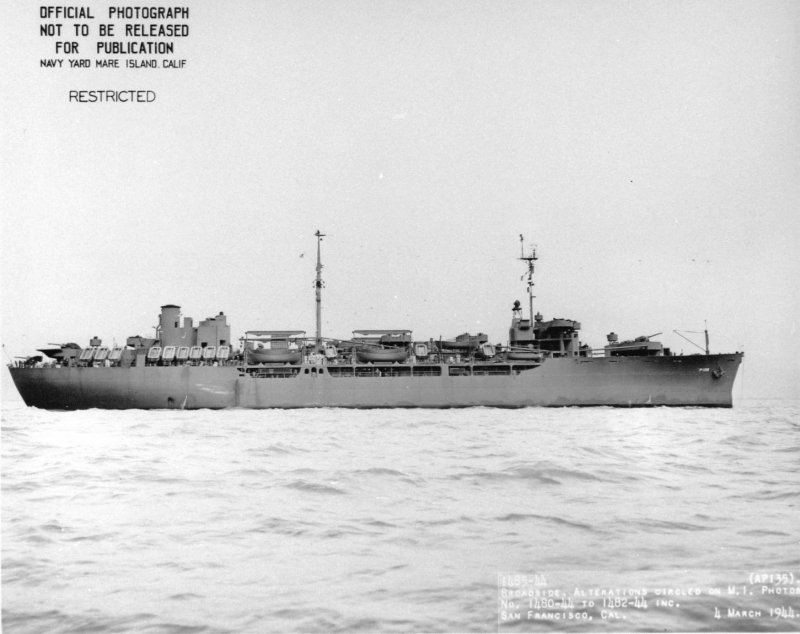
The published specifications for the class give a displacement of 9,950 tons light and 17,250 tons at full load, a length of 522 feet 10 inches and a service speed of 17 knots. Troop capacity is quoted between 2,173 and 6,086 according to the fit of each ship. Twenty-six of the thirty were transferred to the United States Army Transportation Service in 1946, which is why the refugee sailings are usually recorded with the prefix USAT rather than USS. Twenty-four passed again in 1950 to the Military Sea Transportation Service and became USNS ships.1
The wartime fit was never used at full capacity for refugees. A contemporary account of the American refugee sailings notes that these C4 ships were built to carry 3,485 soldiers but usually sailed with fewer than 700 displaced persons, the difference reflecting family accommodation, hospital space and the length of the passage rather than any generosity of quarters.5
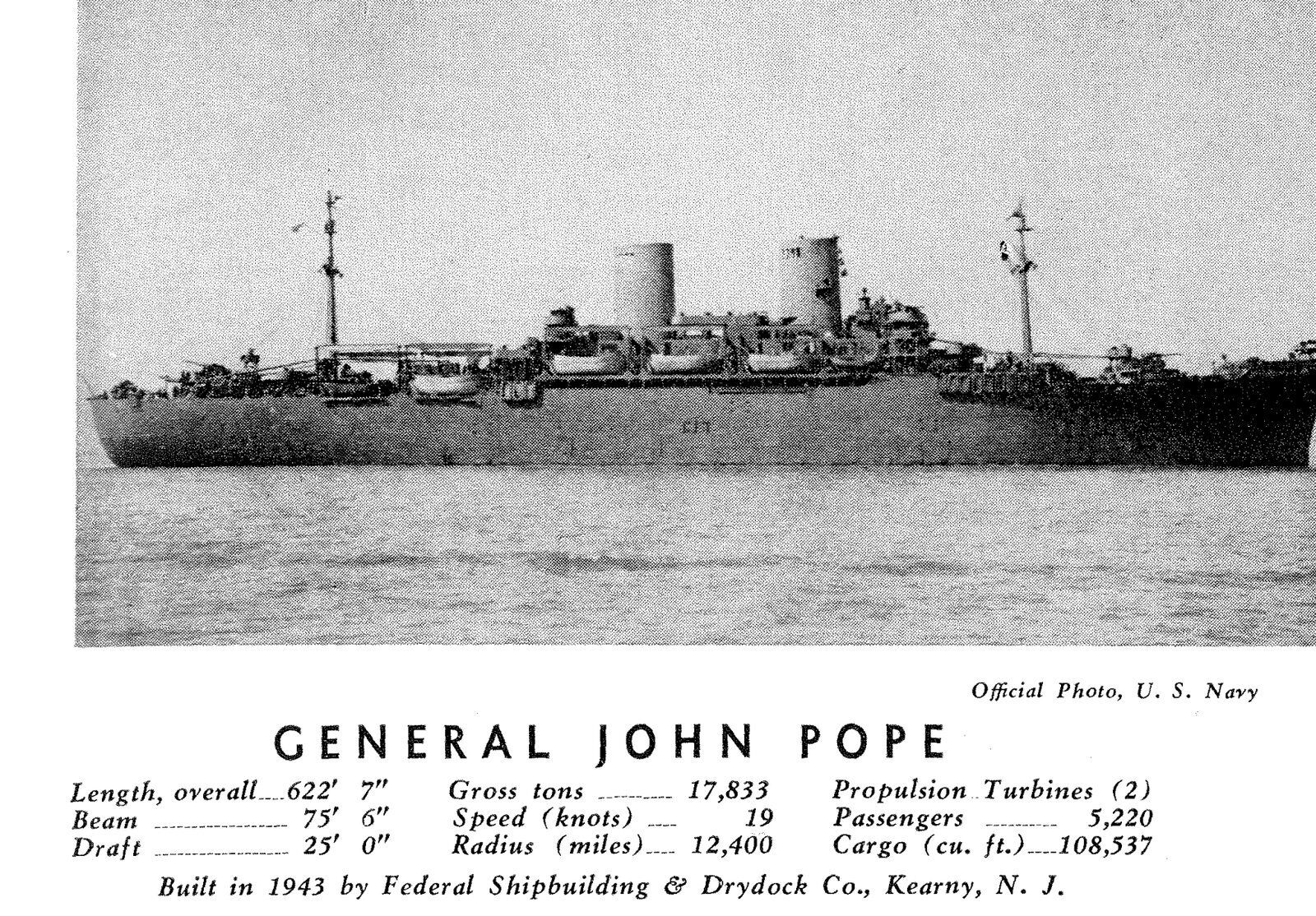
A handbook of troopships published in April 1947 applies the name more widely than the thirty Kaiser ships. Roland W. Charles lists the General G. O. Squier as the first of the C4 type transports, built in 1943 by Kaiser Co., Inc. at Richmond, California, and lists the General John Pope as the first of the P2 'generals', built in 1943 by the Federal Shipbuilding & Drydock Co. at Kearny, New Jersey. The P2 ships came from a different building programme and are not among the thirty C4-S-A1 transports described here.113
From troop transport to refugee transport
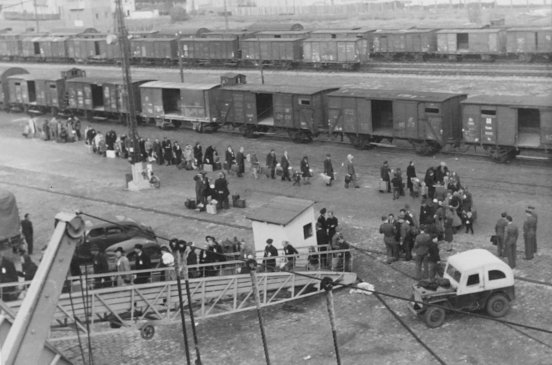
The first American troopship to carry European refugees to a resettlement country was USAT General S. D. Sturgis, which sailed for Rio de Janeiro in 1947. In the same year the class began the two movements that mattered most to Ukrainians. On 7 October 1947 General Stuart Heintzelman loaded 835 people at Bremerhaven for Canada, reaching Halifax on 16 October with 855 aboard; among them were 125 Mennonites, described at the time as the largest single group to leave Bremerhaven. On 30 October the same ship left Bremerhaven again with 843 displaced persons from Estonia, Latvia and Lithuania and reached Fremantle on 28 November 1947. That was the first of about 150 chartered refugee voyages to Australia, and the first time the Australian government paid the passage of non-British migrants.26811
A third route opened in 1948. When the United States Displaced Persons Act came into force, the first sailing under it was made by General W. M. Black, which left Bremerhaven on 21 October 1948 and came up New York harbour at the end of the month. A film held by the United States Holocaust Memorial Museum records the embarkation, with banners on the quay reading “Welcome to the first DP Emigrants to the US, Bremerhaven Port of Embarkation” and “Ship to freedom”, passengers in overcoats and identification tags, and a military band playing as the ship left.57
Sources for this section
What a voyage was like
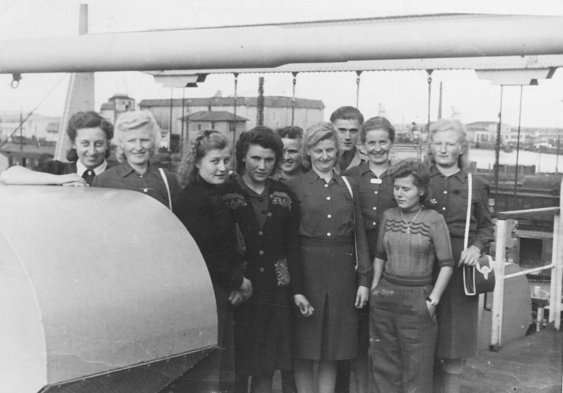
Bremerhaven was the usual port of embarkation, with Naples serving the Italian and Mediterranean movements and, for a few sailings, Shanghai. Emigrants reached the quay through staging camps: the Wentorf Resettlement Centre outside Hamburg for the British zone, and the Funk-Kaserne Transit Centre in Munich for the American zone. Reporting from 1948 describes people boarding in cast-off clothing and carrying very little, orphans first, then the aged, then families. Families were not quartered together: on one sailing 193 family groups were aboard, but the 374 men slept aft and the 316 women forward, with cabins kept for the elderly and for mothers with small children.5
Passengers ran much of the ship's domestic work. Meals were eaten standing at high tables, apart from mothers with young children who were seated in the former officers' dining room. Women were assigned to the galley and men to cleaning details on deck and in the engine room, and the sleeping quarters were swabbed by the passengers themselves. Crossings were rough: one passenger remembered that about half the bunks were folded away and it was still crowded, that many were seasick, and that the deck vents gave off fumes that made it worse. A North Atlantic storm extended one ten-day passage on General R. L. Howze by four days.5
General class refugee voyages to Australia
| Ship | Arrival | Port | Passengers where recorded |
|---|---|---|---|
| General Stuart Heintzelman | 28 November 1947 | Fremantle | 843 Baltic displaced persons |
| General Stewart | 14 February 1948 | Australia | Not recorded in the index |
| General Black | 27 April 1948 | Melbourne | Not recorded in the index |
| General Stuart Heintzelman | 20 April 1948 | Melbourne | 822 |
| General Omar Bundy | 20 March 1949 | Australia | Not recorded in the index |
| General Stewart | 13 April 1949 | Australia | Not recorded in the index |
| General Ballou | 29 April 1949 | Australia | Not recorded in the index |
| General Langfitt | 17 June 1949 | Melbourne | 826, from Naples 22 May 1949 |
| General Black | 25 June 1949 | Melbourne | Not recorded in the index |
| General Omar Bundy | 8 July 1949 | Australia | Not recorded in the index |
| General Langfitt | 22 September 1949 | Melbourne | 826 |
| General Greely | 12 October 1949 | Australia | Not recorded in the index |
| General Blatchford | 11 November 1949 | Sydney | Not recorded in the index |
| General Haan | 15 November 1949 | Australia | Not recorded in the index |
| General Stuart Heintzelman | 24 November 1949 | Sydney | 1,301 |
| General Hersey | 6 December 1949 | Australia | Not recorded in the index |
| General Black | 13 December 1949 | Sydney | Not recorded in the index |
| General Howse | 17 December 1949 | Australia | Not recorded in the index |
| General Langfitt | 14 January 1950 | Melbourne | 1,282 |
| General Langfitt | 18 February 1950 | Fremantle | 1,118 Polish displaced persons |
| General Stuart Heintzelman | 3 March 1950 | Melbourne | 1,302 |
| General M. L. Hersey | 2 November 1950 | Australia | Not recorded in the index |
Sources for this section
Ukrainians aboard
Ukrainians were rarely the largest group on any one sailing, and the classifications used at the time make them hard to count. The first sailing under the American Displaced Persons Act is an exception, because the nationalities were listed as the ship docked. Of 813 passengers there were 388 Poles, 178 Lithuanians, 59 Czechs, 32 Latvians, 17 Ukrainians, 14 Estonians, 10 Yugoslavs, 10 Romanians, 6 Hungarians, 16 Germans and 83 recorded as without country, with 63 orphans among them and ages running from a seven-week-old baby to a woman of seventy-nine. Those numbers describe one voyage of General W. M. Black in October 1948 and nothing wider. The museum catalogue for the film of that embarkation names one boarding passenger, John Poliszczuk.57
The wider movements give the scale. About 34,000 Ukrainians reached Canada between 1947 and 1954 and about 21,500 reached Australia between 1948 and 1951, in both cases mainly from the camps in Germany and Austria and by no means all on General class ships. Many Ukrainians travelling to Australia were entered on manifests under Polish or Soviet nationality, which is one reason ship-by-ship Ukrainian totals are seldom recoverable from the sailing lists alone.109
Nationalities recorded on the first sailing under the United States Displaced Persons Act
| Group | Number |
|---|---|
| Poles | 388 |
| Lithuanians | 178 |
| Czechs | 59 |
| Latvians | 32 |
| Ukrainians | 17 |
| Germans | 16 |
| Estonians | 14 |
| Yugoslavs | 10 |
| Romanians | 10 |
| Hungarians | 6 |
| Recorded without country | 83 |
| Total | 813 |
Arrival and what followed
In Canada the ships discharged at Pier 21 in Halifax, and in some seasons continued to Quebec, Montreal or New York. In Australia the arrival ports were Fremantle, Melbourne and Sydney, and the arrivals were sent on by train to reception centres, above all the Bonegilla Migrant Reception and Training Centre and later Bathurst Migrant Reception and Training Centre and Greta Migrant Camp. Australian entry carried an obligation to work for two years wherever the government directed, without the right to change job or place, before permanent residence followed.6810
The refugee charters were a short episode in the ships' lives. Most of the class passed to the Military Sea Transportation Service in 1950 and went to Korean War trooping. General W. M. Black carried more than 65,000 troops between 1950 and 1953 and was laid up in 1955. General Stuart Heintzelman was deactivated in 1954, sold in 1968, rebuilt as the container ship Mobile and scrapped in Taiwan in 1984. General W. C. Langfitt carried Hungarian refugees after 1956, became the container ship Transindiana in 1969 and was scrapped in Texas in 1983.234
General class arrivals recorded at Halifax
| Ship | Arrival at Halifax | Passengers | Ports |
|---|---|---|---|
| General Stuart Heintzelman | 16 October 1947 | 855 | Bremerhaven, Halifax, New York |
| General M. B. Stewart | 22 August 1947 | 700 | Bremerhaven, Halifax |
| General M. B. Stewart | 13 September 1947 | 831 | Halifax |
| General M. B. Stewart | 9 October 1947 | 834 | Halifax |
| General Stuart Heintzelman | 17 January 1948 | 850 | Bremerhaven, Halifax |
| General M. B. Stewart | 2 March 1948 | 840 | Halifax |
| General M. B. Stewart | 2 April 1948 | 800 | Halifax |
| General W. M. Black | 15 June 1948 | 700 | Halifax |
| General M. B. Stewart | 8 September 1948 | 816 | Halifax |
| General M. B. Stewart | 3 October 1948 | 826 | Halifax |
| General Harry Taylor | 21 October 1948 | 822 | Halifax |
| General W. M. Black | 12 August 1949 | 822 | Naples, Halifax |
| General Stuart Heintzelman | 7 September 1949 | 300 | Bremerhaven, Halifax, New York |
| General Stuart Heintzelman | 28 May 1950 | 1,200 | Bremerhaven, Halifax |
| General Stuart Heintzelman | 23 June 1950 | 386 | Bremerhaven, Halifax, New York |
| General Harry Taylor | 26 December 1950 | 230 | Bremerhaven, Halifax, New York |
Sources
- General G. O. Squier-class transport
Wikipedia · Accessed 13 September 2026
Class list of all thirty ships with hull numbers AP-130 to AP-159, the C4-S-A1 specifications, and the 1946 transfer to the Army Transportation Service and 1950 transfer to MSTS.
- USS General Stuart Heintzelman
Wikipedia, following the Dictionary of American Naval Fighting Ships · Accessed 13 September 2026
Build and commissioning dates, the 30 October 1947 Bremerhaven sailing with 843 Baltic displaced persons, the three later Australian voyages and the ship's disposal.
- USS General W. C. Langfitt
Wikipedia, following the Dictionary of American Naval Fighting Ships · Accessed 13 September 2026
The 1949 Bremerhaven to Buenos Aires voyage, four Australian refugee voyages with passenger numbers, and the 1,118 Polish displaced persons landed at Fremantle in February 1950.
- USS General W. M. Black
Wikipedia, following the Dictionary of American Naval Fighting Ships · Accessed 13 September 2026
Build dates, wartime trooping, refugee voyages of 1948 to 1950 and Korean War service.
- Displaced Person Transports: Cargo of Hope
American Merchant Marine at War, compiling The Mast Magazine, 1948 · Accessed 13 September 2026
Conditions on board, the division of men and women, passenger work details, and the nationality breakdown of the 813 passengers on the first sailing under the Displaced Persons Act, including 17 Ukrainians.
- Ship Arrival Database: General class arrivals at Halifax
Canadian Museum of Immigration at Pier 21 · Accessed 13 September 2026
Individual arrival records read for General Stuart Heintzelman, General M. B. Stewart, General Harry Taylor, General W. M. Black and General W. C. Langfitt, giving Halifax arrival dates, passenger counts and ports.
- Displaced persons board ship in Bremerhaven, Germany to relocate to the United States
United States Holocaust Memorial Museum, gift of Julien Bryan Archive · circa 1948
Film 2003.213, Film ID 3026. Catalogue record describing the embarkation of the General William M. Black at Bremerhaven, the quayside banners and the named passenger John Poliszczuk.
- Why the First Transport?
Ann Tündern-Smith, First Transport to Australia · May 2020
The Fremantle arrival of 28 November 1947, the PCIRO arrangement, the 149 chartered voyages and about 180,000 arrivals to 1954, and the meaning of the USAT prefix.
- World War II Refugees to Australia
Immigrant Ships Transcribers Guild · Accessed 13 September 2026
Index of transcribed manifests listing General class arrivals in Australia from November 1947 to November 1950, with the General Black voyage dates and ports.
- Australia; Canada
Internet Encyclopedia of Ukraine · Accessed 13 September 2026
About 21,500 Ukrainians to Australia in 1948 to 1951 with the two-year work contract, and about 34,000 Ukrainians to Canada in 1947 to 1954.
- Arthur Voth photographs, Bremerhaven, 7 October 1947
Mennonite Church USA Archives, Goshen (HM4-387), via Flickr Commons · 7 October 1947
Captions record 835 people boarding General Stuart Heintzelman at Bremerhaven for Canada, of whom 125 were Mennonites who had left Diepholz that morning.
- USS General W. M. Black off San Francisco, 4 March 1944
United States Navy Yard Mare Island photograph 1485-44, via navsource.net · 4 March 1944
Broadside view of the ship in wartime configuration; public domain as a work of the United States federal government.
- Troopships of World War II
Roland W. Charles, The Army Transportation Association, Washington, D.C.; PDF scan via 80thdivision.com · First edition, April 1947
Vessel entries at pages 94 and 103 read: the General G. O. Squier identified as the first of the C4 type transports, built in 1943 by Kaiser Co., Inc. at Richmond, California, and the General John Pope identified as the first of the P2 'generals', built in 1943 by Federal Shipbuilding & Drydock Co. at Kearny, New Jersey.
Last researched 13 September 2026